
Allergy Asthma Immunol Res.
2010 Jan;2(1):48-54. 10.4168/aair.2010.2.1.48.
Protection of leukotriene receptor antagonist against aspirin-induced bronchospasm in asthmatics

- Affiliations
-
- 1Division of Respiratory and Allergy Medicine, Soonchunhyang University Hospital, College of Medicine, Bucheon, Korea. mdcspark@unitel.co.kr
- 2Division of Respiratory and Allergy Medicine, Soonchunhyang University Hospital, College of Medicine, Seoul, Korea.
- 3Division of Respiratory and Allergy Medicine, Soonchunhyang University Hospital, College of Medicine, Cheonan, Korea.
- 4Genome Research Center for Allergy and Respiratory Disease, Soonchunhyang University Bucheon Hospital, Bucheon, Korea.
- KMID: 2260419
- DOI: http://doi.org/10.4168/aair.2010.2.1.48
Abstract
- PURPOSE
Leukotriene receptor antagonists (LTRAs) are used to treat aspirin-intolerant asthma (AIA); however, the protective effects of long-term LTRA administration against aspirin-induced bronchospasm have not been evaluated.
OBJECTIVES
We investigated the efficacy of a 12-week treatment with a LTRA in protecting against aspirin-induced asthma in AIA patients.
METHODS
Fifty-two adult patients with AIA underwent an aspirin challenge test just before administration of montelukast (10 mg/day) and just after 12 weeks of treatment. The protective effect was assessed as the disappearance of aspirin-induced bronchospasm after 12 weeks of treatment. The results were compared according to the patients' clinical and physiological parameters.
RESULTS
The decline in FEV1 following aspirin challenge was significantly reduced from 28.6+/-1.9% to 10.2+/-1.7% (P=0.0001) after 12 weeks of montelukast treatment. However, 14 subjects (30%) still showed a positive response (>15% decline in FEV1) to aspirin challenge. Grouping the subjects into good and poor responders according to post-treatment responses revealed that the pretreatment aspirin-induced FEV1 decline was significantly greater in the poor responders and that the triggering dose of aspirin and the induction time for a positive response were lower and shorter, respectively, in the poor responders. Histories of aspirin hypersensitivity and sinusitis were more prevalent among the poor responders than among the good responders.
CONCLUSIONS
Twelve weeks of treatment with montelukast protected against aspirin-induced bronchospasm in 70% of the AIA cases. A poor response was associated with more severe aspirin-induced bronchospasms before treatment and a history of aspirin hypersensitivity or sinusitis. CLINICAL IMPLICATIONS: A severe response to aspirin challenge may be a predictor of poor responsiveness to leukotriene antagonist treatment.
Keyword
MeSH Terms
Figure
-
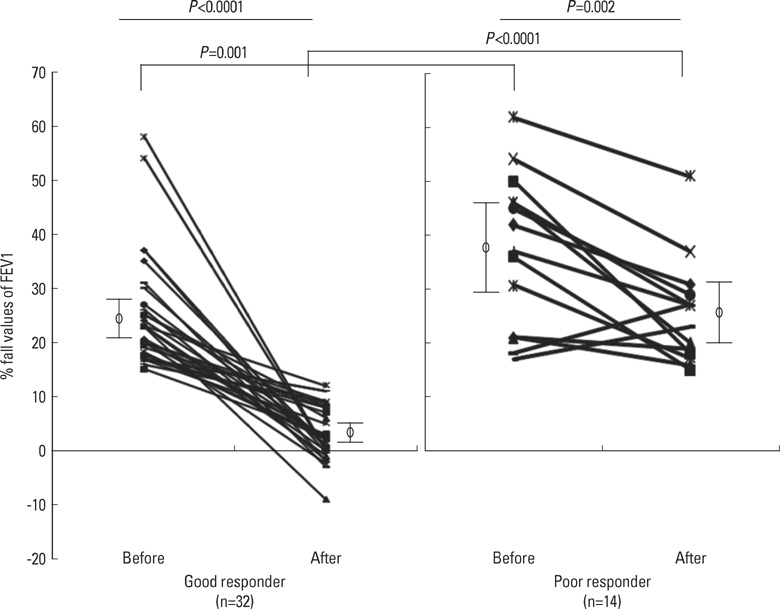
Fig. 1 Change of % fall of FEV1 ratio following aspirin challenge after treatment with Montelukast. Aspirin induced - % fall in FEV1 were measured before and after treatment with daily 10 mg of Montelukast for 12 wk.
Reference
-
1. Samter M, Beers RF. Concerning the nature of intolerance to aspirin. J Allergy. 1967. 40:281–293.2. Szczeklik A, Stevenson DD. Aspirin-induced asthma: advances in pathogenesis, diagnosis, and management. J Allergy Clin Immunol. 2003. 111:913–921. quiz 922.3. Mascia K, Haselkorn T, Deniz YM, Miller DP, Bleecker ER, Borish L; TENOR Study Group. Aspirin sensitivity and severity of asthma: evidence for irreversible airway obstruction in patients with severe or difficult-to-treat asthma. J Allergy Clin Immunol. 2005. 116:970–975.4. Sousa AR, Parikh A, Scadding G, Corrigan CJ, Lee TH. Leukotriene-receptor expression on nasal mucosal inflammatory cells in aspirin-sensitive rhinosinusitis. N Engl J Med. 2002. 347:1493–1499.5. Picado C. Aspirin-intolerant asthma: role of cyclo-oxygenase enzymes. Allergy. 2002. S72:58–60.6. Szczeklik A. The cyclooxygenase theory of aspirin-induced asthma. Eur Respir J. 1990. 3:588–593.7. Arm JP, O'Hickey SP, Spur BW, Lee TH. Airway responsiveness to histamine and leukotriene E4 in subjects with aspirin-induced asthma. Am Rev Respir Dis. 1989. 140:148–153.8. Drazen JM, Israel E, O'Byrne PM. Treatment of asthma with drugs modifying the leukotriene pathway. N Engl J Med. 1999. 340:197–206.9. Leff AR. Regulation of leukotrienes in the management of asthma: biology and clinical therapy. Annu Rev Med. 2001. 52:1–14.10. Hui Y, Funk CD. Cysteinyl leukotriene receptors. Biochem Pharmacol. 2002. 64:1549–1557.11. Nayak A. A review of montelukast in the treatment of asthma and allergic rhinitis. Expert Opin Pharmacother. 2004. 5:679–686.12. Bisgaard H, Zielen S, Garcia-Garcia ML, Johnston SL, Gilles L, Menten J, Tozzi CA, Polos P. Montelukast reduces asthma exacerbations in 2- to 5-year-old children with intermittent asthma. Am J Respir Crit Care Med. 2005. 171:315–322.13. Israel E, Chervinsky PS, Friedman B, van Bavel J, Skalky CS, Ghannam AF, Bird SR, Edelman JM. Effects of montelukast and beclomethasone on airway function and asthma control. J Allergy Clin Immunol. 2002. 110:847–854.14. Szefler SJ, Phillips BR, Martinez FD, Chinchilli VM, Lemanske RF, Strunk RC, Zeiger RS, Larsen G, Spahn JD, Bacharier LB, Bloomberg GR, Guilbert TW, Heldt G, Morgan WJ, Moss MH, Sorkness CA, Taussig LM. Characterization of within-subject responses to fluticasone and montelukast in childhood asthma. J Allergy Clin Immunol. 2005. 115:233–242.15. Dahlén SE, Malmström K, Nizankowska E, Dahlén B, Kuna P, Kowalski M, Lumry WR, Picado C, Stevenson DD, Bousquet J, Pauwels R, Holgate ST, Shahane A, Zhang J, Reiss TF, Szczeklik A. Improvement of aspirin-intolerant asthma by montelukast, a leukotriene antagonist: a randomized, double-blind, placebo-controlled trial. Am J Respir Crit Care Med. 2002. 165:9–14.16. Cristie PE, Smith CM, Lee TH. The potent and selective sulfidopeptide leukotriene antagonist, SK&F 104353, inhibits aspirin-induced asthma. Am Rev Respir Dis. 1991. 144:957–958.17. Yoshida S, Sakamoto H, Ishizaki Y, Onuma K, Shoji T, Nakagawa H, Nakabayashi M, Amayasu H. Efficacy of leukotriene receptor antagonist in bronchial hyperresponsiveness and hypersensitivity to analgesic in aspirin-intolerant asthma. Clin Exp Allergy. 2000. 30:64–70.18. Berges-Gimeno MP, Simon RA, Stevenson DD. The effect of leukotriene-modifier drugs on aspirin-induced asthma and rhinitis reactions. Clin Exp Allergy. 2002. 32:1491–1496.19. White A, Ludington E, Mehra P, Stevenson DD, Simon RA. Effect of leukotriene modifier drugs on the safety of oral aspirin challenges. Ann Allergy Asthma Immunol. 2006. 97:688–693.20. Micheletto C, Tognella S, Visconti M, Pomari C, Trevisan F, Dal Negro RW. Montelukast 10 mg improves nasal function and nasal response to aspirin in ASA-sensitive asthmatics: a controlled study vs placebo. Allergy. 2004. 59:289–294.21. National Asthma Education and Prevention Program. Expert panel report 2: guidelines for the diagnosis and management of asthma. 1997. Bethesda (MD): National Institutes of Health;NIH publication no. 97-4051A.22. Stevenson DD. Barnes PJ, Grunstein MM, Leff AR, Woolcock AJ, editors. Aspirin-sensitive Asthma. Asthma. 1997. New York: Lippincott-Raven;2025–2040.23. Cormican LJ, Farooque S, Altmann DR, Lee TH. Improvement in an oral aspirin challenge protocol for the diagnosis of aspirin hypersensitivity. Clin Exp Allergy. 2005. 35:717–722.24. Metters KM. Leukotriene receptors. J Lipid Mediat Cell Signal. 1995. 12:413–427.25. Dahlén B, Nizankowska E, Szczeklik A, Zetterström O, Bochenek G, Kumlin M, Mastalerz L, Pinis G, Swanson LJ, Boodhoo TI, Wright S, Dubé LM, Dahlén SE. Benefits from adding the 5-lipoxygenase inhibitor zileuton to conventional therapy in aspirin-intolerant asthmatics. Am J Respir Crit Care Med. 1998. 157:1187–1194.26. White AA, Stevenson DD, Simon RA. The blocking effect of essential controller medications during aspirin challenges in patients with aspirin-exacerbated respiratory disease. Ann Allergy Asthma Immunol. 2005. 95:330–335.27. Nasser SM, Pfister R, Christie PE, Sousa AR, Barker J, Schmitz-Schumann M, Lee TH. Inflammatory cell populations in bronchial biopsies from aspirin-sensitive asthmatic subjects. Am J Respir Crit Care Med. 1996. 153:90–96.28. Park HS, Nahm DH, Park K, Suh KS, Yim HE. Immunohistochemical characterization of cellular infiltrate in nasal polyp from aspirin-sensitive asthmatic patients. Ann Allergy Asthma Immunol. 1998. 81:219–224.29. Nasser S, Christie PE, Pfister R, Sousa AR, Walls A, Schmitz-Schumann M, Lee TH. Effect of endobronchial aspirin challenge on inflammatory cells in bronchial biopsy samples from aspirin-sensitive asthmatic subjects. Thorax. 1996. 51:64–70.30. Pods R, Ross D, van Hülst S, Rudack C, Maune S. RANTES, eotaxin and eotaxin-2 expression and production in patients with aspirin triad. Allergy. 2003. 58:1165–1170.31. Min JW, Jang AS, Park SM, Lee SH, Lee JH, Park SW, Park CS. Comparison of plasma eotaxin family level in aspirin-induced and aspirin-tolerant asthma patients. Chest. 2005. 128:3127–3132.32. Fujii M, Tanaka H, Abe S. Interferon-gamma up-regulates expression of cysteinyl leukotriene type 2 receptors on eosinophils in asthmatic patients. Chest. 2005. 128:3148–3155.33. Obase Y, Shimoda T, Tomari S, Mitsuta K, Fukushima C, Kawano T, Matsuse H, Kohno S. Effects of pranlukast on aspirin-induced bronchoconstriction: differences in chemical mediators between aspirin-intolerant and tolerant asthmatic patients. Ann Allergy Asthma Immunol. 2001. 87:74–79.
- Full Text Links
-
- Actions
-
Cited
- CITED
-
- Close
- Share
-
- Similar articles
-
- Association study of polymorphism in leukotriene C4 synthase and cysteinyl leukotriene receptor 1 genes with phenotype of asthma and clinical parameters in Korean children
- Leukotriene C4 synthase promoter polymorphism in aspirin - induced asthma
- Effect of Inhaled Corticosteroid and Leukotriene Receptor Antagonist in Cough-variant Asthma Patients under Five Years of Age
- The effect of ONO-1078 (Pranlukast hydrate), a leukotriene-receptor antagonist, for the treatment of moderate to severe asthmatics with chronic rhinosinusitis
- Clinical effect of montelukast in exercise-induced asthma


