
Nat Prod Sci.
2019 Sep;25(3):238-243. 10.20307/nps.2019.25.3.238.
Quantification of the Bioactive Components of the Rhizomes of Curcuma wenyujin and Assessment of Its Anti-inflammatory Effect in Benign Prostatic Hyperplasia-1 Cells
- Affiliations
-
- 1Herbal Medicine Research Division, Korea Institute of Oriental Medicine, Daejeon 34054, Korea. hkshin@kiom.re.kr
- KMID: 2459966
- DOI: http://doi.org/10.20307/nps.2019.25.3.238
Abstract
- In this study, the marker compounds of Curcumae Rhizoma (CR) were simultaneously quantified by high-performance liquid chromatography equipped with a photodiode array detector and the anti-inflammatory effects of CR extract and marker compounds in human benign prostatic hyperplasia epithelial-1 (BPH-1) cell lines were investigated. The marker components (4S,5S)-(+)-germacrone-4,5-epoxide, furanodienone, and germacrone, were separated on Gemini Câ‚₈ columns (250 mm × 4.6 mm, 5 µm) at 40 ℃ by using a gradient of two mobile phases eluting at 1.0 mL/min. Prostaglandin Eâ‚‚ (PGEâ‚‚) levels in Human BPH-1 cells were determined with an ELISA kit. The coefficients of determination in a calibration curve of each analyte were all 0.9997. The limits of detection and quantification of the three compounds were 0.10 - 0.32 µg/mL and 0.30 - 0.98 µg/mL, respectively. The content of three compounds, (4S,5S)-(+)-germacrone-4,5-epoxide, furanodienone, and germacrone, in the CR sample were found to be 5.79 - 5.92 mg/g, 4.72 - 4.86 mg/g, and 1.06 - 1.09 mg/g, respectively. Regarding pharmacological activity against benign prostatic hyperplasia, CR and its components significantly suppressed PGEâ‚‚ levels of BPH-1 cells. The established analysis method will help to improve quality assessment of CR samples and related products. In addition, CR and its components exhibit anti-inflammatory activity in BPH-1 cells, suggesting the inhibitory efficacy of these compounds against the pathogenesis of BPH.
MeSH Terms
Figure
-

Fig. 1 Chemical structures of the three bioactive components of CR.
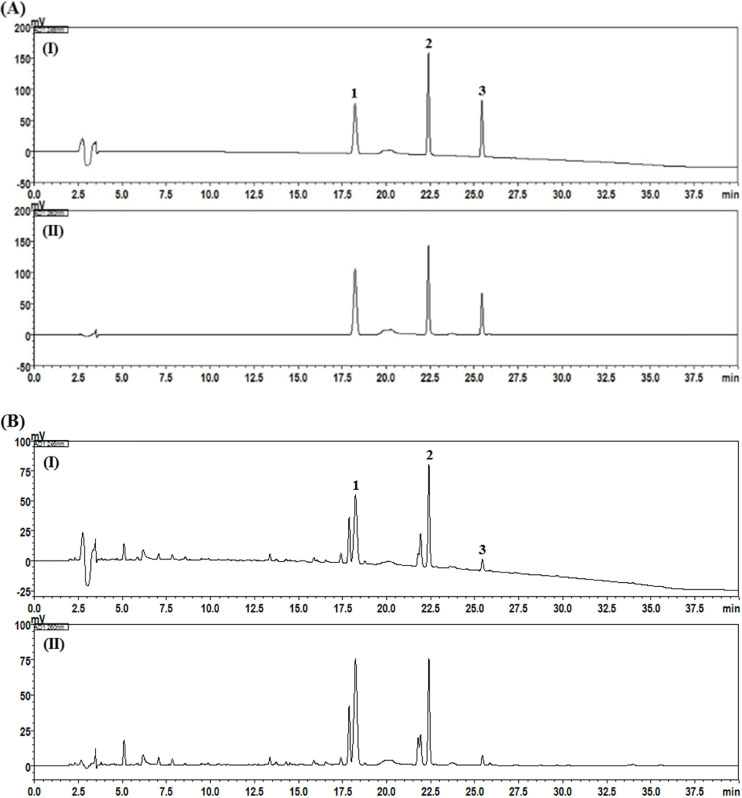
Fig. 2 HPLC chromatograms of standard mixtures (A) and CR sample (B) at UV wavelength 246 nm (I) and 260 nm (II). (4S,5S)-Germacrone-4,5-epoxide (1), furanodienone (2), and germacrone (3).

Fig. 3 The effect of the 70% ethanol extract of CR and its three marker components on PGE2 levels of BPH-1 cells. BPH-1 cells were treated with CR extract (A) or its three compounds (B) and incubated for 24 h. PGE2 levels in culture supernatants from cells were measured using an EIA kit. Value are presented as the mean ± SEM. **, P < 0.01; ***, P < 0.001 compared with vehicle (0 µg/mL).
Reference
-
1. Dong JY, Ma XY, Cai XQ, Yan PC, Yue L, Lin C, Shao WW. Phytochemistry. 2013; 85:122–128.2. An YW, Hu G, Yin GP, Zhu JJ, Zhang QW, Wang ZM, Peng J, Fan B. J Chromatogr Sci. 2014; 52:961–970.3. Korean Pharmacopoeia Committee. The Korean Pharmacopoeia. 11th eds. Seoul: Shinilbooks;2014. p. 1836.4. Yan J, Chen G, Tong S, Feng Y, Sheng L, Lou J. J Chromatogr A. 2005; 1070:207–210.5. Qiu G, Yan P, Shao W, Zhou J, Lin W, Fang L, Zhao X, Dong J. Chem Pharm Bull. 2013; 61:983–986.6. Zhou CX, Zhang LS, Chen FF, Wu HS, Mo JX, Gan LS. Fitoterapia. 2017; 121:141–145.7. Lou Y, Zhao F, He H, Peng KF, Chen LX, Qiu F. Chem Biodivers. 2010; 7:1245–1253.8. Dong J, Shao W, Yan P, Cai X, Fang L, Zhao X, Lin W, Cai Y. Bioorg Med Chem Lett. 2015; 25:198–202.9. Ma ZJ, Meng ZK, Zhang P. Fitoterapia. 2009; 80:374–376.10. Park E, Lee MY, Seo CS, Jeon WY, Shin HK. J Ethnopharmacol. 2017; 209:230–235.11. Wang X, Jiang Y, Hu D. Chem Cent J. 2016; 10:32.12. Tohda C, Nakayama N, Hatanaka F, Komatsu K. Evid Based Complement Alternat Med. 2006; 3:255–260.13. Hou Y, Lu CL, Zeng QH, Jiang JG. EXCLI J. 2015; 14:706–713.14. Shacter E, Weitzman SA. Oncology (Williston Park). 2002; 16:217–226.15. Gual-Vaqués P, Jané-Salas E, Egido-Moreno S, Ayuso-Montero R, Marí-Roig A, López-López J. Med Oral Patol Oral Cir Bucal. 2017; 22:e36–e42.16. Robert G, Descazeaud A, Nicolaiew N, Terry S, Sirab N, Vacherot F, Maillé P, Allory Y, de la. Prostate. 2009; 69:1774–1780.17. Handisurya A, Steiner GE, Stix U, Ecker RC, Pfaffeneder-Mantai S, Langer D, Kramer G, Memaran-Dadgar N, Marberger M. Prostate. 2001; 49:251–262.18. Wu Q, Zhou Y, Chen L, Shi J, Wang CY, Miao L, Klocker H, Park I, Lee C, Zhang J. J Endocrinol. 2007; 195:89–94.19. Zhang YJ, Bai Q. Natl J Androl. 2014; 20:244–248.
- Full Text Links
-
- Actions
-
Cited
- CITED
-
- Close
- Share
-
- Similar articles
-
- A Prominently Large Glans penis as a Possible sign of Benign Prostatic Hyperplasia
- Ethanol Extract of Chaenomeles sinensis Inhibits the Development of Benign Prostatic Hyperplasia by Exhibiting Anti-oxidant and Anti-inflammatory Effects
- Antibiotic Components from the Rhizomes of Curcuma zedoaria
- Inflammatory Responses in a Benign Prostatic Hyperplasia Epithelial Cell Line (BPH-1) Infected with Trichomonas vaginalis
- The Effects of Abdominal Obesity on the Increased Prevalence Rate of Hypertension and Diabetes Mellitus in Benign Prostatic Hyperplasia Patients


