
J Korean Acad Nurs Adm.
2017 Dec;23(5):535-547. 10.11111/jkana.2017.23.5.535.
Development of Hospital Nurses' Job Description based on DACUM Method: Focusing on General Ward and Intensive Care Unit
- Affiliations
-
- 1Department of Nursing, Asan Medical Center, Korea.
- 2College of Nursing, Institute of Health Sciences, Gyeongsang National University, Korea. yumi825@gnu.ac.kr
- KMID: 2408115
- DOI: http://doi.org/10.11111/jkana.2017.23.5.535
Abstract
- PURPOSE
This study was done to clarify nurses' duties, tasks and task elements and to develop a job description for clinical nurses on general and intensive care units in tertiary-level hospitals, and dramatically reflect changing medical trends in Korea.
METHODS
The job description was developed based on the Developing a Curriculum Method (DACUM). The questionnaire included frequency, importance, and difficulty of duties, tasks and task elements, measured on a 4-point scale. Results were analyzed using SPSS version 21.0. Data were collected from September 4 to 7, 2017, and analyzed using descriptive statistics and a scattered graph.
RESULTS
The job description consisted of 10 duties, 38 tasks, and 51 elements. Of the 10 duties, the highest duty in order of importance was "˜Direct nursing care' followed by "˜Infection control'. The highest duties according to frequency and difficulty were "˜Document and notify' and "˜Research and quality improvement'. "˜Safety management' and "˜Infection control' were considered as relatively simple duties, however, these two duties were still included as important jobs for clinical nurses.
CONCLUSION
The job descriptions for clinical nurses developed from this study contain nursing ethics and safety as well as infection control, to faithfully reflect clinical nurses' jobs.
Keyword
MeSH Terms
Figure
-
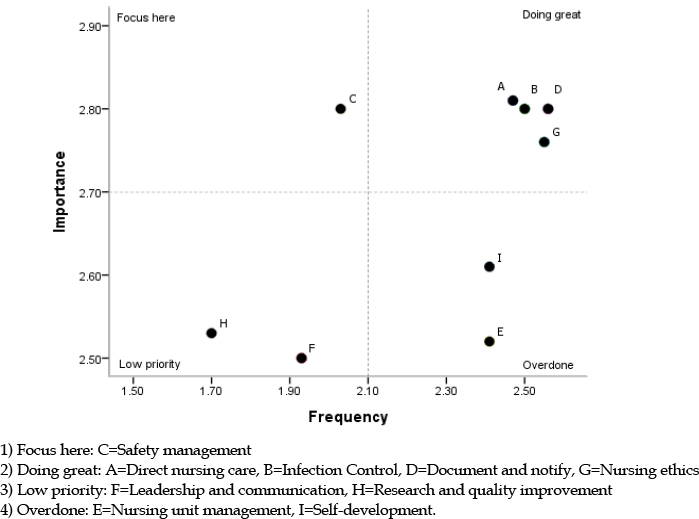
Figure 1 Degree of importance and frequency of hospital's nurses.
Reference
-
1. Korean Hospital Nurses Association. Hospital nurses staffing state survey [Internet]. Seoul: Korean Hospital Nurses Association;2016. cited 2017 February 9. Available from: http://www.khna.or.kr/web/information/resource.php.2. Seo JH, Song ES, Choi SE, Woo KS. Patient safety in Korea: current status and policy issues. Sejong: Korea Institute for Health and Social Affairs;2016.3. Oh YH. The future requirements and supply of registered nurses in Korea. Korean J Health Econ Policy. 2010; 16(3):139–163.4. Cho MS, Cho YA, Kim KH, Kwon IG, Kim MS, Lee JL. Development of clinical ladder system model for nurses: For tertiary care hospitals. J Korean Clin Nurs Res. 2015; 21(3):277–292.5. Cho KS, Son HM, Kang HS, Kim JH, Lim NY, Yoon KS, et al. Job description of the nurses who work in operating room using DACUM technique. J Korean Acad Fundam Nurs. 2008; 15(4):566–577.6. Kim EM. Development of job description of clinical dietitians in hospitals by the DACUM method. J Korean Diet Assoc. 2013; 19(3):265–286. DOI: 10.14373/JKDA.2013.19.3.265.7. Cho CM. Task analysis of geriatric care helpers based on DA CUM method. J Korean Soc Living Environ Syst. 2008; 15(2):66–75.8. Beak HC, Moon JH. Job analysis of geriatric visiting nurses. J Korean Acad Soc Home Care Nurs. 2016; 23(1):80–89.9. Cho KS, Kang HS, Kim JH, Son HM, Han HJ, Sung YH, Park JW, et al. Job description of the nurses working in outpatient department by DACUM technique. J Korean Clin Nurs Res. 2008; 14(2):31–45.10. Chung SR. Development of a job description in cardiovascular critical care using the synergy model [master's thesis]. Seoul: Yonsei University;2008.11. Oh ES, Song SD, Choi EJ, Chun HS, Han HS, Ryoo SS, et al. Job description of nurses in central supply department using DA CUM technique. J Korean Clin Nurs Res. 2014; 20(3):303–312.12. Green CG. Using customer survey data to develop marketing strategies in college/university food services. J Coll Univ Foodserv. 1993; 1(1):39–51. DOI: 10.1300/J278v01n01_04.13. So H, Kim JW, Park JW, Lim NY. Task analysis of the job description of rehabilitation nurse based on DACUM. Korean J Rehabil Nurs. 2009; 12(1):16–29.14. Lee HY. JCI Accreditation and patient safety. J Korean Soc Qual Assur Health Care. 2009; 15(1):49–54.15. Shin JH, Jeong SH, Lee MH, Yang YR. Experiences of ethical issues and needs for ethics education in clinical. J Korean Acad Nurs Adm. 2015; 21(3):327–339. DOI: 10.11111/jkana.2015.21.3.327.16. Sung YH, Lim NY, Park KO, Jung JH, Kwon IG, Kim LS, et al. Analysis for role identification of clinical nurses with expanded role-clinical nurse with education and clinical nurse with coordination. J Korean Clin Nurs Res. 2009; 15(2):139–155.17. Kim M, Park JH, Choi MR. Reliability and validity of the Korean version of nurses' attitudes and preparedness towards delegation. J Korean Acad Nurs Adm. 2016; 22(1):11–21. DOI: 10.11111/jkana.2016.22.1.11.18. Kim DO, Kwon IG, Kim SH, Lee JH, Yang JE, Lee EJ. Setting the basic level of basic nursing skills for new nurses through job analysis. Korean Nurse. 2001; 40(2):57–82.19. Kim MR. Concept analysis of patient safety. J Korean Acad Nurs. 2011; 41(1):1–8. DOI: 10.4040/jkan.2011.41.1.1.20. Kim JH, Lim KH. The factors influencing compliance of multidrug-resistant organism infection control in intensive care units nurses. J Korean Acad Adult Nurs. 2015; 27(3):325–336. DOI: 10.7475/kjan.2015.27.3.325.21. Hong MH, Park JY. Nurses' perception of accreditation, awareness and performance of infection control in an accredited healthcare system. J Korean Acad Nurs Adm. 2016; 22(2):167–177. DOI: 10.11111/jkana.2016.22.2.167.
- Full Text Links
-
- Actions
-
Cited
- CITED
-
- Close
- Share
-
- Similar articles
-
- Task Analysis of the Job Description of Rehabilitation Nurse based on DACUM
- Influence of Verbal Abuse on Job Stress for Special Unit Nurses and General Ward Nurses in General Hospitals
- Nurses' Job Analysis in a Regional Emergency Center Using the DACUM
- Development of Job Description of Nutrition Teacher by the DACUM Method
- Job Description of the Nurses Who Work in Operating Room Using DACUM Technique


