
Quantitative Analysis of Eleven Bioactive Constituents of a Traditional Herbal Medicine, Yeonggyechulgam-tang using, Liquid Chromatography-Electrospray Ionization Tandem Mass Spectrometry
- Affiliations
-
- 1K-herb Research Center, Korea Institute of Oriental Medicine, 1672 Yuseong-daero, Yuseong-gu, Daejeon 34054, Korea. hkshin@kiom.re.kr
- KMID: 2387056
- DOI: http://doi.org/10.20307/nps.2017.23.2.84
Abstract
- This study proposes a sensitive and selective liquid chromatography-electrospray ionization tandem mass spectrometry method of efficiently assessing the quality of a traditional herbal medicine called Yeonggyechulgam-tang (YGCGT). The following compounds 1 - 11, namely, liquiritin apioside (1), liquiritin (2), liquiritigene (3), coumarin (4), cinnamic acid (5), cinnamaldehyde (6), glycyrrhizin (7), atractylenolide III (8), atractylenolide II (9), atractylenolide I (10), and pachymic acid (11) were separated on a UPLC BEH Câ‚₈ column (2.1 × 100 mm, 1.7 µm) at a column temperature of 45℃ eluted with a gradient condition of 0.1% (v/v) formic acid in distilled water and acetonitrile. The correlation coefficient of the calibration curve of the eleven constituents was ≥ 0.9936. The limits of detection and quantification of the compounds 1 - 11 were 0.06 - 4.73 ng/mL and 0.17-14.20 ng/mL, respectively. Using this analytical method, the compound 11 in lyophilized YGCGT decoction extract was not detected, while the compounds 1 - 10 were detected 0.13-166.43 mg/g.
MeSH Terms
Figure
-
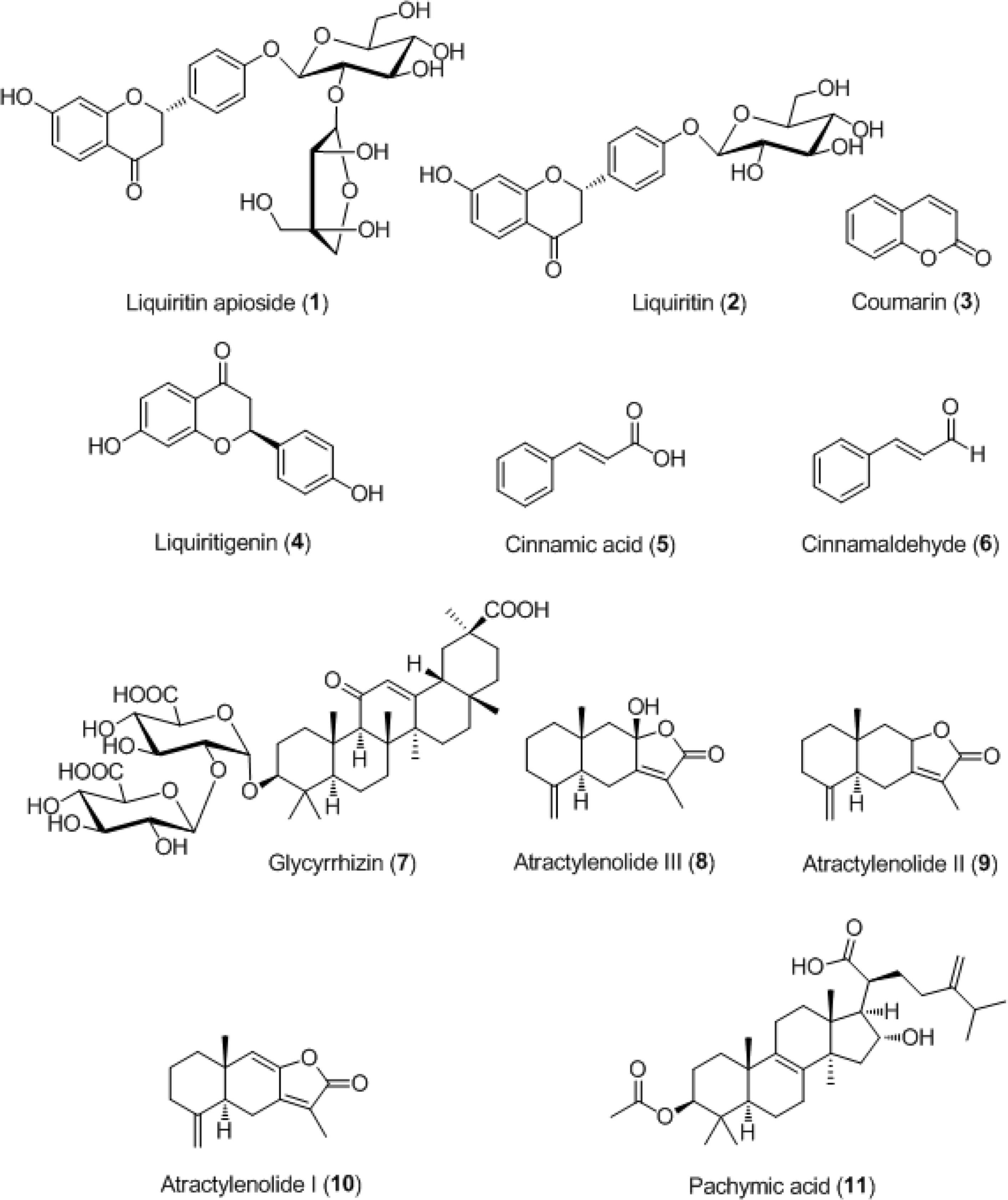
Fig. 1. Chemical structures of the compounds 1 – 11 in Yeonggyechulgam-tang.
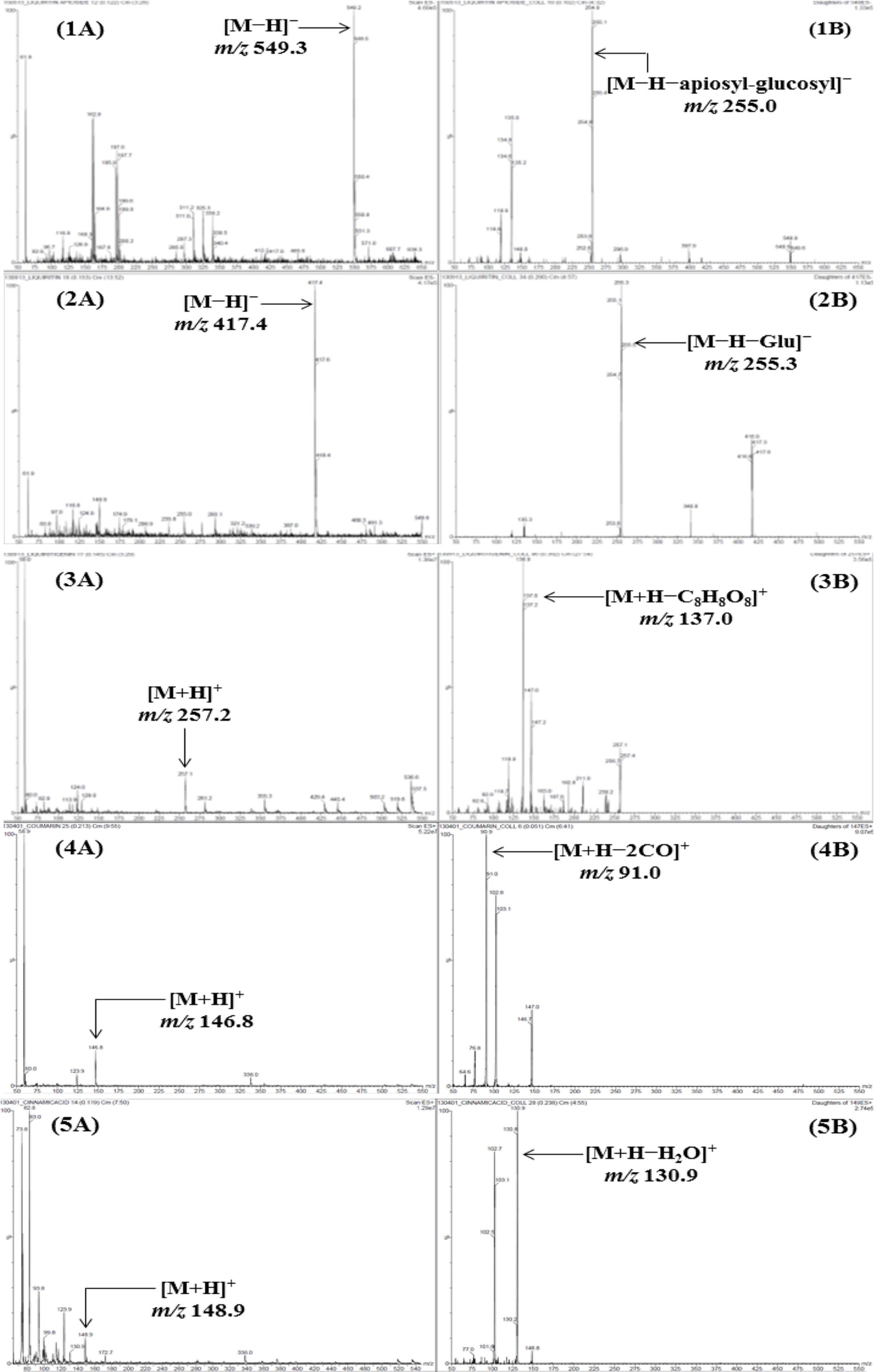
Fig. 2. Mass spectra of the precursor ion (Q1, A) and product ion (Q3, B) for LC-MS/MS MRM mode of the compounds 1 – 11. Liquiritin apioside (1), liquiritin (2), liquiritigene (3), coumarin (4), cinnamic acid (5), cinnamaldehyde (6), glycyrrhizin (7), atractylenolide III (8), atractylenolide II (9), atractylenolide I (10), and pachymic acid (11).
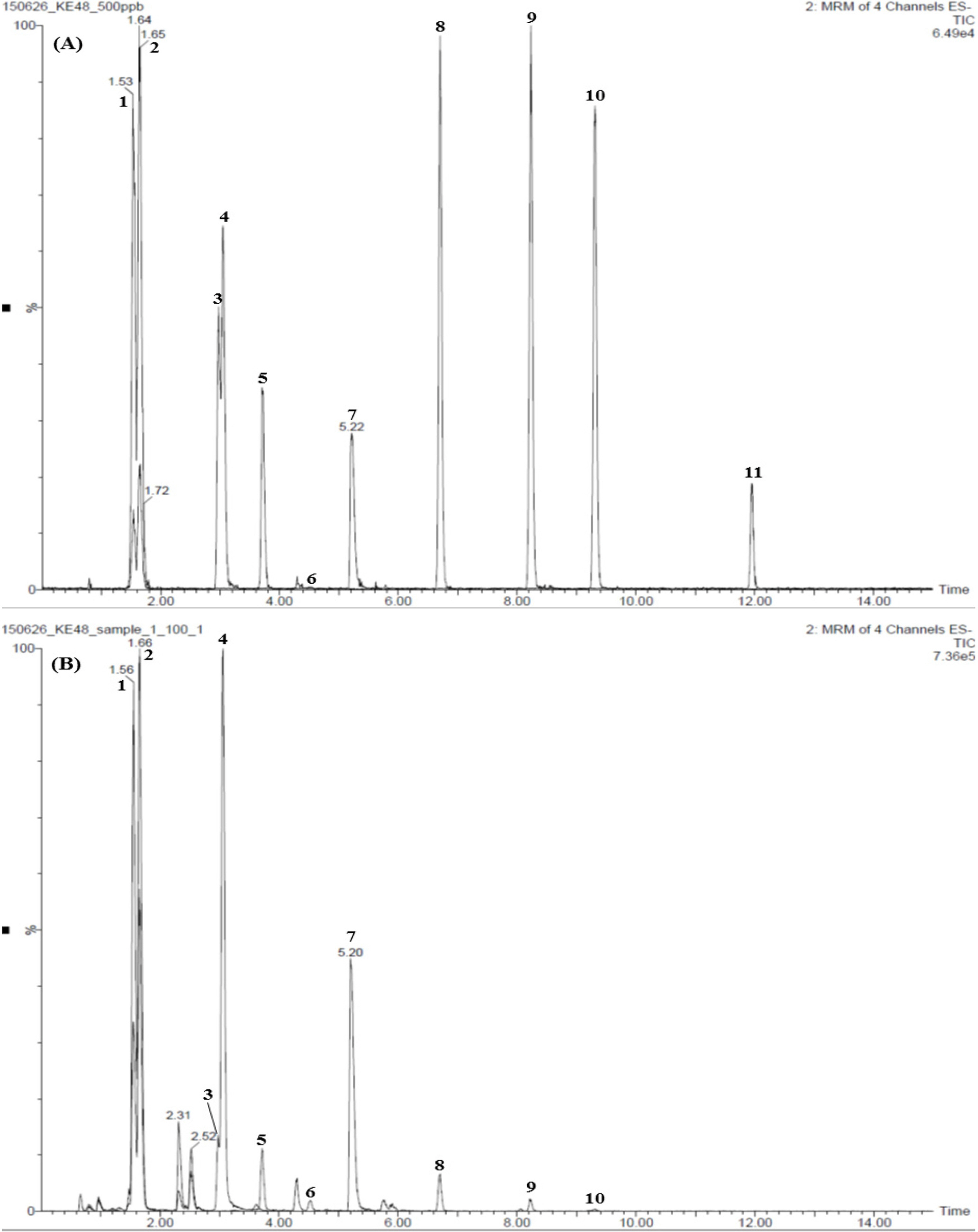
Fig. 3. Total ion chromatograms of the reference standard (A) and lyophilized Yeonggyechulgam-tang extract (B) by LC-MS/MS MRM mode. Liquiritin apioside (1), liquiritin (2), liquiritigene (3), coumarin (4), cinnamic acid (5), cinnamaldehyde (6), glycyrrhizin (7), atractylenolide III (8), atractylenolide II (9), atractylenolide I (10), and pachymic acid (11, not detected).
Reference
-
References
(1). Zhang J.., Qian C. C.., Hao W.S.; Shang Han Lun; People's Medical Publishing House: Beijing,. 2005. ;p.41–42.(2). Heo, J. ; Dongeuibogam; Namsandang: Seoul,. 2004. ;p. 128.(3). Xi F.., Sang F.., Zhou C.., Ling Y.Neural Regener. Res. 2012. 7:2867–2873.(4). Yuanyuan W.., Minghua J.., Lina Z.., Suhua L.., Jiayu Z.., Yongzhi S.., Chunyu C.., Jian Q. J.Tradit. Chin. Med. 2015. 35:218–221.(5). Fu S.., Zhang J.., Gao X.., Xia Y.., Ferrelli R.., Fauci A.., Guerra R.., Hu L.Heart Asia. 2010. 2:24–27.(6). Huang J.., Wang L.., Shi H.., Hou X. J.Tradit. Chin. Med. 2013. 33:343–348.(7). Kim T. H.., Yang K. S.., Park S. A.Kor. J. Pharmacogn. 1999. 30:12–17.(8). Park, S. A; Kim T. H.., Yang K. S.Kor. J. Pharmacogn. 2000. 31:364–372.(9). Kim S.H.; The guideline on the visual and organoleptic examination of herbal medicine II; National Institute of Food and Drug Safety Evaluation: Seoul,. 2007. ;p. 19.(10). Moon C.J.; The guideline on the visual and organoleptic examination of herbal medicine I; Ministry of Food and Drug Safety: Seoul,. 2006. ;p. 17. , 52, 54.(11). Li L.., Liang S.., Du, F; Li C. J.Am. Soc. Mass Spectrom. 2007. 18:778–782.(12). Tan G.., Zhu Z.., Jing J.., Lv L.., Lou Z.., Zhang G.., Chai Y.Biomed. Chromagogr. 2011. 25:913–924.(13). Concannon S.., Ramachandran V. N.., Smyth W. F.Rapid Commun. Mass Spectrom. 2000. 14:1157–1166.(14). Wu L. F.., Wang K. F.., Mao X.., Liang W. Y.., Chen W. J.., Li S.., Qi Q.., Cui Y. P.., Zhang L. Z.Molecules. 2016. 21:, 227,. doi: 10.3390/molecules21020227.(15). Gardana C.., Scaglianti M.., Pietta P.., Simonetti P. J.Pharm. Biomed. Anal. 2007. 45:390–399.(16). Flamini R.., Vedova, A. D,; Cancian D.., Panighel A.., De Rosso M. J.Mass Spectrom. 2007. 42:641–646.(17). Chen L.., Qi J.., Chang Y.., Zhu D.., Yu B. J.Pharm. Biomed. Anal. 2009. 50:127–137.
- Full Text Links
-
- Actions
-
Cited
- CITED
-
- Close
- Share
-
- Similar articles
-
- Qualitative and Quantitative Analysis of Thirteen Marker Components in Traditional Korean Formula, Samryeongbaekchul-san using an Ultra-Performance Liquid Chromatography Equipped with Electrospray Ionization Tandem Mass Spectrometry
- Simultaneous Determination of 11 Marker Compounds in Gumiganghwal-tang by HPLC-DAD and LC-MS
- Mass spectrometry based cellular phosphoinositides profiling and phospholipid analysis: A brief review
- Development and Validation of a Liquid Chromatography-Tandem Mass Spectrometry Method for the Determination of epsilon-Acetamidocaproic Acid in Rat Plasma
- Sporozoite proteome analysis of Cryptosporidium parvum by one-dimensional SDS-PAGE and liquid chromatography tandem mass spectrometry


