The Application of Vacuum-Assisted Closures According to the Texas Staging System in the Treatment of Infective Diabetic Foot Ulcers

- Affiliations
-
- 1Department of Orthopedic Surgery, Kwangju Christian Hospital, Gwanju, Korea
- KMID: 2530485
- DOI: http://doi.org/10.14193/jkfas.2022.26.2.66
Abstract
- Purpose
A group of patients who were hospitalized for diabetic foot ulcers was classified according to the University of Texas Staging System for Diabetic Foot Ulcers, and we attempted to evaluate whether this staging system could be a criterion for treatment success using vacuum-assisted closure (VAC) technique.
Materials and Methods
A total of 32 patients were diagnosed with diabetic foot ulcers according to the University of Texas Staging System for Diabetic Foot Ulcers. Of these, 24 patients who were evaluated as stage B according to the staging system were classified as Group 1, and 8 patients in stage D were classified as Group 2. After applying VAC, the treatment success rate was compared by evaluating the size and severity of ulcers between the two groups.
Results
The grade of granulation after VAC was on average 3.75±0.53 in Group 1 and 2.25±0.71 in Group 2. There was better granulation after VAC application in Group 1 (p<0.01). The success rate of the treatment was 22 cases (91.67%) in Group 1 and one case (12.5%) in Group 2. Thus there were statistically significant differences in the success rate of treatment between groups 1 and 2 (Pearson’s chisquare test, p=0.01; odd ratio 77.00, 95% confidence interval [CI] 1.26~14.66; relative risk 4.30, 95% CI 1.26~14.66).
Conclusion
These results suggest that there was a higher success rate of treatment with VAC in stage B patients. The University of Texas Staging System for Diabetic Foot Ulcers can thus be an index for applying VAC to patients with infective diabetic foot ulcers.
Keyword
Figure
-

Figure. 1 (A) Infective diabetic foot ulcer classified as Texas grade B-stage 3 wound undergoing surgical debridement. (B) Granulation tissue was formed after surgical treatment and vacuum-assisted closure application for 6 weeks. Achilles tendon and marginal infective tissue were seen. (C) Second surgical management was done; Direct closure was done for distal longitudinal wound and debridement was done around Achilles tendon, intractable wound. (D) Full-thickness skin graft which was harvested at ipsilateral inguinal area was done. (E) No significant steno-occlusive lesion.
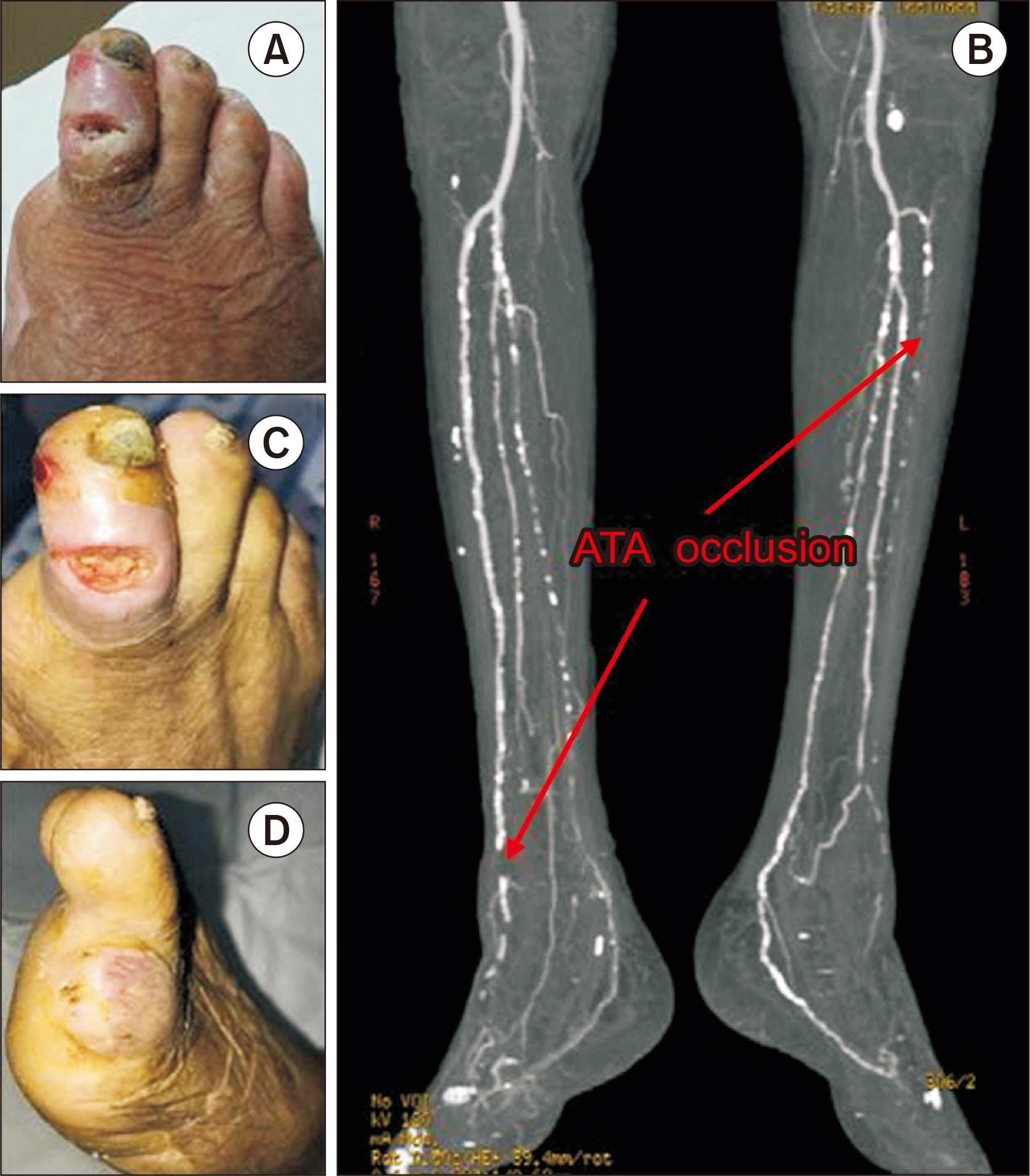
Figure. 2 (A) Infective diabetic foot ulcer classified as Texas grade D-stage 3 ulcer penetrating to proximal interphalangeal joint. (B) Arterial computed tomography angiography; red arrows indicate both anterior tibial artery (ATA) occlusion. (C) Osteolysis proceeded despite surgical treatment and vacuum-assisted closure application for 6 weeks. (D) Second toe amputation was done.
Reference
-
1. Younis BB, Shahid A, Arshad R, Khurshid S, Ahmad M, Yousaf H. 2018; Frequency of foot ulcers in people with type 2 diabetes, presenting to specialist diabetes clinic at a Tertiary Care Hospital, Lahore, Pakistan. BMC Endocr Disord. 18:53. doi: 10.1186/s12902-018-0282-y. DOI: 10.1186/s12902-018-0282-y. PMID: 30081878. PMCID: PMC6090692.
Article2. Sabir M, Kanwal R, Shahzad MN, Khan MMUR. 2018; Wagner versus the university of Texas classification of diabetic foot ulcers: a descriptive study In Nishter hospital Multan. Ann Pak Inst Med Sci. 14:19–24.3. Oyibo SO, Jude EB, Tarawneh I, Nguyen HC, Harkless LB, Boulton AJ. 2001; A comparison of two diabetic foot ulcer classification systems: the Wagner and the University of Texas wound classification systems. Diabetes Care. 24:84–8. doi: 10.2337/diacare.24.1.84. DOI: 10.2337/diacare.24.1.84. PMID: 11194247.4. Jain AKC. 2012; A new classification of diabetic foot complications: a simple and effective teaching tool. J Diabet Foot Complicat. 4:1–5.5. Kota SK, Kota SK, Meher LK, Sahoo S, Mohapatra S, Modi KD. 2013; Surgical revascularization techniques for diabetic foot. J Cardiovasc Dis Res. 4:79–83. doi: 10.1016/j.jcdr.2012.10.002. DOI: 10.1016/j.jcdr.2012.10.002. PMID: 24027360. PMCID: PMC3770111.
Article6. Tresierra-Ayala MA, Rojas AG. 2017; Association between peripheral arterial disease and diabetic foot ulcers in patients with diabetes mellitus type 2. Med Univ. 19:123–6. doi: 10.1016/j.rmu.2017.07.002. DOI: 10.1016/j.rmu.2017.07.002.
Article7. Ingber DE, Folkman J. 1989; Mechanochemical switching between growth and differentiation during fibroblast growth factor-stimulated angiogenesis in vitro: role of extracellular matrix. J Cell Biol. 109:317–30. doi: 10.1083/jcb.109.1.317. DOI: 10.1083/jcb.109.1.317. PMID: 2473081. PMCID: PMC2115480.
Article8. Pietramaggiori G, Liu P, Scherer SS, Kaipainen A, Prsa MJ, Mayer H, et al. 2007; Tensile forces stimulate vascular remodeling and epidermal cell proliferation in living skin. Ann Surg. 246:896–902. doi: 10.1097/SLA.0b013e3180caa47f. DOI: 10.1097/SLA.0b013e3180caa47f. PMID: 17968184.
Article9. Jung HG, Ki S, Kim B, Kim K, Kim Y, Cho Y, et al. 2012; Application of vacuum-assisted closure in difficult wounds. J Korean Orthop Assoc. 47:41–7. doi: 10.4055/jkoa.2012.47.1.41. DOI: 10.4055/jkoa.2012.47.1.41.
Article10. Karatepe O, Eken I, Acet E, Unal O, Mert M, Koc B, et al. 2011; Vacuum assisted closure improves the quality of life in patients with diabetic foot. Acta Chir Belg. 111:298–302. doi: 10.1080/00015458.2011.11680757. DOI: 10.1080/00015458.2011.11680757. PMID: 22191131.
Article11. Prince HP, Sreejayan MP. 2017; Outcome of diabetic foot ulcer management with vacuum assisted closure. J Med Sci Clin Res. 5:19314–8. doi: 10.18535/jmscr/v5i3.157. DOI: 10.18535/jmscr/v5i3.157.12. Nather A, Chionh SB, Han AY, Chan PP, Nambiar A. 2010; Effectiveness of vacuum-assisted closure (VAC) therapy in the healing of chronic diabetic foot ulcers. Ann Acad Med Singap. 39:353–8. doi: 10.47102/annals-acadmedsg.V39N5p353. DOI: 10.47102/annals-acadmedsg.V39N5p353. PMID: 20535423.13. Paola LD, Carone A, Ricci S, Russo A, Ceccacci T, Ninkovic S. 2010; Use of vacuum assisted closure therapy in the treatment of diabetic foot wounds. J Diabet Foot Complicat. 2:33–44.14. Lambert KV, Hayes P, McCarthy M. 2005; Vacuum assisted closure: a review of development and current applications. Eur J Vasc Endovasc Surg. 29:219–26. doi: 10.1016/j.ejvs.2004.12.017. DOI: 10.1016/j.ejvs.2004.12.017. PMID: 15694791.
Article
- Full Text Links
-
- Actions
-
Cited
- CITED
-
- Close
- Share
-
- Similar articles
-
- The Treatment of the Foot Ulcer in Hansen's Disease using by Vacuum-Assisted Closure
- Negative-Pressure Wound Therapy Using Modified Vacuum-Assisted Closure in Patients with Diabetic Foot Ulcers
- Daily Life Management Guidelines for Diabetic Foot Patients
- Wall-Suction Assisted Vacuum Sealing for Treatment of Infected Diabetic Foot Ulcer
- Diagnosis and Management of Diabetic Foot