
J Lipid Atheroscler.
2019 May;8(1):1-7. 10.12997/jla.2019.8.1.1.
Intermittent Fasting: a Promising Approach for Preventing Vascular Dementia

- Affiliations
-
- 1Department of Anatomy, Chonnam National University Medical School, Gwangju, Korea. juhyunsong@chonnam.ac.kr
- 2Department of Biochemistry, Chonnam National University, Gwangju, Korea.
- KMID: 2447751
- DOI: http://doi.org/10.12997/jla.2019.8.1.1
Abstract
- Vascular dementia is the most common neuropsychiatric syndrome and is characterized by synaptic dysfunction, neuroinflammation, and cognitive dysfunction. Vascular dementia is associated with various environmental, genetic, and lifestyle risk factors. Recent research has focused on the association between vascular dementia and dietary patterns, suggesting that dietary regulation leads to better control of energy metabolism, improvements in brain insulin resistance, and the suppression of neuroinflammation. Intermittent fasting is a calorie-restriction method known to be more effective in promoting fat loss and regulating the impairment of glucose metabolism as compared with other dietary restriction regimens. Herein, the authors review the effects of intermittent fasting with regard to vascular dementia based on recent evidence and propose that intermittent fasting could be a therapeutic approach for ameliorating vascular dementia pathology and preventing its onset.
MeSH Terms
Figure
-
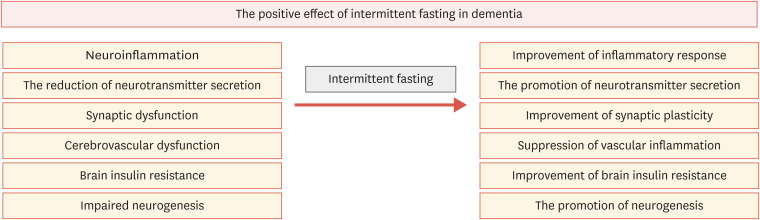
Fig. 1 The positive effects of intermittent fasting in dementia. Pathologies in dementia including neuroinflammation, the abnormal secretion of neurotransmitters, synaptic dysfunction, cerebrovascular inflammation, brain insulin resistance, and impaired neurogenesis were improved by intermittent fasting.
Reference
-
1. Livingston G, Sommerlad A, Orgeta V, Costafreda SG, Huntley J, Ames D, et al. Dementia prevention, intervention, and care. Lancet. 2017; 390:2673–2734. PMID: 28735855.
Article2. Wortmann M. Dementia: a global health priority - highlights from an ADI and World Health Organization report. Alzheimers Res Ther. 2012; 4:40. PMID: 22995353.
Article3. Masters CL, Bateman R, Blennow K, Rowe CC, Sperling RA, Cummings JL. Alzheimer's disease. Nat Rev Dis Primers. 2015; 1:15056. PMID: 27188934.
Article5. McKhann GM, Knopman DS, Chertkow H, Hyman BT, Jack CR Jr, Kawas CH, et al. The diagnosis of dementia due to Alzheimer's disease: recommendations from the National Institute on Aging-Alzheimer's Association workgroups on diagnostic guidelines for Alzheimer's disease. Alzheimers Dement. 2011; 7:263–269. PMID: 21514250.
Article6. Warren JD, Rohrer JD, Rossor MN. Clinical review. Frontotemporal dementia. BMJ. 2013; 347:f4827. PMID: 23920254.7. Dong Y, Gan DZ, Tay SZ, Koay WI, Collinson SL, Hilal S, et al. Patterns of neuropsychological impairment in Alzheimer's disease and mixed dementia. J Neurol Sci. 2013; 333:5–8. PMID: 23978422.
Article8. Bussè C, Anselmi P, Pompanin S, Zorzi G, Fragiacomo F, Camporese G, et al. Specific verbal memory measures may distinguish Alzheimer's disease from dementia with lewy bodies. J Alzheimers Dis. 2017; 59:1009–1015. PMID: 28697561.
Article9. Scheltens P, Blennow K, Breteler MM, de Strooper B, Frisoni GB, Salloway S, et al. Alzheimer's disease. Lancet. 2016; 388:505–517. PMID: 26921134.
Article10. Bhaskar K, Konerth M, Kokiko-Cochran ON, Cardona A, Ransohoff RM, Lamb BT. Regulation of tau pathology by the microglial fractalkine receptor. Neuron. 2010; 68:19–31. PMID: 20920788.
Article11. Gorelick PB, Scuteri A, Black SE, Decarli C, Greenberg SM, Iadecola C, et al. Vascular contributions to cognitive impairment and dementia: a statement for healthcare professionals from the American Heart Association/American Stroke Association. Stroke. 2011; 42:2672–2713. PMID: 21778438.
Article12. Forette F, Seux ML, Thijs L, Le Divenah A, Pérol MB, Rigaud AS, et al. Detection of cerebral aging, an absolute need: predictive value of cognitive status. Eur Neurol. 1998; 39(Suppl 1):2–6. PMID: 9516068.13. Bell RD, Winkler EA, Sagare AP, Singh I, LaRue B, Deane R, et al. Pericytes control key neurovascular functions and neuronal phenotype in the adult brain and during brain aging. Neuron. 2010; 68:409–427. PMID: 21040844.
Article14. Gupta A, Preis SR, Beiser A, Devine S, Hankee L, Seshadri S, et al. Mid-life cardiovascular risk impacts memory function: the Framingham Offspring study. Alzheimer Dis Assoc Disord. 2015; 29:117–123. PMID: 25187219.15. Sun MK, Alkon DL. Links between Alzheimer's disease and diabetes. Timely Top Med Cardiovasc Dis. 2006; 10:E24. PMID: 17066144.
Article16. Aridi YS, Walker JL, Wright OR. The association between the Mediterranean dietary pattern and cognitive health: a systematic review. Nutrients. 2017; 9:E674. PMID: 28657600.
Article17. Bordone L, Guarente L. Calorie restriction, SIRT1 and metabolism: understanding longevity. Nat Rev Mol Cell Biol. 2005; 6:298–305. PMID: 15768047.
Article18. Seimon RV, Roekenes JA, Zibellini J, Zhu B, Gibson AA, Hills AP, et al. Do intermittent diets provide physiological benefits over continuous diets for weight loss? A systematic review of clinical trials. Mol Cell Endocrinol. 2015; 418:153–172. PMID: 26384657.
Article19. Davis CS, Clarke RE, Coulter SN, Rounsefell KN, Walker RE, Rauch CE, et al. Intermittent energy restriction and weight loss: a systematic review. Eur J Clin Nutr. 2016; 70:292–299. PMID: 26603882.
Article20. Ganesan K, Habboush Y, Sultan S. Intermittent fasting: the choice for a healthier lifestyle. Cureus. 2018; 10:e2947. PMID: 30202677.
Article21. Puttonen S, Viitasalo K, Härmä M. Effect of shiftwork on systemic markers of inflammation. Chronobiol Int. 2011; 28:528–535. PMID: 21797781.
Article22. Schafer MJ, Dolgalev I, Alldred MJ, Heguy A, Ginsberg SD. Calorie restriction suppresses age-dependent hippocampal transcriptional signatures. PLoS One. 2015; 10:e0133923. PMID: 26221964.
Article23. Shin BK, Kang S, Kim DS, Park S. Intermittent fasting protects against the deterioration of cognitive function, energy metabolism and dyslipidemia in Alzheimer's disease-induced estrogen deficient rats. Exp Biol Med (Maywood). 2018; 243:334–343. PMID: 29307281.24. Zhang J, Zhan Z, Li X, Xing A, Jiang C, Chen Y, et al. Intermittent fasting protects against Alzheimer's disease possible through restoring aquaporin-4 polarity. Front Mol Neurosci. 2017; 10:395. PMID: 29238290.
Article25. Wang X, Liu Q, Zhou J, Wu X, Zhu Q. β hydroxybutyrate levels in serum and cerebrospinal fluid under ketone body metabolism in rats. Exp Anim. 2017; 66:177–182. PMID: 28100888.
Article26. Vera E, Bernardes de Jesus B, Foronda M, Flores JM, Blasco MA. Telomerase reverse transcriptase synergizes with calorie restriction to increase health span and extend mouse longevity. PLoS One. 2013; 8:e53760. PMID: 23349740.
Article27. Fann DY, Santro T, Manzanero S, Widiapradja A, Cheng YL, Lee SY, et al. Intermittent fasting attenuates inflammasome activity in ischemic stroke. Exp Neurol. 2014; 257:114–119. PMID: 24805069.
Article28. Vasconcelos AR, Yshii LM, Viel TA, Buck HS, Mattson MP, Scavone C, et al. Intermittent fasting attenuates lipopolysaccharide-induced neuroinflammation and memory impairment. J Neuroinflammation. 2014; 11:85. PMID: 24886300.
Article29. Shojaie M, Ghanbari F, Shojaie N. Intermittent fasting could ameliorate cognitive function against distress by regulation of inflammatory response pathway. J Adv Res. 2017; 8:697–701. PMID: 28970945.
Article30. Longo VD, Mattson MP. Fasting: molecular mechanisms and clinical applications. Cell Metab. 2014; 19:181–192. PMID: 24440038.
Article31. Jeong JH, Yu KS, Bak DH, Lee JH, Lee NS, Jeong YG, et al. Intermittent fasting is neuroprotective in focal cerebral ischemia by minimizing autophagic flux disturbance and inhibiting apoptosis. Exp Ther Med. 2016; 12:3021–3028. PMID: 27882110.
Article32. Cohen SM, Li B, Tsien RW, Ma H. Evolutionary and functional perspectives on signaling from neuronal surface to nucleus. Biochem Biophys Res Commun. 2015; 460:88–99. PMID: 25998737.
Article33. Hirano Y, Masuda T, Naganos S, Matsuno M, Ueno K, Miyashita T, et al. Fasting launches CRTC to facilitate long-term memory formation in Drosophila. Science. 2013; 339:443–446. PMID: 23349290.34. Fusco S, Ripoli C, Podda MV, Ranieri SC, Leone L, Toietta G, et al. A role for neuronal cAMP responsive-element binding (CREB)-1 in brain responses to calorie restriction. Proc Natl Acad Sci U S A. 2012; 109:621–626. PMID: 22190495.
Article35. Kondo M, Nakamura Y, Ishida Y, Shimada S. The 5-HT3 receptor is essential for exercise-induced hippocampal neurogenesis and antidepressant effects. Mol Psychiatry. 2015; 20:1428–1437. PMID: 25403840.
Article36. Dasgupta A, Kim J, Manakkadan A, Arumugam TV, Sajikumar S. Intermittent fasting promotes prolonged associative interactions during synaptic tagging/capture by altering the metaplastic properties of the CA1 hippocampal neurons. Neurobiol Learn Mem. 2018; 154:70–77. PMID: 29277679.
Article37. Wang M, Wang Q, Whim MD. Fasting induces a form of autonomic synaptic plasticity that prevents hypoglycemia. Proc Natl Acad Sci U S A. 2016; 113:E3029–E3038. PMID: 27092009.
Article38. Cabral-Costa JV, Andreotti DZ, Mello NP, Scavone C, Camandola S, Kawamoto EM. Intermittent fasting uncovers and rescues cognitive phenotypes in PTEN neuronal haploinsufficient mice. Sci Rep. 2018; 8:8595. PMID: 29872062.
Article39. Gao YZ, Zhang JJ, Liu H, Wu GY, Xiong L, Shu M. Regional cerebral blood flow and cerebrovascular reactivity in Alzheimer's disease and vascular dementia assessed by arterial spinlabeling magnetic resonance imaging. Curr Neurovasc Res. 2013; 10:49–53. PMID: 23151075.
Article40. Iadecola C. The pathobiology of vascular dementia. Neuron. 2013; 80:844–866. PMID: 24267647.
Article41. Hughes TM, Wagenknecht LE, Craft S, Mintz A, Heiss G, Palta P, et al. Arterial stiffness and dementia pathology: Atherosclerosis Risk in Communities (ARIC)-PET Study. Neurology. 2018; 90:e1248–e1256. PMID: 29549223.42. Tarantini S, Tran CH, Gordon GR, Ungvari Z, Csiszar A. Impaired neurovascular coupling in aging and Alzheimer's disease: contribution of astrocyte dysfunction and endothelial impairment to cognitive decline. Exp Gerontol. 2017; 94:52–58. PMID: 27845201.
Article43. Fontana L, Meyer TE, Klein S, Holloszy JO. Long-term calorie restriction is highly effective in reducing the risk for atherosclerosis in humans. Proc Natl Acad Sci U S A. 2004; 101:6659–6663. PMID: 15096581.
Article44. Headland ML, Clifton PM, Keogh JB. Effect of intermittent energy restriction on flow mediated dilatation, a measure of endothelial function: a short report. Int J Environ Res Public Health. 2018; 15:E1166. PMID: 29867034.
Article45. Erdem Y, Özkan G, Ulusoy Ş, Arıcı M, Derici Ü, Şengül Ş, et al. The effect of intermittent fasting on blood pressure variability in patients with newly diagnosed hypertension or prehypertension. J Am Soc Hypertens. 2018; 12:42–49. PMID: 29275920.
Article46. Nematy M, Alinezhad-Namaghi M, Rashed MM, Mozhdehifard M, Sajjadi SS, Akhlaghi S, et al. Effects of Ramadan fasting on cardiovascular risk factors: a prospective observational study. Nutr J. 2012; 11:69. PMID: 22963582.
Article47. Antoni R, Johnston KL, Collins AL, Robertson MD. Investigation into the acute effects of total and partial energy restriction on postprandial metabolism among overweight/obese participants. Br J Nutr. 2016; 115:951–959. PMID: 26819200.
Article48. Anson RM, Guo Z, de Cabo R, Iyun T, Rios M, Hagepanos A, et al. Intermittent fasting dissociates beneficial effects of dietary restriction on glucose metabolism and neuronal resistance to injury from calorie intake. Proc Natl Acad Sci U S A. 2003; 100:6216–6220. PMID: 12724520.
Article49. Thompson PM, Hayashi KM, Dutton RA, Chiang MC, Leow AD, Sowell ER, et al. Tracking Alzheimer's disease. Ann N Y Acad Sci. 2007; 1097:183–214. PMID: 17413023.
Article50. Wolf SA, Kronenberg G, Lehmann K, Blankenship A, Overall R, Staufenbiel M, et al. Cognitive and physical activity differently modulate disease progression in the amyloid precursor protein (APP)-23 model of Alzheimer's disease. Biol Psychiatry. 2006; 60:1314–1323. PMID: 16806094.
Article51. Wang Z, Andrade N, Torp M, Wattananit S, Arvidsson A, Kokaia Z, et al. Meteorin is a chemokinetic factor in neuroblast migration and promotes stroke-induced striatal neurogenesis. J Cereb Blood Flow Metab. 2012; 32:387–398. PMID: 22044868.
Article52. Garza JC, Guo M, Zhang W, Lu XY. Leptin increases adult hippocampal neurogenesis in vivo and in vitro . J Biol Chem. 2008; 283:18238–18247. PMID: 18367451.53. Hu Y, Yang Y, Zhang M, Deng M, Zhang JJ. Intermittent fasting pretreatment prevents cognitive impairment in a rat model of chronic cerebral hypoperfusion. J Nutr. 2017; 147:1437–1445. PMID: 28515159.
Article


