
Nutr Res Pract.
2015 Dec;9(6):637-643. 10.4162/nrp.2015.9.6.637.
Evaluation of the efficacy of nutritional screening tools to predict malnutrition in the elderly at a geriatric care hospital
- Affiliations
-
- 1Department of Food and Nutrition, Chonnam National University, 77 Youngbong-ro, Buk-gu, Gwangju 500-757, Korea. yrhuh@jnu.ac.kr
- 2Research Institute for Human ecology, Chonnam National University, Gwangju 500-757, Korea.
- KMID: 2313888
- DOI: http://doi.org/10.4162/nrp.2015.9.6.637
Abstract
- BACKGROUND/OBJECTIVES
Malnutrition in the elderly is a serious problem, prevalent in both hospitals and care homes. Due to the absence of a gold standard for malnutrition, herein we evaluate the efficacy of five nutritional screening tools developed or used for the elderly.
SUBJECTS/METHODS
Elected medical records of 141 elderly patients (86 men and 55 women, aged 73.5 +/- 5.2 years) hospitalized at a geriatric care hospital were analyzed. Nutritional screening was performed using the following tools: Mini Nutrition Assessment (MNA), Mini Nutrition Assessment-Short Form (MNA-SF), Geriatric Nutritional Risk Index (GNRI), Malnutrition Universal Screening Tool (MUST) and Nutritional Risk Screening 2002 (NRS 2002). A combined index for malnutrition was also calculated as a reference tool. Each patient evaluated as malnourished to any degree or at risk of malnutrition according to at least four out of five of the aforementioned tools was categorized as malnourished in the combined index classification.
RESULTS
According to the combined index, 44.0% of the patients were at risk of malnutrition to some degree. While the nutritional risk and/or malnutrition varied greatly depending on the tool applied, ranging from 36.2% (MUST) to 72.3% (MNA-SF). MUST showed good validity (sensitivity 80.6%, specificity 98.7%) and almost perfect agreement (k = 0.81) with the combined index. In contrast, MNA-SF showed poor validity (sensitivity 100%, specificity 49.4%) and only moderate agreement (k = 0.46) with the combined index.
CONCLUSIONS
MNA-SF was found to overestimate the nutritional risk in the elderly. MUST appeared to be the most valid and useful screening tool to predict malnutrition in the elderly at a geriatric care hospital.
Keyword
MeSH Terms
Figure
-
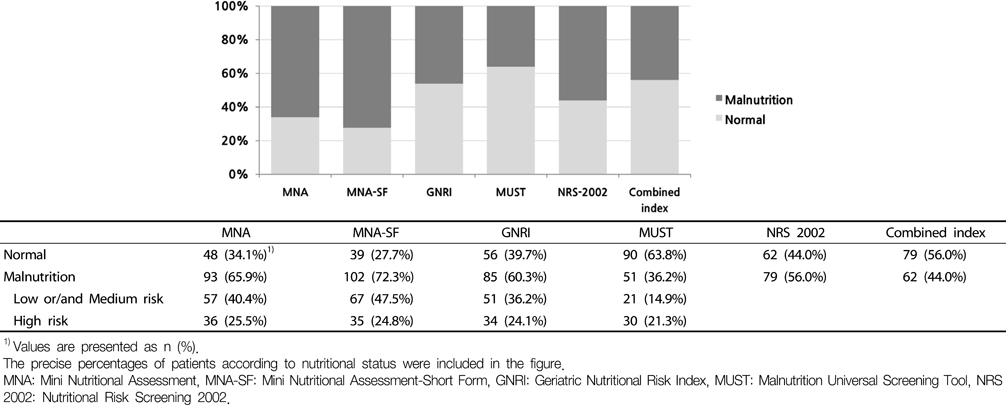
Fig. 1 Distribution of nutritional status according to the screening tools used
Reference
-
1. Statistics Korea. Statistics Korea [Internet]. Daejeon: Statistics Korea;2014. cited 2014 May 12. Available from: http://kostat.go.kr/portal/korea/index.action.2. National Health Insurance Service (KR). National Health Insurance Service [Internet]. Seoul: National Health Insurance Service;2014. cited 2014 May 12. Available from: http://www.nhis.or.kr.3. Brownie S. Why are elderly individuals at risk of nutritional deficiency? Int J Nurs Pract. 2006; 12:110–118.
Article4. Ahmed T, Haboubi N. Assessment and management of nutrition in older people and its importance to health. Clin Interv Aging. 2010; 5:207–216.5. Meijers JM, Schols JM, van Bokhorst-de van der Schueren MA, Dassen T, Janssen MA, Halfens RJ. Malnutrition prevalence in The Netherlands: results of the annual dutch national prevalence measurement of care problems. Br J Nutr. 2009; 101:417–423.
Article6. Pirlich M, Schütz T, Norman K, Gastell S, Lübke HJ, Bischoff SC, Bolder U, Frieling T, Güldenzoph H, Hahn K, Jauch KW, Schindler K, Stein J, Volkert D, Weimann A, Werner H, Wolf C, Zürcher G, Bauer P, Lochs H. The German hospital malnutrition study. Clin Nutr. 2006; 25:563–572.
Article7. Vanderwee K, Clays E, Bocquaert I, Gobert M, Folens B, Defloor T. Malnutrition and associated factors in elderly hospital patients: a Belgian cross-sectional, multi-centre study. Clin Nutr. 2010; 29:469–476.
Article8. Kondrup J, Allison SP, Elia M, Vellas B, Plauth M. Educational and Clinical Practice Committee. European Society of Parenteral and Enteral Nutrition (ESPEN). ESPEN guidelines for nutrition screening 2002. Clin Nutr. 2003; 22:415–421.
Article9. Vellas B, Guigoz Y, Garry PJ, Nourhashemi F, Bennahum D, Lauque S, Albarede JL. The mini nutritional assessment (MNA) and its use in grading the nutritional state of elderly patients. Nutrition. 1999; 15:116–122.
Article10. Rubenstein LZ, Harker JO, Salvà A, Guigoz Y, Vellas B. Screening for undernutrition in geriatric practice: developing the short-form mini-nutritional assessment (MNA-SF). J Gerontol A Biol Sci Med Sci. 2001; 56:M366–M372.
Article11. Bouillanne O, Morineau G, Dupont C, Coulombel I, Vincent JP, Nicolis I, Benazeth S, Cynober L, Aussel C. Geriatric Nutritional Risk Index: a new index for evaluating at-risk elderly medical patients. Am J Clin Nutr. 2005; 82:777–783.
Article12. Elia M. The 'Must' Report. Nutritional Screening of Adults: a Multidisciplinary Responsibility. Development and Use of the 'Malnutrition Universal Screening Tool' ('MUST') for Adults. Redditch: Malnutrition Advisory Group (MAG), a Standing Committee of BAPEN;2003.13. Kondrup J, Rasmussen HH, Hamberg O, Stanga Z. Ad Hoc ESPEN Working Group. Nutritional risk screening (NRS 2002): a new method based on an analysis of controlled clinical trials. Clin Nutr. 2003; 22:321–336.
Article14. Kim S, Kim S, Sohn C. Development of nutrition screening index for hospitalized patients. Korean J Community Nutr. 2006; 11:779–784.15. Han JS, Lee SM, Chung HK, Ahn HS, Lee SM. Development and evaluation of a nutritional risk screening tool (NRST) for hospitalized patients. Korean J Nutr. 2009; 42:119–127.
Article16. Lee JS, Cho MR, Lee GJ. Validation of the developed nutritional screening tool for hospital patients. Korean J Nutr. 2010; 43:189–196.
Article17. Chung SH, Sohn CM. Nutritional status of hospitalized geriatric patients using by the mini nutritional assessment. Korean J Community Nutr. 2005; 10:645–653.18. Yoo SH, Lee GE, Oh HJ, Park EY, Kim YJ, An YH. Validity of patient-generated subjective global assessment (PG-SGA) in hospitalized older patients. J Korean Gerontol Nurs. 2011; 13:215–223.19. Lee H, Kang JH, Kim E, Kim WG. Prevalence of malnutrition in hospitalized elderly Korean patients based on mini nutritional assessment-short form. J Clin Nutr. 2014; 6:24–29.
Article20. Pablo AM, Izaga MA, Alday LA. Assessment of nutritional status on hospital admission: nutritional scores. Eur J Clin Nutr. 2003; 57:824–831.
Article21. Poulia KA, Yannakoulia M, Karageorgou D, Gamaletsou M, Panagiotakos DB, Sipsas NV, Zampelas A. Evaluation of the efficacy of six nutritional screening tools to predict malnutrition in the elderly. Clin Nutr. 2012; 31:378–385.
Article22. van Bokhorst-de van der Schueren MA, Guaitoli PR, Jansma EP, de Vet HC. Nutrition screening tools: does one size fit all? A systematic review of screening tools for the hospital setting. Clin Nutr. 2014; 33:39–58.
Article23. Landis JR, Koch GG. The measurement of observer agreement for categorical data. Biometrics. 1977; 33:159–174.
Article24. Baker JP, Detsky AS, Wesson DE, Wolman SL, Stewart S, Whitewell J, Langer B, Jeejeebhoy KN. Nutritional assessment: a comparison of clinical judgement and objective measurements. N Engl J Med. 1982; 306:969–972.25. Martins CP, Correia JR, do Amaral TF. Undernutrition risk screening and length of stay of hospitalized elderly. J Nutr Elder. 2005; 25:5–21.
Article26. Kyle UG, Kossovsky MP, Karsegard VL, Pichard C. Comparison of tools for nutritional assessment and screening at hospital admission: a population study. Clin Nutr. 2006; 25:409–417.
Article27. Almeida AI, Correia M, Camilo M, Ravasco P. Length of stay in surgical patients: nutritional predictive parameters revisited. Br J Nutr. 2013; 109:322–328.
Article28. Ranhoff AH, Gjøen AU, Mowé M. Screening for malnutrition in elderly acute medical patients: the usefulness of MNA-SF. J Nutr Health Aging. 2005; 9:221–225.29. Neelemaat F, Meijers J, Kruizenga H, van Ballegooijen H, van Bokhorst-de van der Schuerenn M. Comparison of five malnutrition screening tools in one hospital inpatient sample. J Clin Nurs. 2011; 20:2144–2152.
Article30. Durán Alert P, Milà Villarroel R, Formiga F, Virgili Casas N, Vilarasau Farré C. Assessing risk screening methods of malnutrition in geriatric patients: mini nutritional assessment (MNA) versus geriatric nutritional risk index (GNRI). Nutr Hosp. 2012; 27:590–598.
- Full Text Links
-
- Actions
-
Cited
- CITED
-
- Close
- Share
-
- Similar articles
-
- Nutrition Screening and Assessment of Patients for Malnutrition
- The Importance of Nutrition in Neurological Disorders and Nutrition Assessment Methods
- Nutritional Status of the Hospitalized Patients with High Risk of Dysphagia in Korea
- Nutritional Screening and Assessment in Hospitalized Patients
- Nutritional Assessment of Geriatric Stroke Patients in a Rehabilitation Hospital


