
J Adv Prosthodont.
2009 Mar;1(1):1-5. 10.4047/jap.2009.1.1.1.
Wettability of denture relining materials under water storage over time
- Affiliations
-
- 1Department of Prosthodontics, Graduate School of Clinical Dentistry, Ewha Womans University, Korea.
- 2Seoul Top Dental Clinic, Korea.
- 3Department of Oral Anatomy, Dental School, Kangnung National University, Korea.
- 4Department of Prosthodontics, School of Dentistry, Kyung Hee University, Seoul, Korea. ahranp@hotmail.com
- KMID: 2176330
- DOI: http://doi.org/10.4047/jap.2009.1.1.1
Abstract
- STATEMENT OF PROBLEM: Poor wettability of denture relining materials may lead to retention problems and patient discomfort. PURPOSE: Purpose of this study is to compare and evaluate wettability of nine denture relining materials using contact angle measurements under air and water storage over time. MATERIAL AND METHODS: Nine denture relining materials were investigated in this study. Two heat-curing polymethyl-methacrylate (PMMA) denture base materials: Vertex RS, Lang, one self-curing polyethyl-methacrylate (PEMA) chairside reline resin: Rebase II, six silicone relining materials: Mucopren soft, Mucosoft, Mollosil(R) plus, Sofreliner Touch, GC Reline(TM) Ultrasoft, Silagum automix comfort were used in this experiment. Contact angles were measured using high-resolution drop shape analysis system (DSA 10-MK2, KRUESS, Germany) under three conditions (in air after setting, 1 hour water storage, and 24 hours water storage). Nine materials were classified into three groups according to material composition (Group 1: PMMA, Group 2: PEMA, Group 3: Silicone). Mean values of contact angles were compared using independent samples t-test and one-way ANOVA, followed by a Scheffe's post hoc analysis (alpha= 0.01). RESULTS: Contact angles of materials tested after air and water storage increased in the following order: Group 1 (PMMA), Group 2 (PEMA), Group 3 (Silicone). Heat-cured acrylic denture base resins had more wettability than silicone relining materials. Lang had the highest wettability after 24 hours of water storage. Silicone relining materials had lower wettability due to their hydrophobicity. Wettability of all denture relining materials, except Rebase II and Mollosil(R) plus, increased after 24 hours of water storage. CONCLUSIONS: Conventional heat-cured resin showed the highest wettability, therefore, it can be suggested that heat-cured acrylic resin is material of choice for denture relining materials.
MeSH Terms
Figure
-
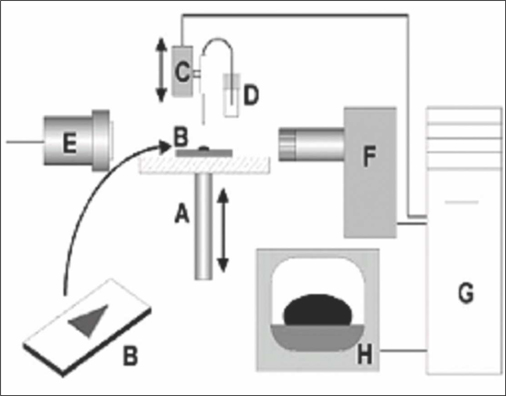
Fig. 1 Schematic illustration of high-resolution Drop Shape Analysis System. A. Table, B. Specimen, C. Liquid Syringe System, D. Liquid Container, E. Light, F. High-resolution Video Camera, G. Computer, H. Monitor.

Fig. 2 Bar graph of contact angles of denture relining materials.
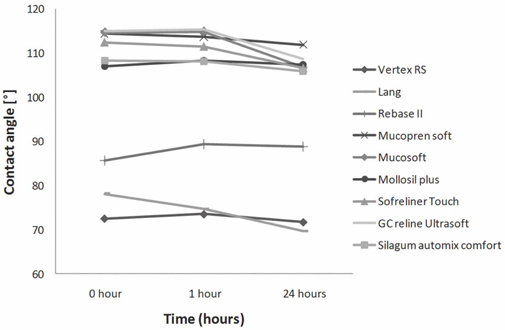
Fig. 3 Line graph of contact angles of denture relining materials over time.
Reference
-
1. Kawano F, Tada N, Nagal K, Matsuomoto N. Influence of soft lining materials on pressure distribution. J Prosthet Dent. 1991. 65:567–575.2. Haywood J, Basker RM, Watson CJ, Wood DJ. A comparison of three hard chairside denture reline materials. Part I. Clinical evaluation. Eur J Prosthodont Restor Dent. 2003. 11:157–163.3. Matsumura H, Tanoue N, Kawasaki K, Atsuta M. Clinical evaluation of a chemically cured hard denture relining material. J Oral Rehabil. 2001. 28:640–644.4. Arima T, Murata H, Hamada T. Analysis of composition and structure of hard autopolymerizing reline resins. J Oral Rehabil. 1996. 23:346–352.5. Wright PS. The success and failure of denture soft-lining materials in clinical use. J Dent. 1984. 12:319–327.6. Barsby MJ, Braden MJ. A hydrophilic denture base resin. J Dent Res. 1979. 58:1581–1584.7. Qudah S, Harrison A, Huggett R. Soft lining materials in prosthetic dentistry: A review. Int J Prosthodont. 1990. 3:477–483.8. Ellis B, Lamb DJ, McDonald MP. A study of the composition and diffusion characteristics of a soft liner. J Dent. 1979. 7:133–140.9. Jones DW, Sutow EJ, Hall GC, Tobin WM, Graham BS. Dental soft polymers, plasticizer composite and leachability. Dent Mater. 1988. 4:1–7.10. Craig RG, Gibbons P. Properties of resilient denture liners. J Am Dent Assoc. 1961. 63:382–390.11. Monsénégo P, Baszkin A, Costa ML, Lejoyeux J. Complete denture retention. Part II: Wettability studies on various acrylic resin denture base materials. J Prosthet Dent. 1989. 62:308–312.12. Wright PS. Soft lining materials: their status and prospects. J Dent. 1976. 4:247–256.13. Kwok D, Gietzelt T, Grundke K, Jacobash H, Neumann A. Contact angle measurements and contact angle interpretation. 1. Contact angle measurements by axisymmetric drop shape analysis and a goniometer sessile drop technique. Langmuir. 1997. 13:2880–2894.14. Good RJ. Mittal KL, editor. Contact angle, wetting, and adhesion a critical review. Contact angle, wettability and adhesion. 1993. Utrecht, The Netherlands: VSP;3–36.15. Anusavice KJ. Phillip's science of dental materials. 1996. 10th ed. Philadelphia, PA: Saunders;28–29.16. Wright PS. Composition and properties of soft lining materials for acrylic dentures. J Dent. 1981. 9:210–223.17. Kalachandra S, Turner DT. Water sorption of plasticized denture acrylic lining material. Dent Mater. 1989. 5:161–164.18. Parker S, Martin D, Braden M. Soft acrylic resin materials containing a polymerizable plasticizer I: Mechanical properties. Biomaterials. 1998. 19:1695–1701.19. Kazanji MNM, Watkinson AC. Influence of thickness, boxing and storage on the softness of resilient denture lining materials. J Prosthet Dent. 1988. 59:677–680.20. Parr GR, Rueggeberg FA. Physical-property comparison of a chairside- or laboratory-polymerized permanent soft-liner during 1 year. J Prosthodont. 1999. 8:92–99.21. Jepson NJA, McCabe JF, Storer R. The clinical serviceability of two permanent denture soft linings. Br Dent J. 1994. 177:11–16.22. Combe EC, Burke FJT, Douglas WH. Dental Biomaterials. 1999. Boston: Kluwer Academic;396–400.23. Emmer TJ Jr, Emmer TJ Sr, Vaidynathan J, Vaidynathan TK. Bond strength of permanent soft denture liners bonded to the denture base. J Prosthet Dent. 1995. 74:595–601.24. Boening KW, Walter MH, Schuette U. Clinical significance of surface activation of silicone impression materials. J Dent. 1998. 26:447–452.25. Mandikos MN. Polyvinylsiloxane impression materials: an update on clinical use. Aust Dent J. 1998. 43:428–434.26. McMurry J. Fundamentals of organic chemistry. 1998. 4th ed. Pacific Grove, CA: Brooks/Cole Publishing Co.;36–45.27. Anusavice KJ. Phillips' science of dental materials. 2003. 11th ed. Philadelphia, PA: Saunders;205–231.28. Villar A, Pesun IJ, Brosky ME, Fines C, Hodges JS, DeLong R, Lai JH. Clinical evaluation of a new resilient denture liner. part 1: Compliance and color evaluation. J Prosthodont. 2003. 12:82–89.29. Veres EM, Wolfaardt JF, Becker PJ. An evaluation of the surface characteristics of a facial prosthetic elastomer. Part III: wettability and hardness. J Prosthet Dent. 1990. 63:466–471.30. Kawano F, Dootz ER, Koran A III, Craig RG. Sorption and solubility of 12 soft denture liners. J Prosthet Dent. 1994. 72:393–398.31. Jones DW, Hall GC, Sutow EJ, Langman MF, Robertson KN. Chemical and molecular weight analyses of prosthodontic soft polymers. J Dent Res. 1991. 70:874–879.32. O'Brien WJ. Dental materials and their selection. 1997. Chicago: Quintessence Publishing Co.;90.33. Waters MG, Jagger RG, Polyzois GL. Wettability of silicone rubber maxillofacial prosthetic materials. J Prosthet Dent. 1999. 81:439–443.
- Full Text Links
-
- Actions
-
Cited
- CITED
-
- Close
- Share
-
- Similar articles
-
- Clinical considerations for complete denture relining
- ADHERENCE OF ORAL BACTERIA ON VARIOUS DENTURE RELINING MATERIALS WITH CHITOSAN
- A case of allergic contact stomatitis due to denture relining materials
- A comparison study on shear bond strength of 3D printed resin and conventional heat-cured denture base resin to denture relining materials
- A STUDY ON DIFFERENT AMOUNT OF DENTURE BASE DISPLACEMENT USING SOFT DENTURE RELINING MATERIAL UNDER MASTICATORY FORCE


