
Ann Pediatr Endocrinol Metab.
2015 Sep;20(3):162-165. 10.6065/apem.2015.20.3.162.
A Leri-Weill dyschondrosteosis patient confirmed by mutation analysis of SHOX gene
- Affiliations
-
- 1Department of Pediatrics, Pusan National University Hospital, Pusan National University School of Medicine, Busan, Korea. glorymj0123@gmail.com
- 2Department of Pediatrics, Pusan National University Children's Hospital, Pusan National University School of Medicine, Yangsan, Korea.
- KMID: 2150393
- DOI: http://doi.org/10.6065/apem.2015.20.3.162
Abstract
- Leri-Weill dyschondrosteosis is characterized by SHOX deficiency, Madelung deformity, and mesomelic short stature. In addition, SHOX deficiency is associated with idiopathic short stature, Turner syndrome, and Langer mesomelic dysplasia. We report the first case of a Leri-Weill dyschondrosteosis patient confirmed by SHOX gene mutation analysis in Korea. The patient, who was a 7-year-old female, showed short stature. Her height and weight were 108.9 cm (<3rd percentile) and 19.7 kg (5th-10th percentile), respectively. Her arm span, height of trunk, leg length, and sitting length were 100.5 cm, 58 cm, 50.9 cm, and 62.5 cm, respectively. Her body proportion was 1.13:1. Extremities to trunk ratio was 2.61. Her hand radiograph showed Madelung deformity. And the growth hormone stimulation test showed a normal response. Furthermore, because of Madelung deformity with idiopathic short stature, she was suspected of SHOX deficiency. We performed SHOX gene mutation analysis and found a c.491G>A (p.W164X) mutation of the SHOX gene. Accordingly, this patient was diagnosed with Leri-Weill dyschondrosteosis. Recently, many mutations have been reported in the SHOX gene. However, to date, mutation analysis of the SHOX gene for Leri-Weill dyschondrosteosis has not been reported in Korea as yet. We report the first case of a Leri-Weill dyschondrosteosis patient confirmed by mutation analysis of the SHOX gene.
MeSH Terms
Figure
-

Fig. 1 Left hand radiograph. Bone age determined by the Greulich-Pyle method was 5 years 9 months (chonological age was 7 years 2 months). Madelung deformity is shown: triangularization of the distal radial epiphysis, and lucent ulnar side of distal radius (arrow).
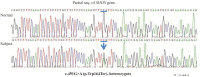
Fig. 2 Partial genomic DNA sequencing of the SHOX gene of the patient: heterogygous mutation of c.491G>A (p.W164X) in the SHOX gene.
Reference
-
1. Cohen P, Rogol AD, Deal CL, Saenger P, Reiter EO, Ross JL, et al. Consensus statement on the diagnosis and treatment of children with idiopathic short stature: a summary of the Growth Hormone Research Society, the Lawson Wilkins Pediatric Endocrine Society, and the European Society for Paediatric Endocrinology Workshop. J Clin Endocrinol Metab. 2008; 93:4210–4217. PMID: 18782877.
Article2. Rao E, Weiss B, Fukami M, Rump A, Niesler B, Mertz A, et al. Pseudoautosomal deletions encompassing a novel homeobox gene cause growth failure in idiopathic short stature and Turner syndrome. Nat Genet. 1997; 16:54–63. PMID: 9140395.
Article3. Binder G. Short stature due to SHOX deficiency: genotype, phenotype, and therapy. Horm Res Paediatr. 2011; 75:81–89. PMID: 21325865.
Article4. Clement-Jones M, Schiller S, Rao E, Blaschke RJ, Zuniga A, Zeller R, et al. The short stature homeobox gene SHOX is involved in skeletal abnormalities in Turner syndrome. Hum Mol Genet. 2000; 9:695–702. PMID: 10749976.
Article5. Rosilio M, Huber-Lequesne C, Sapin H, Carel JC, Blum WF, Cormier-Daire V. Genotypes and phenotypes of children with SHOX deficiency in France. J Clin Endocrinol Metab. 2012; 97:E1257–E1265. PMID: 22518848.
Article6. Rappold GA, Fukami M, Niesler B, Schiller S, Zumkeller W, Bettendorf M, et al. Deletions of the homeobox gene SHOX (short stature homeobox) are an important cause of growth failure in children with short stature. J Clin Endocrinol Metab. 2002; 87:1402–1406. PMID: 11889216.
Article7. Seki A, Jinno T, Suzuki E, Takayama S, Ogata T, Fukami M. Skeletal deformity associated with SHOX deficiency. Clin Pediatr Endocrinol. 2014; 23:65–72. PMID: 25110390.8. Blaschke RJ, Rappold GA. SHOX: growth, Léri-Weill and Turner syndromes. Trends Endocrinol Metab. 2000; 11:227–230. PMID: 10878753.
Article9. Leka SK, Kitsiou-Tzeli S, Kalpini-Mavrou A, Kanavakis E. Short stature and dysmorphology associated with defects in the SHOX gene. Hormones (Athens). 2006; 5:107–118. PMID: 16807223.
Article10. Belin V, Cusin V, Viot G, Girlich D, Toutain A, Moncla A, et al. SHOX mutations in dyschondrosteosis (Leri-Weill syndrome). Nat Genet. 1998; 19:67–69. PMID: 9590292.
Article11. Rappold G, Blum WF, Shavrikova EP, Crowe BJ, Roeth R, Quigley CA, et al. Genotypes and phenotypes in children with short stature: clinical indicators of SHOX haploinsufficiency. J Med Genet. 2007; 44:306–313. PMID: 17182655.
Article12. Binder G, Ranke MB, Martin DD. Auxology is a valuable instrument for the clinical diagnosis of SHOX haploinsufficiency in school-age children with unexplained short stature. J Clin Endocrinol Metab. 2003; 88:4891–4896. PMID: 14557470.
Article13. Jorge AA, Souza SC, Nishi MY, Billerbeck AE, Liborio DC, Kim CA, et al. SHOX mutations in idiopathic short stature and Leri-Weill dyschondrosteosis: frequency and phenotypic variability. Clin Endocrinol (Oxf). 2007; 66:130–135. PMID: 17201812.
Article14. Fukami M, Nishi Y, Hasegawa Y, Miyoshi Y, Okabe T, Haga N, et al. Statural growth in 31 Japanese patients with SHOX haploinsufficiency: support for a disadvantageous effect of gonadal estrogens. Endocr J. 2004; 51:197–200. PMID: 15118270.
Article15. Shears DJ, Vassal HJ, Goodman FR, Palmer RW, Reardon W, Superti-Furga A, et al. Mutation and deletion of the pseudoautosomal gene SHOX cause Leri-Weill dyschondrosteosis. Nat Genet. 1998; 19:70–73. PMID: 9590293.
Article16. Binder G, Renz A, Martinez A, Keselman A, Hesse V, Riedl SW, et al. SHOX haploinsufficiency and Leri-Weill dyschondrosteosis: prevalence and growth failure in relation to mutation, sex, and degree of wrist deformity. J Clin Endocrinol Metab. 2004; 89:4403–4408. PMID: 15356038.
Article17. Zinn AR, Wei F, Zhang L, Elder FF, Scott CI Jr, Marttila P, et al. Complete SHOX deficiency causes Langer mesomelic dysplasia. Am J Med Genet. 2002; 110:158–163. PMID: 12116254.18. Blum WF, Crowe BJ, Quigley CA, Jung H, Cao D, Ross JL, et al. Growth hormone is effective in treatment of short stature associated with short stature homeobox-containing gene deficiency: Two-year results of a randomized, controlled, multicenter trial. J Clin Endocrinol Metab. 2007; 92:219–228. PMID: 17047016.
Article19. Scalco RC, Melo SS, Pugliese-Pires PN, Funari MF, Nishi MY, Arnhold IJ, et al. Effectiveness of the combined recombinant human growth hormone and gonadotropin-releasing hormone analog therapy in pubertal patients with short stature due to SHOX deficiency. J Clin Endocrinol Metab. 2010; 95:328–332. PMID: 19926713.
Article
- Full Text Links
-
- Actions
-
Cited
- CITED
-
- Close
- Share
-
- Similar articles
-
- A Case of Leri-Weill Syndrome
- Leri-Weill dyschondrosteosis in a newborn presenting with respiratory failure due to severe micrognathia
- Identification of a novel mutation of the SHOX gene in a patient with Leri-Weill dyschondrosteosis accompanied by growth hormone deficiency
- A Case of 9.7 Mb Terminal Xp Deletion Including OA1 Locus Associated with Contiguous Gene Syndrome
- Screening of SHOX gene sequence variants in Saudi Arabian children with idiopathic short stature


