
Ann Pediatr Endocrinol Metab.
2022 Mar;27(1):69-72. 10.6065/apem.2142002.001.
Hyperosmolar hyperglycemic state as the first manifestation of type 1 diabetes mellitus in an adolescent male: a case report

- Affiliations
-
- 1Department of Pediatrics, Ajou University Hospital, Ajou University School of Medicine, Suwon, Korea
- KMID: 2528200
- DOI: http://doi.org/10.6065/apem.2142002.001
Abstract
- A hyperosmolar hyperglycemic state (HHS) is a life-threatening complication rarely seen in children and adolescents with type 1 diabetes mellitus (T1DM). However, early diagnosis and proper treatment are vital to reduce the high morbidity and mortality rates associated with HHS. We describe a male patient who presented with polydipsia, polyuria, and a drowsy mental status. His initial biochemistry results demonstrated severe hyperglycemia (1,456 mg/dL), hyperosmolarity of 359 mOsm/kg (effective osmolarity, 323 mOsm/kg), and mild acidosis (venous pH, 7.327). The patient was diagnosed with HHS and T1DM based on the presence of hyperosmolarity, hyperglycemia, and positivity for antiglutamic acid antibodies. Intensive intravenous fluid and regular insulin (0.025 units/kg/hr) were administered. After hydration and insulin treatment, the patient's mental status and serum glucose and sodium levels improved, and no neurological complications were observed. In summary, most cases of HHS are observed in adult patients with type 2 diabetes. However, occurrences in children and adolescents with T1DM have also been reported. Therefore, HHS should be considered in the differential diagnosis of hyperglycemic emergencies.
Figure
-
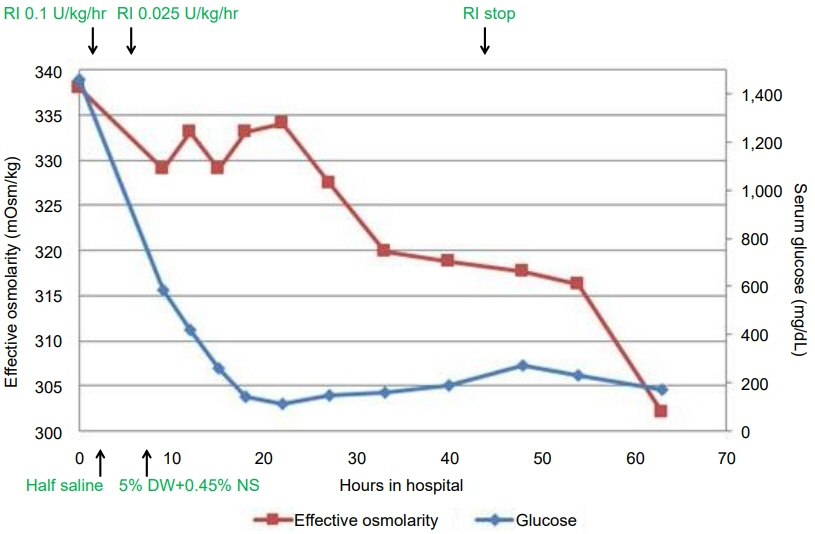
Fig. 1. Time course of laboratory findings from hospital admission to 60 hours. DW, dextrose water; NS, normal saline.
Reference
-
References
1. Umpierrez G, Korytkowski M. Diabetic emergencies-ketoacidosis, hyperglycaemic hyperosmolar state and hypoglycaemia. Nat Rev Endocrinol. 2016; 12:222–32.2. Dhatariya KK, Vellanki P. Treatment of diabetic ketoacidosis (DKA)/hyperglycemic hyperosmolar state (HHS): novel advances in the management of hyperglycemic crises (UK versus USA). Curr Diab Rep. 2017; 17:33.3. Watanabe S, Kido J, Ogata M, Nakamura K, Mizukami T. Hyperglycemic hyperosmolar state in an adolescent with type 1 diabetes mellitus. Endocrinol Diabetes Metab Case Rep. 2019; 2019:18–0131.4. Cho YM, Park BS, Kang MJ. A case report of hyperosmolar hyperglycemic state in a 7-year-old child: an unusual presentation of first appearance of type 1 diabetes mellitus. Medicine (Baltimore). 2017; 96:e7369.5. Alharfi IM, Singh R, Clarson C, Foster JR. Hyperosmolar hyperglycemic state without ketosis in a toddler with type 1 diabetes. Pediatr Emerg Care. 2014; 30:485–7.6. Kershaw MJ, Newton T, Barrett TG, Berry K, Kirk J. Childhood diabetes presenting with hyperosmolar dehydration but without ketoacidosis: a report of three cases. Diabet Med. 2005; 22:645–7.7. Pasquel FJ, Umpierrez GE. Hyperosmolar hyperglycemic state: a historic review of the clinical presentation, diagnosis, and treatment. Diabetes Care. 2014; 37:3124–31.8. Kim JH, Yun S, Hwang SS, Shim JO, Chae HW, Lee YJ, et al. The 2017 Korean National Growth Charts for children and adolescents: development, improvement, and prospects. Korean J Pediatr. 2018; 61:135–49.9. Rosenbloom AL. Hyperglycemic hyperosmolar state: an emerging pediatric problem. J Pediatr. 2010; 156:180–4.10. Agrawal S, Baird GL, Quintos JB, Reinert SE, Gopalak rishnan G, Boney CM, et al. Pediatric diabetic ketoacidosis with hyperosmolarity: clinical characteristics and outcomes. Endocr Pract. 2018; 24:726–32.11. Wolfsdorf JI, Glaser N, Agus M, Fritsch M, Hanas R, Rewers A, et al. ISPAD clinical practice consensus guidelines 2018: diabetic ketoacidosis and the hyperglycemic hyperosmolar state. Pediatr Diabetes. 2018; 19 Suppl 27:155–77.12. Fadini GP, de Kreutzenberg SV, Rigato M, Brocco S, Marchesan M, Tiengo A, et al. Characteristics and outcomes of the hyperglycemic hyperosmolar non-ketotic syndrome in a cohort of 51 consecutive cases at a single center. Diabetes Res Clin Pract. 2011; 94:172–9.13. Zeitler P, Haqq A, Rosenbloom A, Glaser N. Hyperglycemic hyperosmolar syndrome in children: pathophysiological considerations and suggested guidelines for treatment. J Pediatr. 2011; 158:9–14. 14.e1-2.
- Full Text Links
-
- Actions
-
Cited
- CITED
-
- Close
- Share
-
- Similar articles
-
- Diabetic Ketoacidosis with Hyperglycemic Hyperosmolar State at the Onset of Type 2 Diabetes Mellitus in an Adolescent Male
- Hyperglycemic Hyperosmolar State in Children with Type 2 Diabetes Mellitus: A Report of Two Cases
- A case of diabetic ketoacidosis and hyperosmolar hyperglycemic state complicated with iatrogenic left femoral arterial thrombosis in a 14-year-old girl with newly diagnosed type 2 diabetes mellitus
- Expressive aphasia as the manifestation of hyperglycemic crisis in type 2 diabetes
- Newly Diagnosed Diabetes Mellitus With Pancreatic Cancer Manifested as Hyperglycemic Hyperosmolar State


