Outpatient Percutaneous Flexor Tenotomy for Diabetic Claw Toe Deformity with Ulcer

- Affiliations
-
- 1Department of Orthopedic Surgery, Bucheon St. Mary's Hospital, College of Medicine, Catholic Universtiy of Korea, Bucheon, Korea. koreafoot@gmail.com
- KMID: 2428654
- DOI: http://doi.org/10.14193/jkfas.2018.22.4.151
Abstract
- PURPOSE
Toe ulcers have been implicated as a causative factor in diabetic foot amputation. The aim of this study was to evaluate the outcomes of percutaneous needle flexor tenotomies of diabetic claw toes with ulcers or pending ulcers.
MATERIALS AND METHODS
The authors undertook a retrospective chart review between January 2014 and June 2016 to identify those patients who underwent a percutaneous needle flexor tenotomy for diabetic claw toe deformities. We evaluated 54 toes in 42 patients. Twenty-four patients were female and the mean age at the time of operation was 57 years. The mean follow-up time was 11 months. Thirty-four patients (46 toes) had tip toe ulcers or pending ulcers and 8 patients (8 toes) had dorsal pending ulcers. All patients had palpable pulses and good capillary refill.
RESULTS
Forty-three of 46 tip toe ulcers (93.5%) healed without significant complications and 8 dorsal ulcers showed no specific changes within 5 weeks. There were no recurrent ulcers at final follow-up. Four patients developed transfer lesion of the adjacent toe and needed subsequent tenotomy.
CONCLUSION
Percutaneous needle tenotomy in an outpatient clinic was an effective and safe method for treating toe ulcers in neuropathic patients to offload the tip of the toe so that ulcer healing could occur.
Keyword
MeSH Terms
Figure
-
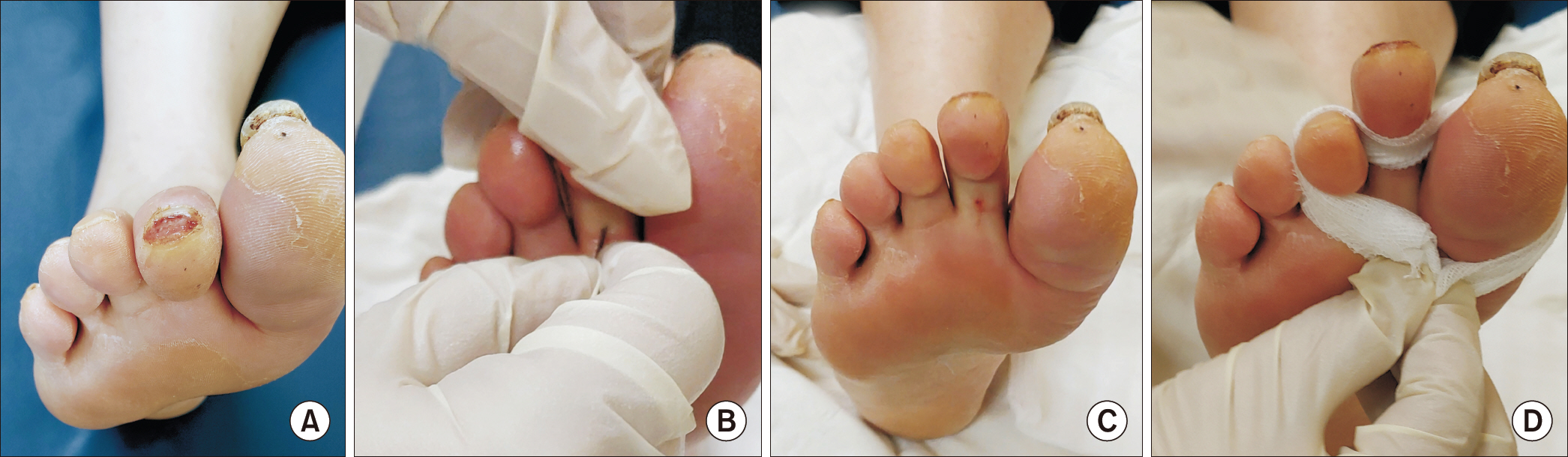
Figure 1. Photographs of 57-year-old female patient with 12 year history of diabetes. (A) Patient had a second tip toe ulcer with claw toe deformity. (B, C) A percutaneous needle flexor tenotomy was performed while applying forceful extension of the interphalangeal joint to inducing bowstring of the flexor tendon. (D) The dressing gauze was adhered to adjacent toes while keeping elevation of the ulcerated toe.
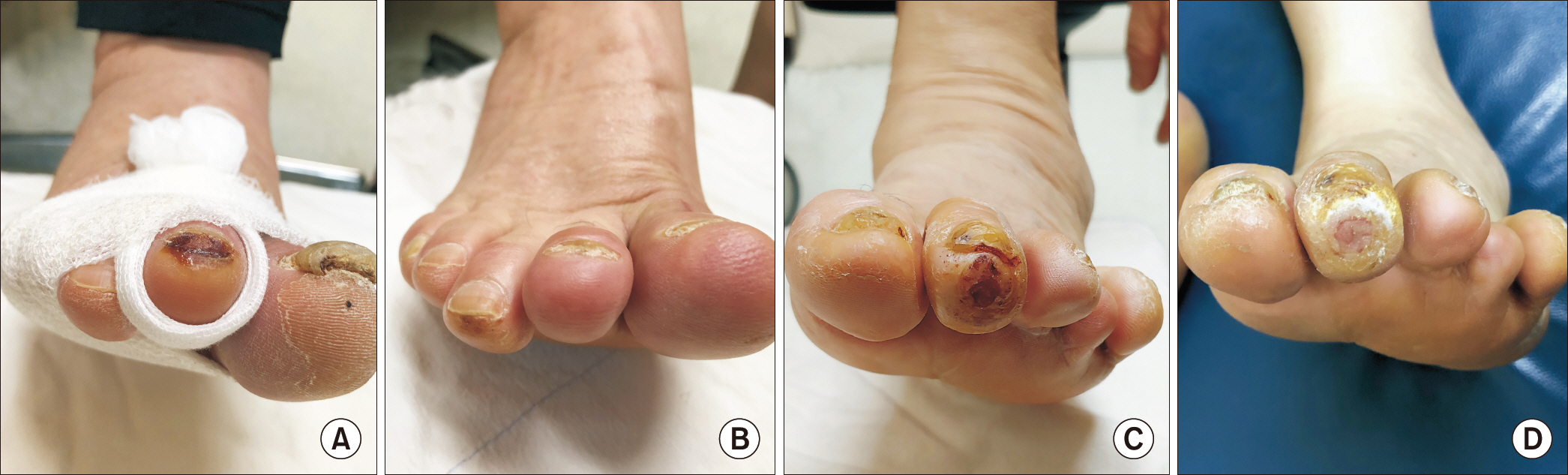
Figure 2. Photographs of 57-year-old female (A, B) and 61-year-old male (C, D) patients during follow-up. Patients had a second tip toe ulcer with claw toe deformity. (A, C) The wounds had dried up at one week after percutaneous flexor tenotomy. Small ulcer had healed completely (B), and the large ulcer had become smaller with formation of granulation tissue (D) at five weeks postoperatively. Note the toes had kept their straight position during follow-up.
Reference
-
1.Strauss MB. The orthopaedic surgeon’s role in the treatment and prevention of diabetic foot wounds. Foot Ankle Int. 2005. 26:5–14.2.Singh N., Armstrong DG., Lipsky BA. Preventing foot ulcers in patients with diabetes. JAMA. 2005. 293:217–28.
Article3.Ramsey SD., Newton K., Blough D., McCulloch DK., Sandhu N., Reiber GE, et al. Incidence, outcomes, and cost of foot ulcers in patients with diabetes. Diabetes Care. 1999. 22:382–7.
Article4.Myerson MS., Shereff MJ. The pathological anatomy of claw and hammer toes. J Bone Joint Surg Am. 1989. 71:45–9.
Article5.Armstrong DG., Lavery LA., Bushman TR. Peak foot pressures influence the healing time of diabetic foot ulcers treated with total contact casts. J Rehabil Res Dev. 1998. 35:1–5.6.Lavery LA., Vela SA., Fleischli JG., Armstrong DG., Lavery DC. Reducing plantar pressure in the neuropathic foot. A comparison of footwear. Diabetes Care. 1997. 20:1706–10.
Article7.Maciejewski ML., Reiber GE., Smith DG., Wallace C., Hayes S., Boyko EJ. Effectiveness of diabetic therapeutic footwear in preventing reulceration. Diabetes Care. 2004. 27:1774–82.
Article8.Tamir E., Vigler M., Avisar E., Finestone AS. Percutaneous tenotomy for the treatment of diabetic toe ulcers. Foot Ankle Int. 2014. 35:38–43.
Article9.van Netten JJ., Bril A., van Baal JG. The effect of flexor tenotomy on healing and prevention of neuropathic diabetic foot ulcers on the distal end of the toe. J Foot Ankle Res. 2013. 6:3.
Article10.Roukis TS., Schade VL. Percutaneous flexor tenotomy for treatment of neuropathic toe ulceration secondary to toe contracture in persons with diabetes: a systematic review. J Foot Ankle Surg. 2009. 48:684–9.
Article11.Debarge R., Philippot R., Viola J., Besse JL. Clinical outcome after percutaneous flexor tenotomy in forefoot surgery. Int Orthop. 2009. 33:1279–82.
Article12.Gudas CJ. Prophylactic surgery in the diabetic foot. Clin Podiatr Med Surg. 1987. 4:445–58.13.Pecoraro RE., Reiber GE., Burgess EM. Pathways to diabetic limb amputation. Basis for prevention. Diabetes Care. 1990. 13:513–21.
Article14.Ashry HR., Lavery LA., Armstrong DG., Lavery DC., van Houtum WH. Cost of diabetes-related amputations in minorities. J Foot Ankle Surg. 1998. 37:186–90.
Article15.Cowley MS., Boyko EJ., Shofer JB., Ahroni JH., Ledoux WR. Foot ulcer risk and location in relation to prospective clinical assessment of foot shape and mobility among persons with diabetes. Diabetes Res Clin Pract. 2008. 82:226–32.
Article16.Batista F., Pinzur MS. Disease knowledge in patients attending a diabetic foot clinic. Foot Ankle Int. 2005. 26:38–41.
Article17.Green DR., Brekke M. Anatomy, biomechanics, and pathome-chanics of lesser digital deformities. Clin Podiatr Med Surg. 1996. 13:179–200.18.Mueller MJ., Hastings M., Commean PK., Smith KE., Pilgram TK., Robertson D, et al. Forefoot structural predictors of plantar pressures during walking in people with diabetes and peripheral neuropathy. J Biomech. 2003. 36:1009–17.
Article19.Tamir E., McLaren AM., Gadgil A., Daniels TR. Outpatient percutaneous flexor tenotomies for management of diabetic claw toe deformities with ulcers: a preliminary report. Can J Surg. 2008. 51:41–4.20.Boulton AJ. Pressure and the diabetic foot: clinical science and offloading techniques. Am J Surg. 2004. 187:17S–24S.
Article21.Piaggesi A., Schipani E., Campi F., Romanelli M., Baccetti F., Arvia C, et al. Conservative surgical approach versus non-surgical management for diabetic neuropathic foot ulcers: a randomized trial. Diabet Med. 1998. 15:412–7.
Article22.Boyer ML., DeOrio JK. Transfer of the flexor digitorum longus for the correction of lesser-toe deformities. Foot Ankle Int. 2007. 28:422–30.
Article23.O’Kane C., Kilmartin T. Review of proximal interphalangeal joint excisional arthroplasty for the correction of second hammer toe deformity in 100 cases. Foot Ankle Int. 2005. 26:320–5.
Article24.Mueller MJ., Sinacore DR., Hastings MK., Strube MJ., Johnson JE. Effect of achilles tendon lengthening on neuropathic plantar ulcers. A randomized clinical trial. J Bone Joint Surg Am. 2003. 85:1436–45.
- Full Text Links
-
- Actions
-
Cited
- CITED
-
- Close
- Share
-
- Similar articles
-
- The Proximal Lengthening of Long Flexor Tendon in the Management of Claw Toe Deformities
- Outcome of Treatment for the Curly Toe Deformity
- Treatment of Lesser Toe Deformities
- Checkrein deformity of the lesser toes following comminuted fracture of calcaneus : A Case Report
- Resection Arthroplasty on Lessor Toe Deformity