
Long-term Outcome of Chondrosarcoma: A Single Institutional Experience
- Affiliations
-
- 1Department of Orthopaedic Surgery, Seoul National University Hospital, Seoul, Korea. hik19@snu.ac.kr
- KMID: 2403410
- DOI: http://doi.org/10.4143/crt.2014.135
Abstract
- PURPOSE
The prognostic factors of chondrosarcoma remain uncertain as only a few large studies with long-term follow-up have been reported. The aim of this study was to analyze oncological outcomes and prognostic factors.
MATERIALS AND METHODS
A retrospective review of oncological outcomes and prognostic factors was performed on 125 consecutive chondrosarcoma patients who underwent surgery at our institution.
RESULTS
Overall survival was 91.6%+/-2.5%, 84.1%+/-3.8%, and 84.1%+/-3.8% at 5, 10, and 15 years respectively. Among the histological types, dedifferentiated type showed the worst survival (p < 0.001). As for conventional type chondrosarcoma, histologic grade and anatomical location predicted outcome, with high-grade with axial location having the worst outcome (p < 0.001). In contrast, low-grade chondrosarcoma of appendicular skeleton could be treated safely by intralesional curettage.
CONCLUSION
Histological type was significantly associated with the outcome of chondrosarcoma. For the conventional type, histologic grade and anatomical location predicted outcome, with high-grade with axial location having the worst outcome.
Keyword
MeSH Terms
Figure
-
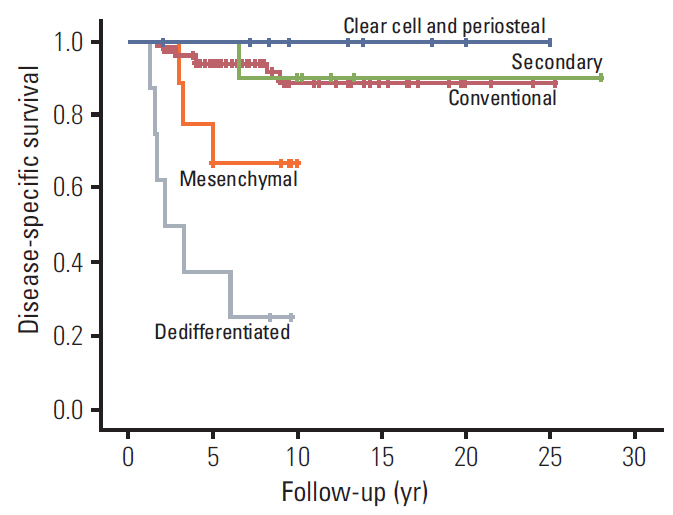
Fig. 1. Kaplan-Meier survival curves based on histologic types. Clear cell, juxta-cortical, and secondary types had the best survival of 100% and 90%±9.5% at 10 years. Survival for primary central conventional chondrosarcoma was 94%±2.6% and 89.3%±4.1% at 5 and 10 years, respectively. Dedifferentiated types showed the worst survival of 37.5%±17.1% and 25.0%±15.3% at 5 and 10 years, respectively (p=0.002).
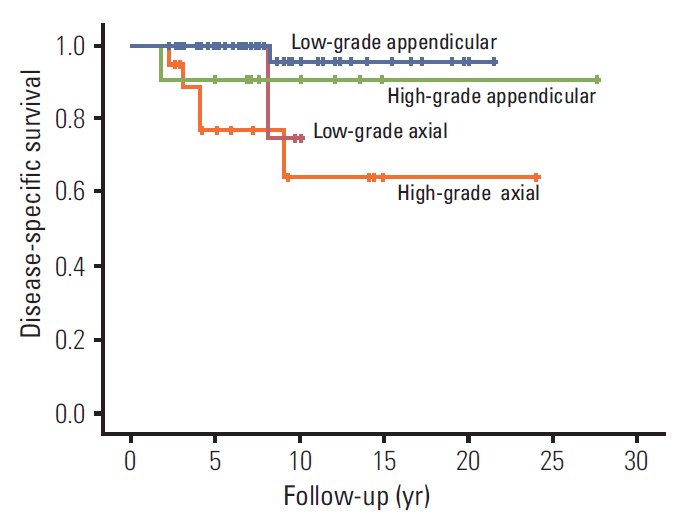
Fig. 2. Kaplan-Meier analysis for disease-specific survival by group based on histological grade and anatomical location. Low-grade tumors of appendicular skeleton showed the best survival of 95.8%±4.1% and 90.9%±8.2% at 5 and 10 years, respectively. High-grade tumors with axial location showed the worst survival of 77.2%±10.1% and 64.3%±14.4% at 5 and 10 years, respectively (p=0.009).
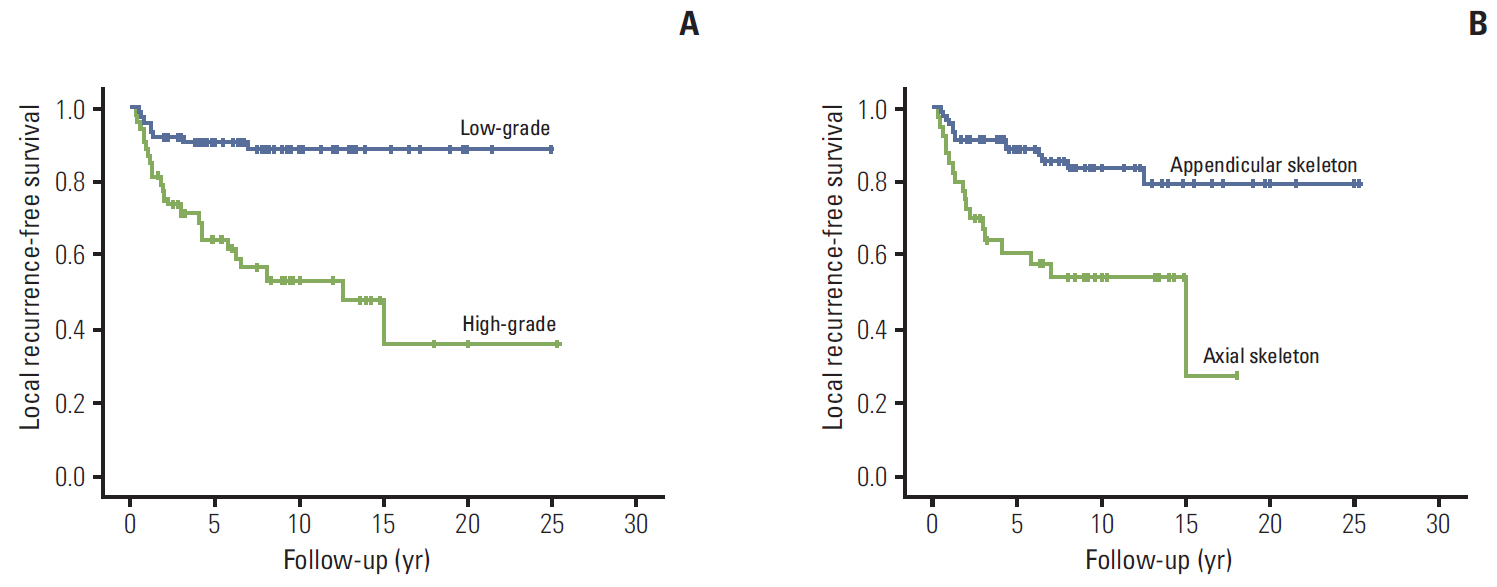
Fig. 3. Kaplan-Meier analyses for prognostic factors for local recurrence. (A) Patients with low-grade chondrosarcoma had lower risk of local recurrence than those with high-grade chondrosarcoma (p=0.012). (B) Patients with appendicular chondrosarcoma had lower risk of local recurrence than those with axial chondrosarcoma (p=0.010).
Reference
-
References
1. Giuffrida AY, Burgueno JE, Koniaris LG, Gutierrez JC, Duncan R, Scully SP. Chondrosarcoma in the United States (1973 to 2003): an analysis of 2890 cases from the SEER database. J Bone Joint Surg Am. 2009; 91:1063–72.
Article2. Dahlin DC, Henderson ED. Chondrosarcoma, a surgical and pathological problem: review of 212 cases. J Bone Joint Surg Am. 1956; 38:1025–38.3. Gitelis S, Bertoni F, Picci P, Campanacci M. Chondrosarcoma of bone: the experience at the Istituto Ortopedico Rizzoli. J Bone Joint Surg Am. 1981; 63:1248–57.
Article4. Donati D, El Ghoneimy A, Bertoni F, Di Bella C, Mercuri M. Surgical treatment and outcome of conventional pelvic chondrosarcoma. J Bone Joint Surg Br. 2005; 87:1527–30.
Article5. Lee FY, Mankin HJ, Fondren G, Gebhardt MC, Springfield DS, Rosenberg AE, et al. Chondrosarcoma of bone: an assessment of outcome. J Bone Joint Surg Am. 1999; 81:326–38.6. Schwab JH, Wenger D, Unni K, Sim FH. Does local recurrence impact survival in low-grade chondrosarcoma of the long bones? Clin Orthop Relat Res. 2007; 462:175–80.
Article7. Fiorenza F, Abudu A, Grimer RJ, Carter SR, Tillman RM, Ayoub K, et al. Risk factors for survival and local control in chondrosarcoma of bone. J Bone Joint Surg Br. 2002; 84:93–9.
Article8. Abudu A, Davies AM, Pynsent PB, Mangham DC, Tillman RM, Carter SR, et al. Tumour volume as a predictor of necrosis after chemotherapy in Ewing's sarcoma. J Bone Joint Surg Br. 1999; 81:317–22.
Article9. Enneking WF, Spanier SS, Goodman MA. A system for the surgical staging of musculoskeletal sarcoma. Clin Orthop Relat Res. 1980; (153):106–20.
Article10. Angelini A, Guerra G, Mavrogenis AF, Pala E, Picci P, Ruggieri P. Clinical outcome of central conventional chondrosarcoma. J Surg Oncol. 2012; 106:929–37.
Article11. Gelderblom H, Hogendoorn PC, Dijkstra SD, van Rijswijk CS, Krol AD, Taminiau AH, et al. The clinical approach towards chondrosarcoma. Oncologist. 2008; 13:320–9.
Article12. Evans HL, Ayala AG, Romsdahl MM. Prognostic factors in chondrosarcoma of bone: a clinicopathologic analysis with emphasis on histologic grading. Cancer. 1977; 40:818–31.13. van Loon CJ, Veth RP, Pruszczynski M, Wobbes T, Lemmens JA, van Horn J. Chondrosarcoma of bone: oncologic and functional results. J Surg Oncol. 1994; 57:214–21.14. Pritchard DJ, Lunke RJ, Taylor WF, Dahlin DC, Medley BE. Chondrosarcoma: a clinicopathologic and statistical analysis. Cancer. 1980; 45:149–57.
Article15. Ozaki T, Hillmann A, Lindner N, Blasius S, Winkelmann W. Chondrosarcoma of the pelvis. Clin Orthop Relat Res. 1997; (337):226–39.
Article16. Puri A, Pruthi M, Gulia A. Outcomes after limb sparing resection in primary malignant pelvic tumors. Eur J Surg Oncol. 2014; 40:27–33.
Article17. Leerapun T, Hugate RR, Inwards CY, Scully SP, Sim FH. Surgical management of conventional grade I chondrosarcoma of long bones. Clin Orthop Relat Res. 2007; 463:166–72.
Article18. Puri A, Shah M, Agarwal MG, Jambhekar NA, Basappa P. Chondrosarcoma of bone: does the size of the tumor, the presence of a pathologic fracture, or prior intervention have an impact on local control and survival? J Cancer Res Ther. 2009; 5:14–9.
Article19. Andreou D, Ruppin S, Fehlberg S, Pink D, Werner M, Tunn PU. Survival and prognostic factors in chondrosarcoma: results in 115 patients with long-term follow-up. Acta Orthop. 2011; 82:749–55.20. Rizzo M, Ghert MA, Harrelson JM, Scully SP. Chondrosarcoma of bone: analysis of 108 cases and evaluation for predictors of outcome. Clin Orthop Relat Res. 2001; (391):224–33.


