
J Korean Acad Psychiatr Ment Health Nurs.
2010 Sep;19(3):252-260. 10.12934/jkpmhn.2010.19.3.252.
Mediating Effect of Self-efficacy in the Relationship between Irrational Belief and Mental Health of Korean Soldiers
- Affiliations
-
- 1School of Nursing, Ajou University, Korea.
- 2Department of Nursing, Chung-Ang University, Korea.
- 3Division of Nursing, Hallym University, Korea. namka@hallym.ac.kr
- KMID: 2321838
- DOI: http://doi.org/10.12934/jkpmhn.2010.19.3.252
Abstract
- PURPOSE
This study was done to examine the association among irrational belief, mental health, and self-efficacy, and explored the mediation of self-efficacy in the relationship between irrational belief and mental health of Korean soldiers.
METHODS
A cross sectional study design was employed. The participants were 118 soldiers who signed consent forms. Data were analyzed using descriptive statistics, Pearson correlation coefficients, and multiple regression analysis.
RESULTS
Irrational beliefs were positively correlated with mental health problems, and self-efficacy was negatively correlated with irrational beliefs and mental health problems. Self-efficacy acted as a mediator in the relationship between irrational beliefs and mental health problems.
CONCLUSION
The study results suggest that effective interventions to reduce mental health problems of soldiers should apply strategies to change irrational belief and increase self efficacy. These results also provide more empirical support to the hypothesis that self-efficacy serves as a mediator in a mental health.
Keyword
Figure
-
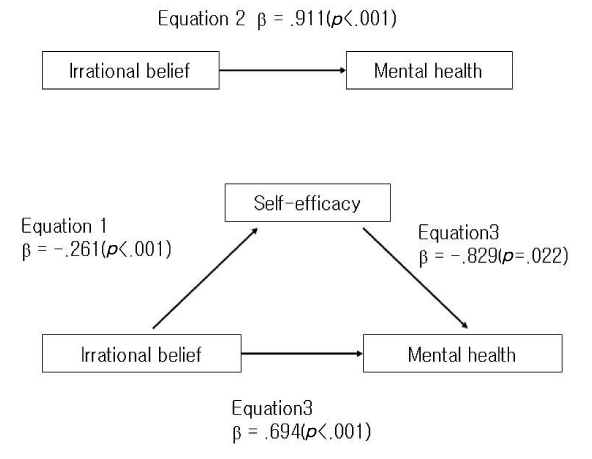
Figure 1 Mediating effect of self-efficacy on the relationship between irrational belief and mental health.
Cited by 1 articles
-
Military Stress, Stress Coping, and Mental Health Status among Soldiers who Need Intensive Care
Hyunlye Kim, Ran Keum, Sunah Kim, Su In Park, Jin Young Park
J Korean Acad Psychiatr Ment Health Nurs. 2013;22(4):285-294. doi: 10.12934/jkpmhn.2013.22.4.285.
Reference
-
1. Bandura A. Self-efficacy: The exercise of control. New York, NY: W.H. Freeman;1997.2. Baron RM, Kenny DA. The moderator-mediator variable distinction in social psychological research: Conceptual, strategic, and statistical considerations. J Pers Soc Psychol. 1986; 51(6):1173–1182.
Article3. Bartone PT. Resilience under military operational stress: Can leaders influence hardiness? Mil Psychol. 2006; 18:131–148.
Article4. Benight CC, Bandura A. Social cognitive theory of posttraumatic recovery: The role of perceived self-efficacy. Behav Res Ther. 2004; 42:1129–1148.
Article5. Cieslak R, Benight CC, Lehman VC. Coping self-efficacy mediates the effects of negative cognitions on posttraumatic distress. Behav Res Ther. 2008; 46:788–798.
Article6. Cohen J. Statistical power analysis for the behavioral sciences. 2nd ed. Hillsdale, NJ: Lawrence Erlbaum Associates;1988.7. Choy C, Lee J. Irrational beliefs and situational factors in social anxiety. Korean J Couns Psychother. 1994; 6(1):21–47.8. Derogatis LR. The SCL-90 manual: Scoring, administration and procedures for the SCL-90. Baltimore: John Hopkins University School of Medicine. Clinical Psychometrics Unit;1977.9. Dolan CA, Adler AB. Military hardiness as a buffer of psychological health on return from deployment. Mil Psychol. 2006; 171(2):93–98.
Article10. Ellis A. Thinking processes involved in irrational beliefs and their disturbed consequences. Cognitive Ther Res. 1995; 9:105–116.
Article11. Han I. Mental health of Korean soldiers and their need for social service. Ment Health Soc Work. 1999; 8:199–220.12. Hyun MS, Nam KA, Kim MA. A study on parents' drinking behaviors and the mental health of their adolescent offsprings. J Korean Acad Psychiatr Ment Health Nurs. 2008; 17(4):392–402.13. Jang S. The army of regulation and control and the soldiers of resistance and despair. Korean Lit. 2008; 12(4):259–282.14. Joe SY. Relations of health promoting behaviors, mental health, and military life adjustments of soldiers. J Korean Acad Psychiatr Ment Health Nurs. 2003; 12(2):164–171.15. Jones RG. A factored measures of Ellis irrational belief system with personality and maladjustment correlates. Ann Arbor Mith University. Micofilms, Inc;1968.16. Karademas EC, Kalantzi-Azizi A. The stress process, self-efficacy expectations, and psychological health. Pers individ Differences. 2004; 37:1033–1043.
Article17. Kim I. The relationship between irrational belief and anger in the college students. Seoul: Myong-Ji University;1999. Unpublished master's thesis.18. Kim KI, Kim JH, Won HT. Symptom checklist procedure manual. Seoul: Chungang Jeoksung Publishing;1984.19. Kho K. Trait anger, anger expression, and irrational belief. Seoul: Ewha Womans University;2000. Unpublished master's thesis.20. Koo SS. A study on mental health of new generation soldiers. Ment Health Soc Work. 2006; 24:64–93.21. Kwon E, Sin M, Kim E. The influence of covert narcissism on social phobia. Korean J Psychol Gen. 2009; 28(3):627–642.22. Lazarus RS, Folkman S. Stress, appraisal, and coping. New York: Springer;1984.23. Lee KH, Ha EH. The mediating effects of selfefficacy in the relationships between adolescent's traumatic experience and social anxiety. Korean J Sch Psychol. 2009; 6(1):1–18.
Article24. Lombardo ER, Tan G, Jensen MP, Anderson K. Anger management style and associations with self-efficacy and pain in male veterans. J Pain. 2005; 6(11):765–770.
Article25. Oh HS. Health promoting behaviors and quality of life of Korean women with arthritis. Austin: University of Texas;1993. Unpublished doctoral dissertation.26. Seo HS. The influence of new generation soldiers career decision level and self-efficacy on their adjustment in military. Korean J Youth Stud. 2008; 15(5):109–131.27. Shin HD. The effects of college student's self-efficacy on the ways of coping stress and social problem-solving ability. Seoul: Kwanwoon University;2006. Unpublished master's thesis.28. Sherer M, Maddux JE, Mercandante B, Pretice-dunn S, Jacobs B, Rogers RW. The self-efficacy scale: Construction and validation. Psychol Rep. 1982; 51:663–671.
Article29. Solberg OA, Laberg JC, Johnsen BH, Eid J. Predictors of self-efficacy in a Norwegian Battalion prior to deployment in an international operation. Mil Psychol. 2005; 17(4):299–314.
Article30. Xian H, Shah KR, Phillips SM, Scherrer JF, Volberg R, Eisen S. The association of cognitive distortions with problem and pathological gambling in adult male twins. Psychiatry Res. 2008; 160(3):300–307.
Article
- Full Text Links
-
- Actions
-
Cited
- CITED
-
- Close
- Share
-
- Similar articles
-
- Mediating Effect of Self-Efficacy in the Relationship between Internalized Stigma and Treatment Adherence of Community Dwelling Patients with Mental Illness
- The Relationship between Illness Perception and Health Behaviors among Patients with Tuberculosis: Mediating Effects of Self-efficacy and Family Support
- The Mediating Effects of Flexibility on the Relationship between Job Stress, Sleep Quality and Mental Well-being of Psychiatric Hospital Workers
- Mediating Effects of Hope and Therapeutic Relationship in the Relation between General Social Functions and Mental Health Recovery of Community People with Mental Illness
- Impact of Depression on Medication Adherence of Patients with Systemic Lupus Erythematosus: Focusing on Mediating Effect of Self-Efficacy and Belief about Medication


