
Eye and Rheumatic Disease
- Affiliations
-
- 1Department of Ophthalmology, University of Ulsan College of Medicine, Asan Medical Center, Seoul, Korea. ophthalmo@amc.seoul.kr
- KMID: 2222753
- DOI: http://doi.org/10.4078/jrd.2013.20.3.149
Abstract
- Rheumatic disorders commonly affect the sclera, cornea, retina, and orbit. These disorders range from relatively mild ocular surface problems to a serious threat for the visual sight. The most common ocular manifestations of rheumatic diseases include keratoconjunctivitis sicca, anterior uveitis, and scleritis. The most common entities to causing anterior uveitis and scleritis are seronegative spondyloarthropathies associated with human leukocyte antigen (HLA)-B27 and rheumatoid arthritis, respectively. Patients who developed bilateral or recurrent uveitis, or who have involvement of posterior ocular structures are more likely to have underlying systemic inflammatory diseases. The most significant side effects of the drugs used to treat rheumatic diseases are the maculopathy-associated with anti-malarial agents and cataracts and glaucoma associated with corticosteroid use. Close collaborations between ophthalmologists and rheumatologists are necessary for optimal treatments and the prevention of complications. Understanding the range and patterns of ocular manifestations of rheumatic diseases can provide valuable suggestions for the most suitable diagnosis and optimal management for these patients.
Keyword
MeSH Terms
Figure
-
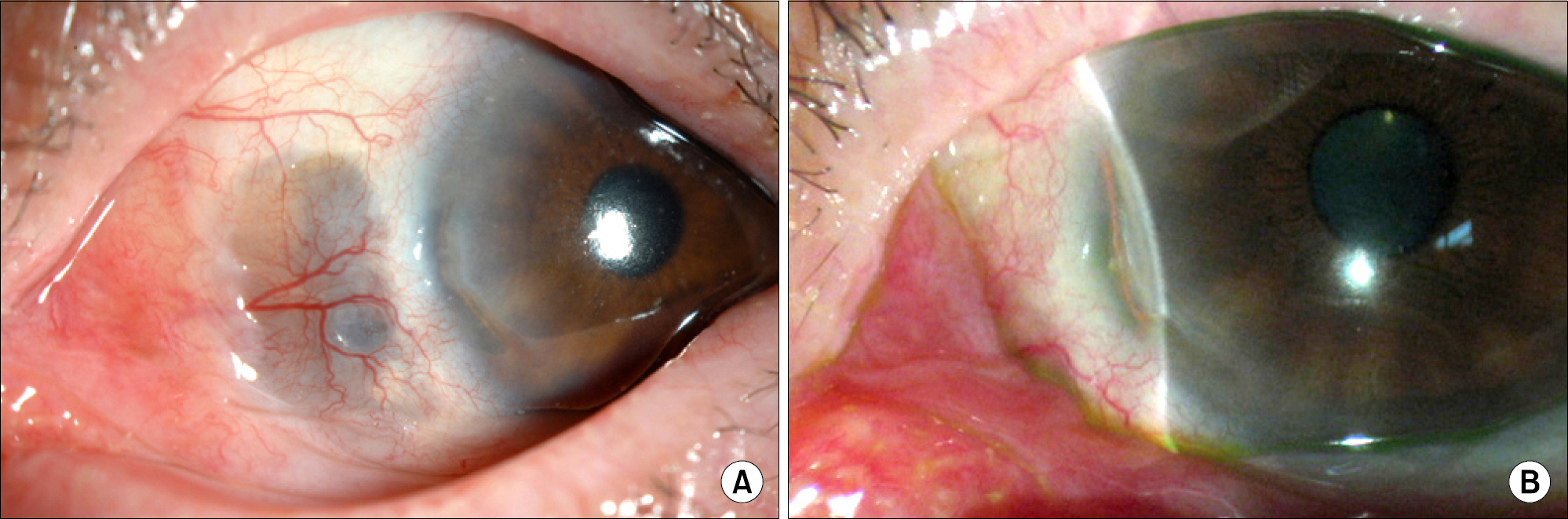
Figure 1. (A) Anterior segment photograph of the left eye showing peripheral ulcerative keratitis combined with conjunctival involvement with dilated tortuous vessels and underlying scleromalacia in a patient with rheumatoid arthritis. (B) Photograph taken with the slit beam denoting a crescent lesion involving the nasal corneal margin from 7 to 10 o'clock in a clockwise direction was associated with corneal stromal thinning in the same patient.
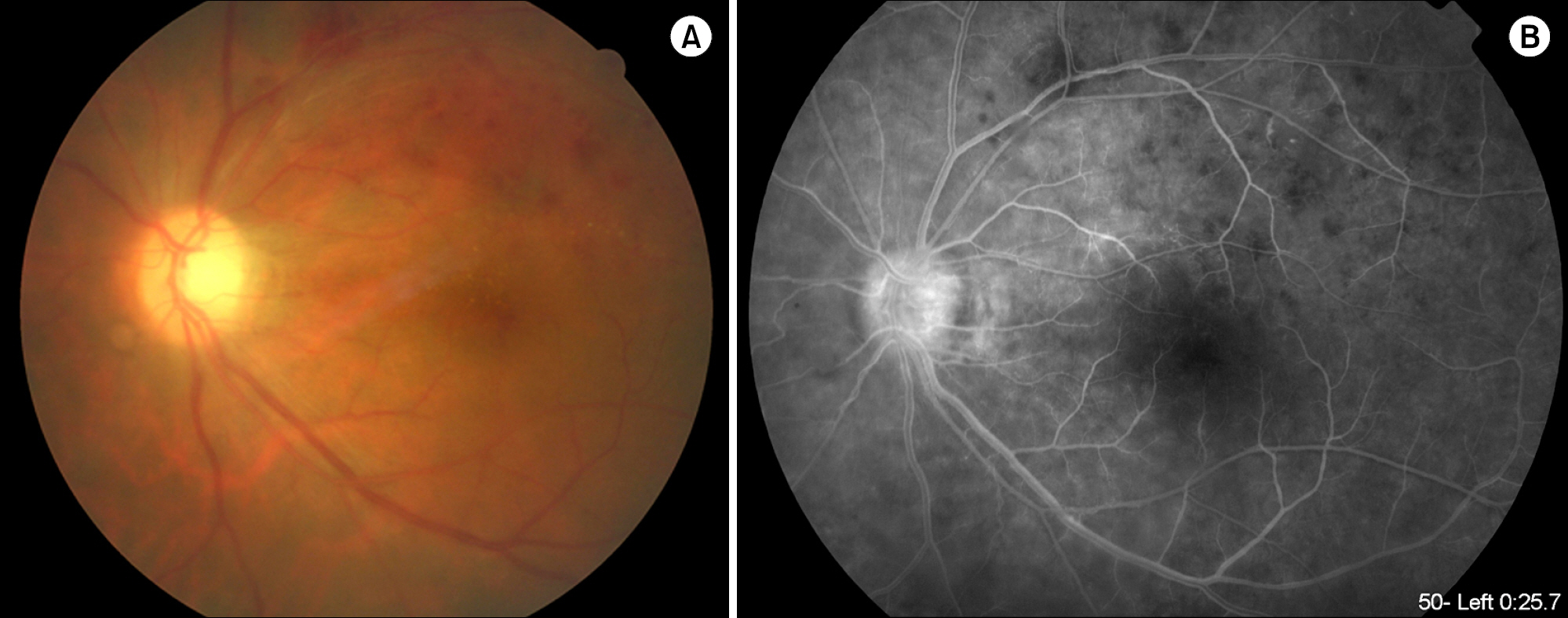
Figure 2. (A) Fundus photograph with retinal vasculitis and retinal hemorrhage associated with branch retinal vein occlusion due to Behcet's diseases. (B) Mid-phase fluorescein angiogram demonstrating retinal vasculitis in the same patient.
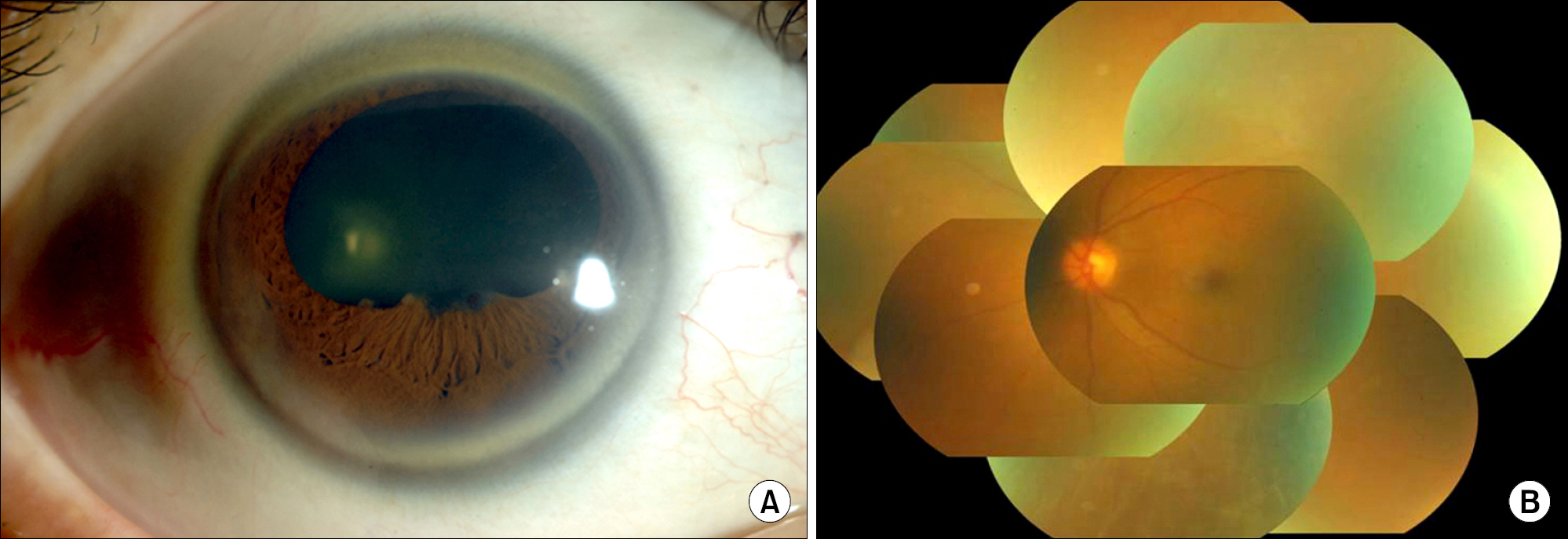
Figure 3. (A) Posterior iridolenticular synechiae associated with chronic granulomatous anterior uveitis in a patient with sarcoidosis. (B) Fundus photograph of the same patient showing vitreous infiltration and periphlebitis called “candle-wax drippings”.
Reference
-
References
1. McCluskey P, Powell RJ. The eye in systemic inflammatory diseases. Lancet. 2004; 364:2125–33.
Article2. Hamideh F, Prete PE. Ophthalmologic manifestations of rheumatic diseases. Semin Arthritis Rheum. 2001; 30:217–41.
Article3. Foster CS. Ocular manifestations of the potentially lethal rheumatologic and vasculitic disorders. J Fr Ophtalmol. 2013; 36:526–32.
Article4. Hunter RS, Skondra D, Papaliodis G, Sobrin L. Role of OCT in the diagnosis and management of macular edema from uveitis. Semin Ophthalmol. 2012; 27:236–41.
Article5. Kim NK, Park MY, Lee JH, Lee DH, Yoon BY. Uveitis and Rheumatic diseases in a community based practice - Korean population. J Rheum Dis. 2011; 18:276–82.
Article6. Farris RL, Stuchell RN, Nisengard R. Sjogren's syndrome and keratoconjunctivitis sicca. Cornea. 1991; 10:207–9.
Article7. The definition and classification of dry eye disease: report of the Definition and Classification Subcommittee of the International Dry Eye WorkShop (2007). Ocul Surf. 2007; 5:75–92.8. Galor A, Thorne JE. Scleritis and peripheral ulcerative keratitis. Rheum Dis Clin North Am. 2007; 33:835–54.
Article9. Akpek EK, Thorne JE, Qazi FA, Do DV, Jabs DA. Evaluation of patients with scleritis for systemic disease. Ophthalmology. 2004; 111:501–6.
Article10. Foster CS, Forstot SL, Wilson LA. Mortality rate in rheumatoid arthritis patients developing necrotizing scleritis or peripheral ulcerative keratitis. Effects of systemic immunosuppression. Ophthalmology. 1984; 91:1253–63.11. Rothova A, van Veenedaal WG, Linssen A, Glasius E, Kijlstra A, de Jong PT. Clinical features of acute anterior uveitis. Am J Ophthalmol. 1987; 103:137–45.
Article12. Poole TR, Graham EM. Ocular manifestations of rheumatologic disorders. Curr Opin Ophthalmol. 1999; 10:458–63.
Article13. Giordano N, D'Ettorre M, Biasi G, Fioravanti A, Moretti L, Marcolongo R. Retinal vasculitis in rheumatoid arthritis: an angiographic study. Clin Exp Rheumatol. 1990; 8:121–5.14. Singh JA, Furst DE, Bharat A, Curtis JR, Kavanaugh AF, Kremer JM, et al. 2012 update of the 2008 American College of Rheumatology recommendations for the use of disease-modifying antirheumatic drugs and biologic agents in the treatment of rheumatoid arthritis. Arthritis Care Res (Hoboken). 2012; 64:625–39.
Article15. Dougados M, van der Linden S, Juhlin R, Huitfeldt B, Amor B, Calin A, et al. The European Spondylarthropathy Study Group preliminary criteria for the classification of spondylarthropathy. Arthritis Rheum. 1991; 34:1218–27.
Article16. Zeboulon N, Dougados M, Gossec L. Prevalence and characteristics of uveitis in the spondyloarthropathies: a systematic literature review. Ann Rheum Dis. 2008; 67:955–9.
Article17. Rosenbaum JT. Acute anterior uveitis and spondyloarthropathies. Rheum Dis Clin North Am. 1992; 18:143–51.
Article18. Tay-Kearney ML, Schwam BL, Lowder C, Dunn JP, Meisler DM, Vitale S, et al. Clinical features and associated systemic diseases of HLA-B27 uveitis. Am J Ophthalmol. 1996; 121:47–56.
Article19. Pavlidis NA, Karsh J, Moutsopoulos HM. The clinical picture of primary Sjögren's syndrome: a retrospective study. J Rheumatol. 1982; 9:685–90.20. Friedlaender MH. Ocular manifestations of Sjögren's syndrome: keratoconjunctivitis sicca. Rheum Dis Clin North Am. 1992; 18:591–608.
Article21. Management and therapy of dry eye disease: report of the Management and Therapy Subcommittee of the International Dry Eye WorkShop (2007). Ocul Surf. 2007; 5:163–78.22. Morton SJ, Powell RJ. Management of systemic lupus erythematosus (SLE). Clin Exp Allergy. 2001; 31:686–93.
Article23. Tugal-Tutkun I, Onal S, Altan-Yaycioglu R, Huseyin Altunbas H, Urgancioglu M. Uveitis in Behç et disease: an analysis of 880 patients. Am J Ophthalmol. 2004; 138:373–80.24. Yu HG, Kim MJ, Oh FS. Fluorescein angiography and visual acuity in active uveitis with Behç et disease. Ocul Immunol Inflamm. 2009; 17:41–6.25. Tabbara KF, Al-Hemidan AI. Infliximab effects compared to conventional therapy in the management of retinal vasculitis in Behç et disease. Am J Ophthalmol. 2008; 146:845–50.e1.26. Nowinski TS. Ocular manifestations of sarcoidosis. Curr Opin Ophthalmol. 1998; 9:80–4.
Article27. Usui Y, Kaiser ED, See RF, Rao NA, Sharma OP. Update of ocular manifestations in sarcoidosis. Sarcoidosis Vasc Diffuse Lung Dis. 2002; 19:167–75.28. Nowinski T, Flanagan J, Ruchman M. Lacrimal gland en-largement in familial sarcoidosis. Ophthalmology. 1983; 90:909–13.
Article29. Palejwala NV, Walia HS, Yeh S. Ocular manifestations of systemic lupus erythematosus: a review of the literature. Autoimmune Dis. 2012; 2012; 290898.
Article30. Sivaraj RR, Durrani OM, Denniston AK, Murray PI, Gordon C. Ocular manifestations of systemic lupus erythematosus. Rheumatology (Oxford). 2007; 46:1757–62.
Article31. Jabs DA, Fine SL, Hochberg MC, Newman SA, Heiner GG, Stevens MB. Severe retinal vaso-occlusive disease in systemic lupus erythematous. Arch Ophthalmol. 1986; 104:558–63.32. Peponis V, Kyttaris VC, Tyradellis C, Vergados I, Sitaras NM. Ocular manifestations of systemic lupus erythematosus: a clinical review. Lupus. 2006; 15:3–12.
Article33. Peponis V, Kyttaris VC, Chalkiadakis SE, Bonovas S, Sitaras NM. Ocular side effects of antirheumatic medications: what a rheumatologist should know. Lupus. 2010; 19:675–82.34. Hobbs HE, Sorsby A, Freedman A. Retinopathy following chloroquine therapy. Lancet. 1959; 2:478–80.
Article35. Lee AG. Hydroxychloroquine screening. Br J Ophthalmol. 2005; 89:521–2.
Article36. Marmor MF, Kellner U, Lai TY, Lyons JS, Mieler WF. American Academy of Ophthalmology. Revised recommendations on screening for chloroquine and hydroxychloroquine retinopathy. Ophthalmology. 2011; 118:415–22.
Article37. West SK, Valmadrid CT. Epidemiology of risk factors for age-related cataract. Surv Ophthalmol. 1995; 39:323–34.38. Clark AF, Wordinger RJ. The role of steroids in outflow resistance. Exp Eye Res. 2009; 88:752–9.
Article


