The Effects of Epiblepharon Surgery on the Improvement of Astigmatism
- Affiliations
-
- 1Department of Ophthalmology, Chonbuk National University College of Medicine, Jeonju, Korea. ahnmin@jbnu.ac.kr
- KMID: 2218260
- DOI: http://doi.org/10.3341/jkos.2014.55.3.343
Abstract
- PURPOSE
To evaluate the changes in visual acuity and astigmatism after epiblepharon surgery regarding preoperative age and astigmatism.
METHODS
We retrospectively reviewed the charts of 37 patients with epiblepharon surgery. Preoperative best-corrected visual acuity and degree of astigmatism were obtained. Postoperative data were collected at 6 and 12 months.
RESULTS
The mean patient age was 5.7 +/- 2.5 years. In the 5-9 year-old group and < or =3D group, significant improvement of mean BCVA was demonstrated (p = 0.02, p = 0.039, respectively). In the cylinder groups, 1-2 D, 2-3 D, and < or =3D showed decreased mean astigmatism (p = 0.006, p = 0.034, p = 0.015, respectively).
CONCLUSIONS
Significant astigmatic reduction was found after surgical correction in epiblepharon patients with higher baseline astigmatism. These results suggest that an epiblepharon surgery should be considered in patients with a high levels of astigmatism.
Keyword
Figure
-
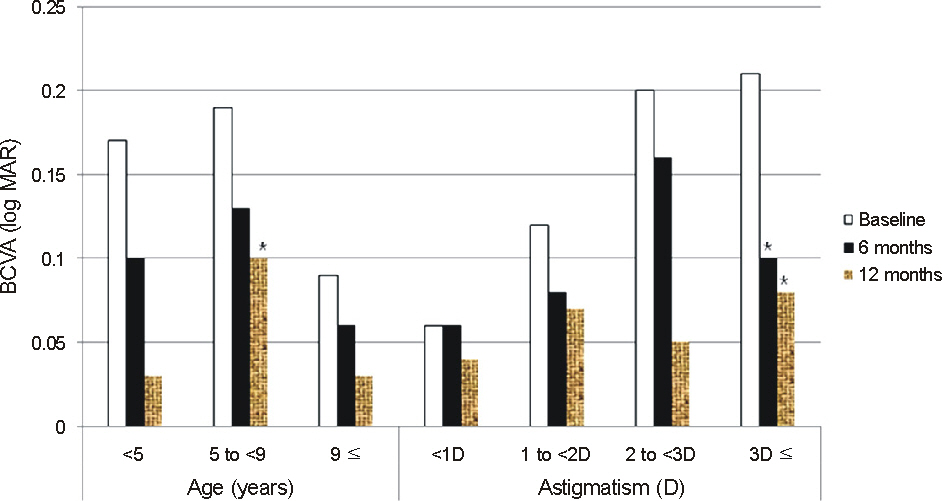
Figure 1. Change of mean BCVA with age and astigmatism. There was a statistically significant improvement in BCVA in the 5 to <9 age group at 12 months postoperative (p = 0.002) and in the 3 D ≤ group at 6 and 12 months postoperative (p = 0.045, p = 0.039, respectively). * p < 0.05; Compared to baseline, Wilcoxon signed rank test.
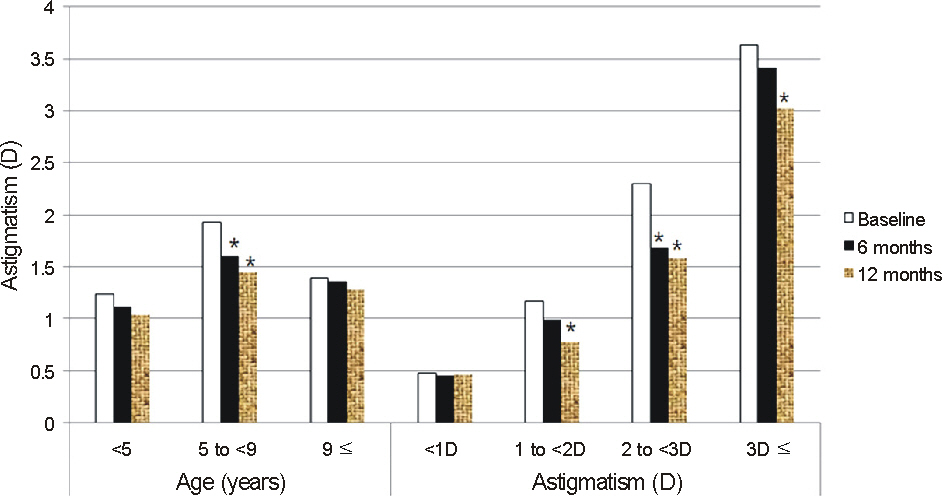
Figure 2. Change of mean astigmatism with age and astigmatism. There was a statistically significant decrease in astigmatism in the 5 to <9 age group at 6 and 12 months postoperative (p = 0.006, p = 0.004, respectively). In the astigmatism group, there was a decrease in 2 to <3 D at 6 and 12 months (p = 0.029, p = 0.034, respectively) and 1 to <2 D (p = 0.006), 3 D ≤ (p = 0.015) * p < 0.05; Compared to group at 12 months postoperative. baseline, Wilcoxon signed rank test.
Cited by 1 articles
-
Relationship between Palpebral Fissure Height and Corneal Astigmatism of Epiblepharon
Jinsoo Kim, Hyo Sung Yoon, Joo Yeon Lee
J Korean Ophthalmol Soc. 2017;58(2):192-196. doi: 10.3341/jkos.2017.58.2.192.
Reference
-
References
1. Levitt JM. Epiblepharon and congenital entropion. Am J Ophthalmol. 1957; 44:112–3.
Article2. Johnson CC. Epiblepharon. Trans Am Ophthalmol Soc. 1968; 66:74–80.
Article3. Noda S, Hayasaka S, Setogawa T. Epiblepharon with inverted eye-lashes in Japanese children. I. Incidence and symptoms. Br J Ophthalmol. 1989; 73:126–7.
Article4. Khwarg SI, Lee YJ. Epiblepharon of the lower eyelid: classification and association with astigmatism. Korean J Ophthalmol. 1997; 11:111–7.
Article5. McCord CD, Tanenbaum M, Nunery W. Oculoplastic Surgery. 3rd ed.New York: RavenPress;1995. p. 221–2.6. Jeoung JW, Kim NJ, Choung HK, Khwarg SI. Changes in astigmatism after surgical repair of epiblepharon or ptosis: A vectorial-ana-lytic approach. J Korean Ophthalmol Soc. 2005; 46:1429–34.7. Kim SY, Moon IA, Kang YK, Yang SW. Clinical evaluation of epiblepharon and congenital entropion. J Korean Ophthalmol Soc. 1999; 40:646–51.8. Lee DP, Kim SD, Hu YJ. Change of visual acuity and astigmatism after operation in epiblepharon children. J Korean Ophthalmol Soc. 2001; 42:223–7.9. Park SW, Sok JY, Park YG. The effect of surgical correction of epiblepharon on astigmatism in children. J Pediatr Ophthalmol Strabismus. 2008; 45:31–5.
Article10. Kim MS, Lee DS, Woo KI, Chang HR. Changes in astigmatism after surgery for epiblepharon in highly astigmatic children: a controlled study. J AAPOS. 2008; 12:597–601.
Article11. Kim NM, Jung JH, Choi HY. The effect of epiblepharon surgery on visual acuity and with-the-rule astigmatism in children. Korean J Ophthalmol. 2010; 24:325–30.
Article12. Shih MH, Huang FC. Astigmatism in children with epiblepharon. Cornea. 2007; 26:1090–4.
Article13. Preechawai P, Amrith S, Wong I, Sundar G. Refractive changes in epiblepharon. Am J Ophthalmol. 2007; 143:835–9.
Article14. Hyun DW, Jeon CY, Jin SY, Ha MS. Visual acuity and astigmatism after simultaneous surgery for upper and lower eyelid epiblepharon in children. J Korean Ophthalmol Soc. 2011; 52:272–6.
Article15. Kim JC, Ahn SK, Byun DS, Moon YS. A study on the characteristics of the astigmatism among the school children. J Korean Ophthalmol Soc. 1990; 31:1587–93.16. Sohn SW, Woo KI, Chang HR. Astigmatism in children with epiblepharon. J Korean Ophthalmol Soc. 2002; 43:1827–32.17. Yang SW, Choi WC, Kim SY. Refractive changes of congenital entropion and epiblepharon on surgical correction. Korean J Ophthalmol. 2001; 15:32–7.
Article18. Baek SH, Heo NH, Lee KS. Corneal topographic changes after surgery in epiblepharon children. J Korean Ophthalmol Soc. 2002; 43:1841–6.
- Full Text Links
-
- Actions
-
Cited
- CITED
-
- Close
- Share
-
- Similar articles
-
- Relationship between Palpebral Fissure Height and Corneal Astigmatism of Epiblepharon
- Comparing Changes in Corneal Astigmatism Using Scheimpflug Camera after Epiblepharon Correction Surgery
- Change of Visual Acuity and Astigmatism after Operation in Epiblepharon Children
- Astigmatism in Children with Epiblepharon
- Corneal Topographic Changes after Surgery in Epiblepharon Children