
Treatment of Mallet Finger Fracture by Extension Block K-wire Fixation
- Affiliations
-
- 1Department of Orthopedic Surgery, Inje University Ilsan Paik Hospital, Goyang, Korea. ostone01@ilsanpaik.ac.kr
- KMID: 2186447
- DOI: http://doi.org/10.4055/jkoa.2008.43.3.316
Abstract
-
PURPOSE: The purpose of this study was to evaluate the outcomes of the extension block fixation technique for a bony mallet finger.
MATERIALS AND METHODS
Thirty-five patients that received extension block fixation for bony mallet finger were enrolled in this study between July 2001 and October 2005. The fracture type was classified by the Wehbe and Schneider method. The average follow up period was 15 months, ranging between 12-52 months. The results were classified by the Crawford criteria.
RESULTS
There was 30 cases of type I, 5 cases of type II and no cases of type III, with 11 cases of subtype A, 22 cases of subtype B, and 2 cases of subtype C. The average time from injury to operation was 12 days, which included three cases of over 28 days. The K-wire was removed 30 days after the operation, and joint exercises were initiated immediately. There were 10 cases with excellent outcomes, 18 cases with good outcomes, 4 cases with fair outcomes, and 3 cases with poor outcomes. The poor outcome had complications such as subluxation of the DIP joint, lag between injury to operation time (more than 4 weeks), and more than 1 mm displacement.
CONCLUSION
The extension block technique for the treatment of bony mallet finger is relatively simple and results in satisfactory bone union.
MeSH Terms
Figure
-

Fig. 1 Operative method. The distal IP joint is held in flexion and a K-wire is passed through the extensor tendon 1-2 mm dorsal to the fragment (A). The DIP joint is extended and the fragment is reduced carefully (B). The second K-wire is inserted to the DIP joint (C).
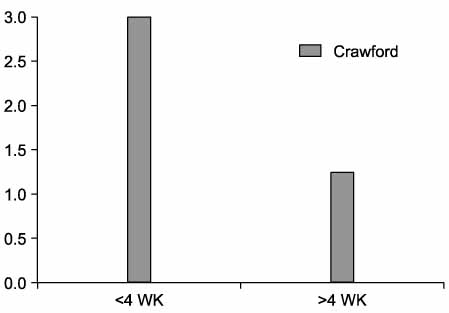
Fig. 2 Time to operation results.

Fig. 3 A 46 years old male patient had an injury on his left ring finger 29 days previously. Preoperative radiograph showed 30 percent of joint involvement without joint subluxation (A). Monocortical extension block K-wire fixation is performed (B). Three months after the operation, the fracture was united but the joint was incongruent (C).
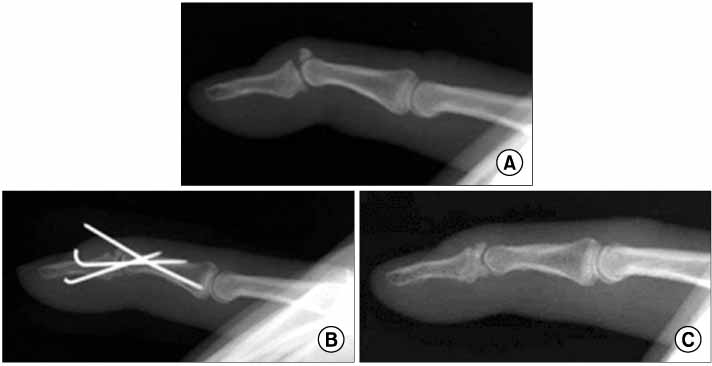
Fig. 4 A 15 years old male patient had an injury on the left middle finger 4 days previously. The preoperative radiograph showed 30 percent of joint involvement without joint subluxation (A). Bicortical extension block K-wire fixation is performed (B). 3 months after the operation, the fractured bone had fused well (C).
Cited by 2 articles
-
Prognostic Factors of the Extension Block Technique for the Bony Mallet Finger
Soo-Bong Hahn, Kwang-Hwan Park, Yun-Rak Choi, Ho-Jung Kang, Jung-Kil Lee
J Korean Orthop Assoc. 2010;45(2):127-132. doi: 10.4055/jkoa.2010.45.2.127.Extension block pinning combined with traction using towel clamps for effective reduction of mallet fracture: a technical tip
Il Seo, Kang-San Lee, Seungho Chung, Sang-Woo Son, Hyun-Joo Lee
Arch Hand Microsurg. 2023;28(2):93-96. doi: 10.12790/ahm.23.0009.
Reference
-
1. Abouna JM, Brown H. The treatment of mallet finger. Br J Surg. 1968. 55:653–657.2. Auchincloss JM. Mallet-finger injuries: a prospective, controlled trial of internal and external splintage. Hand. 1982. 14:168–173.
Article3. Bischoff R, Buechler U, De Roche R, Jupiter J. Clinical results of tension band fixation of avulsion fractures of the hand. J Hand Surg Am. 1994. 19:1019–1026.
Article4. Crawford GP. The molded polythene splint for mallet finger deformities. J Hand Surg Am. 1984. 9:231–237.
Article5. Damron TA, Engber WD. Surgical treatment of mallet finger fractures by tension band technique. Clin Orthop Relat Res. 1994. 300:133–140.
Article6. Darder-Prats A, Fernández-Garcia E, Fernández-Garbada R, Darder-Garcia A. Treatment of mallet finger fractures by the extension-block K-wire technique. J Hand Surg Br. 1998. 23:802–805.
Article7. Garbermann SF, Diao E, Peimer CA. Mallet finger: results of early versus delayed closed treatment. J Hand Surg Am. 1994. 19:850–852.8. Green DP, Rowland SA. Fractures. 1975. 1st ed. Philadelphia: Lippincott-Raven;273–275.9. Hillman FE. New technique for treatment of mallet fingers and fractures of distal phalanx. J Am Med Assoc. 1956. 161:1135–1138.
Article10. Hofmeister EP, Mazurek MT, Shin AY, Bishop AT. Extension block pinning for large mallet fractures. J Hand Surg Am. 2003. 28:453–459.
Article11. Inoue G. Closed reduction of mallet fractures using extension-block Kirschner wire. J Orthop Trauma. 1992. 6:413–415.
Article12. Ishiguro T, Inoue K, Matsubayashi N, Ito Y, Hashizume N. A new method of closed reduction for mallet fractures. Cent Jpn Orthop Traumatol. 1988. 31:2049–2051.13. Ishiguro T, Itoh Y, Yabe Y, Hashizume N. Extension block with Kirschner wire for fracture dislocation of the distal interphalangeal joint. Tech Hand Up Extrem Surg. 1997. 1:95–102.
Article14. Kang HJ, Lee WS, Hahn SB, Kang ES. Complications of bony mallet finger after operative treatement. J Korean Soc Surg Hand. 1998. 3:10–17.15. Kim PT, Lee YS, Kim JH, Kim ID. Treatment of mallet finger. J Korean Soc Surg Hand. 1996. 1:110–116.16. Niechajev IA. Conservative and operative treatment of mallet finger. Plast Reconstr Surg. 1973. 16:366–375.
Article17. Robb WA. The results of treatment of mallet finger. J Bone Joint Surg Br. 1959. 41:546–549.
Article18. Robert SH, Eugene DH, Guy PP. Treatment of mallet finger due to intra-articular fracture of the distal phalanx. J Hand Surg. 1987. 3:167–174.19. Stack HG. Mallet finger. Lancet. 1968. 2:1303.
Article20. Stark HH, Gainor BJ, Ashworth CR, Zemel NP, Rickard TA. Operative treatment of intra-articular fractures of the dorsal aspect of the distal phalanx of digits. J Bone Joint Surg Am. 1987. 69:892–896.
Article21. Stern PJ, Kastrup JJ. Complications and prognosis of treatment of mallet finger. J Hand Surg Am. 1998. 3:329–334.
Article22. Tetik C, Gudemez E. Modification of the extension block Kirschner wire technique for mallet fractures. Clin Orthop Relat Res. 2002. 404:284–290.
Article23. Damron TA, Engber WD, Lange RH, et al. Biomechanical analysis of mallet finger fractures fixation techniques. J Hand Surg Am. 1993. 18:600–608.24. Wehbé MA, Schneider LH. Mallet fractures. J Bone Joint Surg Am. 1984. 66:658–669.
Article
- Full Text Links
-
- Actions
-
Cited
- CITED
-
- Close
- Share
-
- Similar articles
-
- Osteoarthritis after Extension Block Technique for the Bony Mallet Finger
- Treatment of Bony Mallet Finger: Closed Reduction Using Extension Block K-wire
- Modified Extension Block Technique Using Conjoined Kirschner Wires for Bony Mallet Fingers
- Closed Reduction of Mallet Fractures using Extension Black Kirshner Wire
- Evaluation of Fragment Reduction Feasibility When Treating Bony Mallet Finger Using Extension Block K-Wire Technique


