Limb Salvage with Low and Heat Treated Autobone
- Affiliations
-
- 1Department of Orthopaedic Surgery, Yonsei University College of Medicine, Korea. qshin@yumc.yonsei.ac.kr
- KMID: 2184741
- DOI: http://doi.org/10.5124/jkma.2006.49.12.1110
Abstract
- Limb salvage surgery for treatment of malignant bone tumors is an acceptable alternative to amputation in most patients as marked improvement has been achieved in diagnostic imaging, neoadjuvant chemotherapy, and operative techniques. There are several options for limb salvage: endoprosthesis, allograft, treated autobone, etc and each has its own advantages and disadvantages. Prosthetic replacement is an option for limb salvage surgery, but loosening, breakage, and wear are encountered during long-term follow up. Allografts require a large scale bone bank system, and there are concerns of immunologic responses, transmission of disease, religious and social circumstance, and high complication rate. Low heat treated autobone graft are reasonable option of treated autobone. Multiple studies and clinical application of heat treated bone proved the superiority of low heat treated bone(pasteurization, heating at 60 degrees ... to 65 degrees ... for 30 minutes) over other methods of heat treatment such as autoclaving or boiling. Low heat treatment has a lethal effect on malignant cells while preserving sufficient biomechanical strength and bone inducing property. Low heat treatment showed satisfactory results of bone remodeling and union, function, complication (fracture, infection and bone resorption). Several studies suggest that low heat treatment(pasteurization) may be superior to other cell-lethal treatment for autologous bone graft used for limb salvage surgery.
MeSH Terms
Figure
-
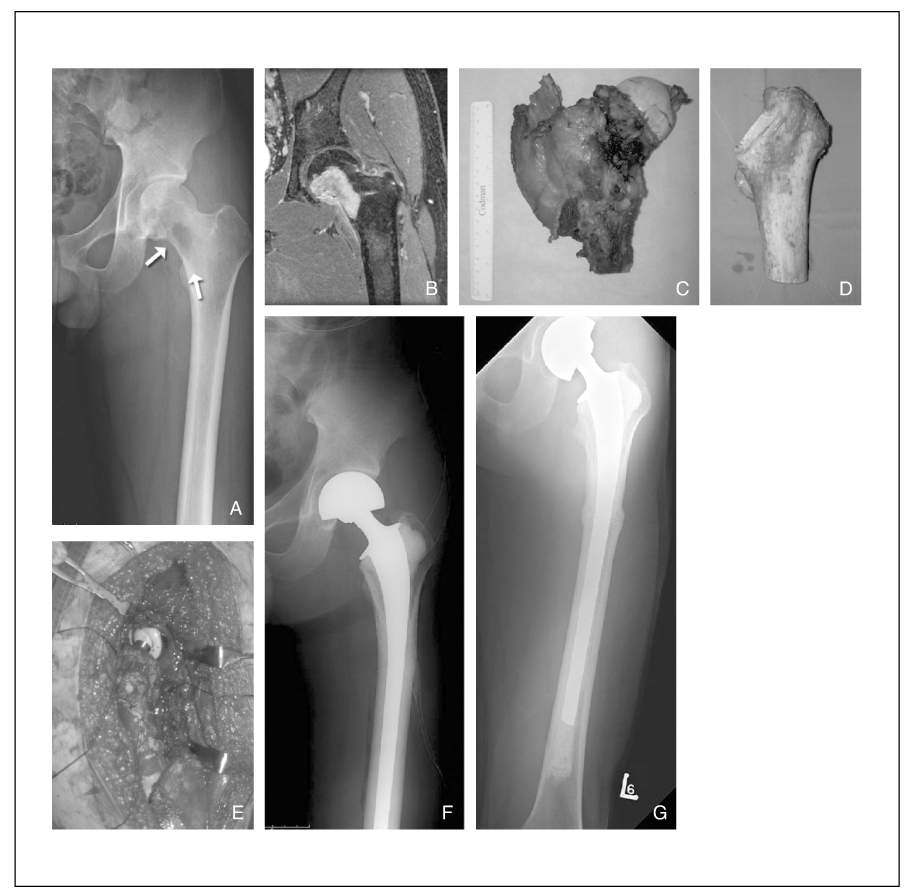
Figure 1 A case of limb salvage surgery using low-heat treated autobone (A) 21years male patient visited our hospital for right hip pain (B/1,2) Right hip MRI, enhanced mass was noted on femur neck area osteosarcoma was diagnosed by incisional biopsy (C) Wide excision including incisional biopsy site (D) After removal of Femoral head & soft tissue, bone was treated by 65° saline for 30 minutes (E) Fixation using long stem of hemiarthroplasty & soft tisssue reconstruction using Bard mesh (F) Postoperative plain reontgenogram (G) On postoperative 2.2 years, complete union of graft bone is noted. Patient's functional score is 80% of MSTS score
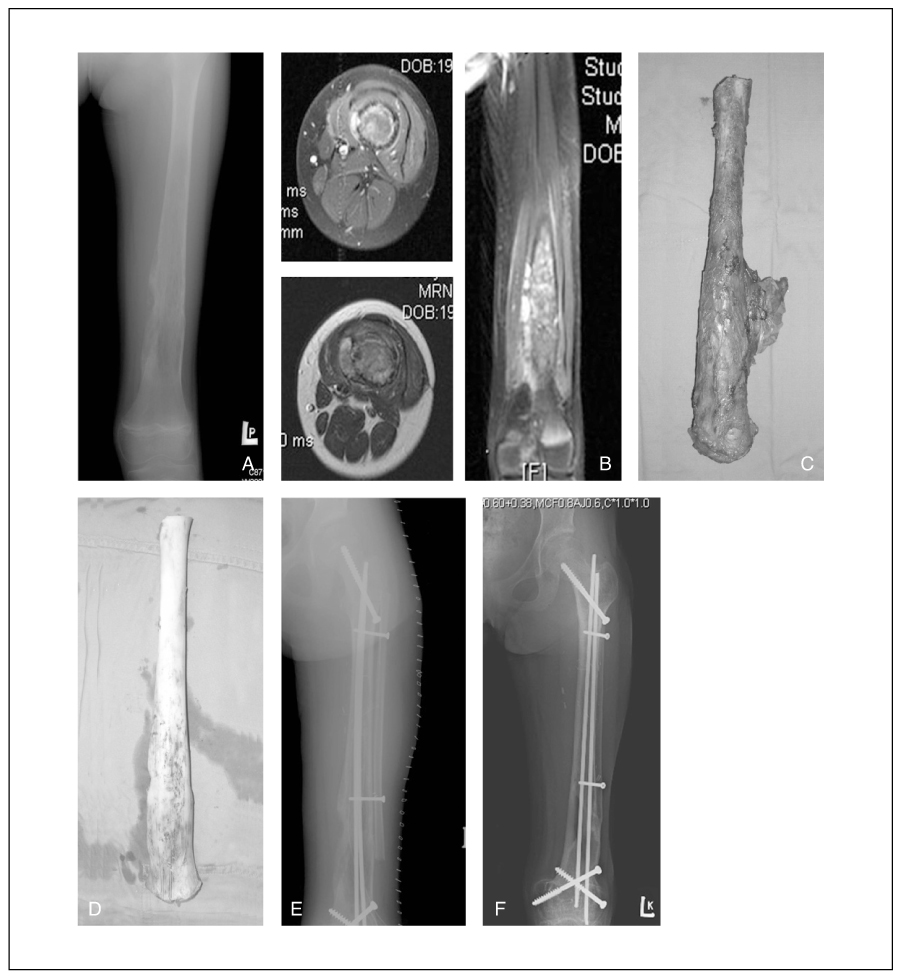
Figure 2 A case of limb salvage surgery using low-heat treated autobone & vascularized fibular graft (A, B) 14years female patients with osteosarcoma (C) Wide excision including incisional biopsy site (D) After removal of Femoral head & soft tissue, bone was treated by 65° saline for 30 minutes (E) Reconstruction with low heat treated autobone & vascularized fibular graft (F) After 1.8 years, graft bone was incorperated completely
Reference
-
1. Cortes EP, Holland JF, Wang JJ, Sinks JF, Blom J, Glidewell O, et al. Doxorubicin in disseminated osteosarcoma. JAMA. 1972. 221:1132–1138.
Article2. Jaffe N, Paed D, Farber S, Traggis D, Geisse C, Cassady JR, et al. Favorable response of metastatic osteogenic sarcoma to pulse high-dose methotrexate with citrovorum rescue and radiation therapy. Cancer. 1973. 31:1367–1373.
Article3. Harrington KD, Johnston JO, Kaufer HN, Luck JV Jr, Moore TM. Limb salvage and prosthetic joint reconstruction for low-grade and selected high-grade sarcomas of bone after wide resection and replacement by autoclaved autogeneic grafts. Clin Orthop Relat Res. 1986. 211:180–214.4. Miller MD. Review of orthopaedics. 4th ed. Philadelphia: WB Saunders;15–22.5. Thompson VP, Steggal CT. Chondrosarcoma of the proximal portion of the femur treated by resection and bone replacement. J Bone Joint Surg. 1956. 38A:357–367.
Article6. Kohler P, Kreichergs A, Stromberg L. Physical properties of autoclaved bone. Acta Orthop Scand. 1986. 57:141–145.7. Ohura K. Osteoconduction of heated bone graft. J Jpn Orthop Addoc. 1990. S1141:64–68.8. Böhm P, Stihler J. Intraosseous temperature during autoclaving. J Bone Joint Surg. 1995. 77B:649–653.9. Liebergall M, Simkin A, Mendelson S, Rosenthal A, Amir G, Segal D. Effect of moderate bone hyperthermia on cell viability and mechanical function. Clin Orthop Relat Res. 1998. 349:242–248.
Article10. Ham SJ, Schraffordt Koops H, Veth RP, Van Horn JR, Molenaar WM, Hoekstra HJ. Limb salvage surgery for primary bone sarcoma of the lower extremities: Long-term consequences of endoprosthetic reconstructions. Ann Surg Oncol. 1998. 5:423–436.
Article11. Kwon SK, Oh KS, Shin KH, Hahn SB. Limb salvage with low heat treated autobone in malignant bone and soft tissue tumor. J Korean Mus. Transplantation Society. 2004. 4:53–62.12. Manabe J, Ashmed AR, Kawaguchi N, Matsumoto S, Kuroda H. Pasteurized autologous bone graft in surgery for bone and soft tissue sarcoma. Clin Orthop. 2004. 419:258–266.
Article13. Sugiura H, Yamamura S, Sato K, Katagiri H, Nishida Y, Yamada Y, et al. Remodelling and healing process of moderately heat treaed bone grafts after wide resection of bone and soft tissue tumors. Arch Orthop Trauma Surg. 2003. 123:514–520.
Article14. Kattapuram SV, Phillips WC, Mankin HJ. Intercalary bone allografts: radiographic evaluation. Radiology. 1989. 170:137–141.
Article15. Ehara S, Nishida J, Shiraishi H, Tamakwa Y. Pasteurized intercalary autogenous bone graft: radiographic and scintigraphic featrues. Skeletal Radiol. 2000. 29:335–339.
Article16. Kattapuram SV, Rosol MS, Rosenthal DI, Palmer WE, Mankin HJ. Magnetic resonance imaging features of allografts. Skeletal Radiol. 1999. 28:383–389.
Article17. Jeon DG, Lee JS, Kim SJ, Cho WH, Kwang BJ, Lee SY. Autogenous low heat treated bone graft for bone reconstruction in bone and soft tissue tumors. J of Korean Bone & Joint Tumor Soc. 1998. 4:81–87.18. Ehara S, Nishida J, Shiraishi H, Tamakawa Y. Pasteurized intercalary autogenous bone graft: radiograpic and scintigraphic fratures. Skeletal radiol. 2000. 29:335–339.
Article19. Enneking WF, Dunham W, Gebhardt MC, Malawar M, Pritchard DJ. A system for the functional evaluation of reconstructive procedures after surgical treatment of tumors of the musculoskeletal system. Clin Orthop. 1993. 286:241–246.
Article
- Full Text Links
-
- Actions
-
Cited
- CITED
-
- Close
- Share
-
- Similar articles
-
- Reconstructive surgery in primary malignant and aggressive benign bone tumor of the proximal humerus
- Low-heat Treated Intercalary Autograft Reconstruction in Limb Salvage of Primary Malignant Bone Tumor
- Non Blood Transfusion Limb Salvage Operation in the Distal Femur Osteosarcoma Patient: A Case Report
- Experimental study for tendon to bone fixation with clinical relevance in limb salvage operation
- A case of limb salvage by obturator foramen bypass with goretex graft