
Hip Pelvis.
2014 Sep;26(3):129-135. 10.5371/hp.2014.26.3.129.
Medical Treatment of Ankylosing Spondylitis
- Affiliations
-
- 1Department of Orthopedic Surgery, Inha University School of Medicine, Incheon, Korea. moon@inha.ac.kr
- KMID: 2054175
- DOI: http://doi.org/10.5371/hp.2014.26.3.129
Abstract
- The diagnosis of ankylosing spondylitis is often delayed due to ambiguous clinical manifestations and strict diagnostic criteria. However, imaging techniques such as magnetic resonance imaging have been found effective for the early diagnosis of non-radiographic sacroiliitis. New tumor necrosis factor alpha (TNF-alpha) inhibitors have good efficacy for patients with persistently high disease activity despite conventional nonsteroidal anti-inflammatory drug treatment. Thus, early diagnosis and aggressive treatments are essential for ankylosing spondylitis patients. Because many patients complain of musculoskeletal pains, especially around the sacroiliac joint area, hip specialists should be informed of up-to-date knowledge. In this review, we discuss new diagnostic criteria for ankylosing spondylitis, administration methods of TNF-alpha inhibitors, and the long-term follow-up results for patients treated with TNF-alpha inhibitors.
MeSH Terms
Figure
-
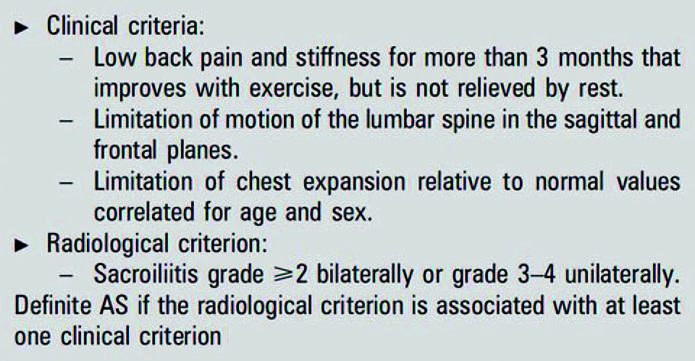
Fig. 1 Modified New York criteria for ankylosing spondylitis (AS).
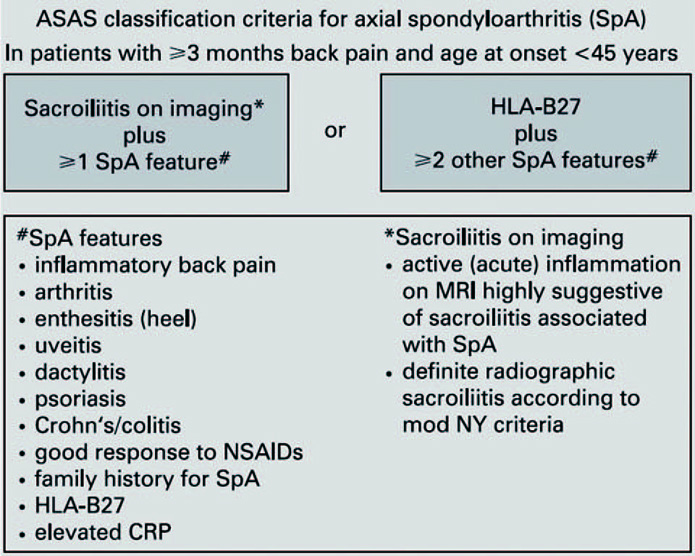
Fig. 2 ASAS classification criteria for axial spondyloarthritis. ASAS: ASsessment of Ankylosing Spondylitis, NSAIDs: nonsteroidal anti-inflammatory drugs, HLA-B27: human leukocyte antigen B-27, CRP: C-reactive protein, mod NY criteria: modified New Yoirk criteria.
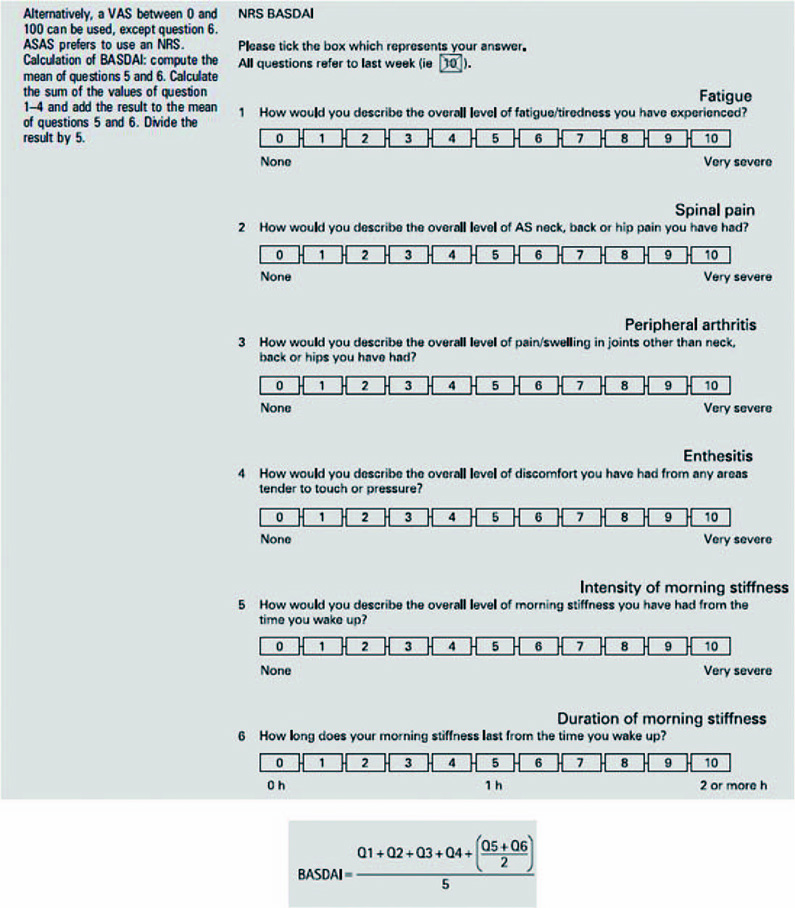
Fig. 3 Numerical rating scale of Bath Ankylosing Spondylitis Disease Activity Index (BASDAI). VAS: visual analogue scale, ASAS: ASsessment of Ankylosing Spondylitis, NRS: numeric rating scale, AS: ankylosing spondylitis.
Reference
-
1. van Royen BJ, Dijkmans BAC. Ankylosing spondylitis: diagnosis and management. New York: Taylor & Francis;2006.2. Zochling J, Maxwell L, Beardmore J, Boonen A. TNF-alpha inhibitors for ankylosing spondylitis. Cochrane Database Systemic Rev. 2005; 3:CD005468.
Article3. Khan MA. Update on spondyloarthropathies. Ann Intern Med. 2002; 136:896–907.
Article4. Zochling J, van der Heijde D, Burgos-Vargas R, et al. ASAS/EULAR recommendations for the management of ankylosing spondylitis. 'ASsessment in AS' international working group; European League Against Rheumatism. Ann Rheum Dis. 2006; 65:442–452.5. Braun J, de Keyser F, Brandt J, Mielants H, Sieper J, Veys E. New treatment options in spondyloarthropathies: increasing evidence for significant efficacy of anti-tumor necrosis factor therapy. Curr Opin Rheumatol. 2001; 13:245–249.
Article6. Braun J, van den Berg R, Baraliakos X, et al. 2010 update of the ASAS/EULAR recommendations for the management of ankylosing spondylitis. Ann Rheum Dis. 2011; 70:896–904.7. Sieper J, Braun J, Rudwaleit M, Boonen A, Zink A. Ankylosing spondylitis: an overview. Ann Rheum Dis. 2002; 61:Suppl 3. iii8–iii18.
Article8. Rudwaleit M, Metter A, Listing J, Sieper J, Braun J. Inflammatory back pain in ankylosing spondylitis: a reassessment of the clinical history for application as classification and diagnostic criteria. Arthritis Rheum. 2006; 54:569–578.
Article9. Bennett AN, McGonagle D, O'Connor P, et al. Severity of baseline magnetic resonance imaging-evident sacroiliitis and HLA-B27 status in early inflammatory back pain predict radiographically evident ankylosing spondylitis at eight years. Arthritis Rheum. 2008; 58:3413–3418.
Article10. Haibel H, Rudwaleit M, Listing J, et al. Efficacy of adalimumab in the treatment of axial spondylarthritis without radiographically defined sacroiliitis: results of a twelve-week randomized, double-blind, placebo-controlled trial followed by an open-label extension up to week fifty-two. Arthritis Rheum. 2008; 58:1981–1991.
Article11. Barkham N, Keen HI, Coates LC, et al. Clinical and imaging efficacy of infliximab in HLA-B27-Positive patients with magnetic resonance imaging-determined early sacroiliitis. Arthritis Rheum. 2009; 60:946–954.
Article12. Evans DM, Spencer CC, Pointon JJ, et al. Interaction between ERAP1 and HLA-B27 in ankylosing spondylitis implicates peptide handling in the mechanism for HLA-B27 in disease susceptibility. Nat Genet. 2011; 43:761–767.13. Wanders A, Heijde Dv, Landewe´ R, et al. Nonsteroidal antiinflammatory drugs reduce radiographic progression in patients with ankylosing spondylitis: a randomized clinical trial. Arthritis Rheum. 2005; 52:1756–1765.
Article14. El Miedany Y, Youssef S, Ahmed I, El Gaafary M. The gastrointestinal safety and effect on disease activity of etoricoxib, a selective cox-2 inhibitor in inflammatory bowel diseases. Am J Gastroenterol. 2006; 101:311–317.
Article15. Braun J, Bollow M, Neure L, et al. Use of immunohistologic and in situ hybridization techniques in the examination of sacroiliac joint biopsy specimens from patients with ankylosing spondylitis. Arthritis Rheum. 1995; 38:499–505.
Article16. Baraliakos X, Listing J, Fritz C, et al. Persistent clinical efficacy and safety of infliximab in ankylosing spondylitis after 8 years--early clinical response predicts long-term outcome. Rheumatology (Oxford). 2011; 50:1690–1699.
Article17. Martĺn-Mola E, Sieper J, Leirisalo-Repo M, et al. Sustained efficacy and safety, including patient-reported outcomes, with etanercept treatment over 5 years in patients with ankylosing spondylitis. Clin Exp Rheumatol. 2010; 28:238–245.18. Baraliakos X, Haibel H, Fritz C, et al. Long-term outcome of patients with active ankylosing spondylitis with etanercept-sustained efficacy and safety after seven years. Arthritis Res Ther. 2013; 15:R67.
Article19. Sieper J, van der Heijde D, Dougados M, Brown LS, Lavie F, Pangan AL. Early response to adalimumab predicts long-term remission through 5 years of treatment in patients with ankylosing spondylitis. Ann Rheum Dis. 2012; 71:700–706.
Article20. Khalessi AA, Oh BC, Wang MY. Medical management of ankylosing spondylitis. Neurosurg Focus. 2008; 24:E4.
Article21. Bruner V, Atteno M, Spano´ A, Scarpa R, Peluso R. Biological therapies for spondyloarthritis. Ther Adv Musculoskelet Dis. 2014; 6:92–101.
Article22. Adams K, Bombardier C, van der Heijde D. Safety and efficacy of on-demand versus continuous use of nonsteroidal antiinflammatory drugs in patients with inflammatory arthritis: a systematic literature review. J Rheumatol Suppl. 2012; 90:56–58.
Article23. Baraliakos X, Listing J, Brandt J, et al. Clinical response to discontinuation of anti-TNF therapy in patients with ankylosing spondylitis after 3 years of continuous treatment with infliximab. Arthritis Res Ther. 2005; 7:R439–R444.
- Full Text Links
-
- Actions
-
Cited
- CITED
-
- Close
- Share
-
- Similar articles
-
- Ankylosing Spondylitis: Prevention And Surgical Correction Of Deformity
- Treatment of Cervical Cord Injury with Ankylosing Spondylitis: Case Report
- Orthopaedic Management of Ankylosing Spondylitis
- Treatment of Cervical Cord Injury in Ankylosing Spondylitis
- Clinieal Values of Single Photon Emission Computed Tomography ( SPECT ) in Ankylosing Spondylitis


