
Anatomic Reduction of Mallet Fractures Using Extension Block and Additional Intrafocal Pinning Techniques
- Affiliations
-
- 1Department of Orthopaedic Surgery, Kyung Hee University School of Medicine, Seoul, Korea. ljhos69@naver.com
- KMID: 1245401
- DOI: http://doi.org/10.4055/cios.2012.4.1.72
Abstract
- BACKGROUND
The purpose of this article is to report the efficacy of the extension block pinning and additional intrafocal pinning technique applied to cases whose mallet fractures were not reduced with extension block pinning alone.
METHODS
We retrospectively reviewed 14 digits with 14 patients who were treated with the extension block pinning and additional intrafocal pinning technique. There were eight men and six women with an average age of 34 years. The average articular surface involvement was 52%. The average follow-up was 16 months and the mean time from injury to operation was 23 days.
RESULTS
All the cases achieved anatomic reduction of fractures. By Crawford's classification, 9 were excellent and 5 were good. The average active flexion of the distal interphalangeal joint was 78 degrees and the average extension loss was 1.8 degrees. Bone union was observed in all cases after a postoperative mean of 38.4 days. Complications such as skin necrosis, fracture of bony fragments, and nail-plate deformity were not found.
CONCLUSIONS
Additional intrafocal pinning technique is considered a simple and useful method to obtain anatomic reduction of mallet fractures in cases where extension block pinning alone is insufficient to restore the anatomic configuration of the articular surface.
MeSH Terms
Figure
-
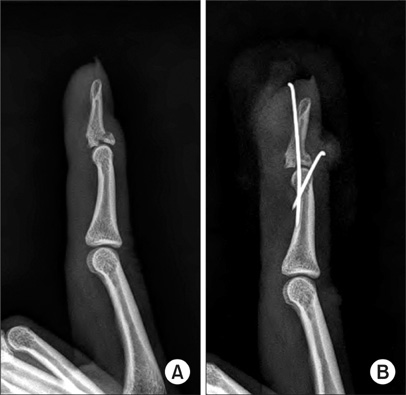
Fig. 1 A 19-year-old woman presenting with a mallet fracture in the right third finger. (A) A preoperative lateral radiographic finding. (B) An extension block pinning shows incongruent reduction of the distal interphalangeal joint.
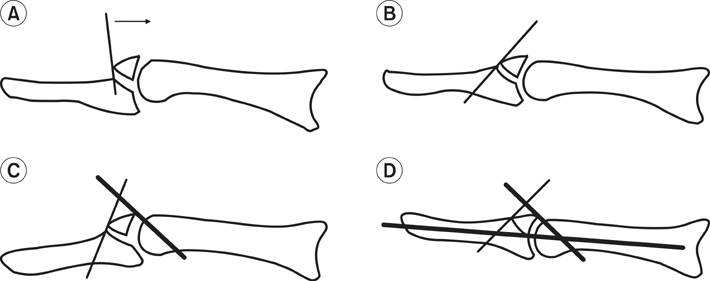
Fig. 2 Illustrations for surgical procedures. (A) Under C-arm image intensifier control, a 0.7 mm K-wire was inserted into the fracture site dorsally. (B) K-wire was tilted proximally and was then advanced through the palmar cortical bone. (C) With 30° flexion of the distal interphalangeal joint, a 0.9 mm extension block K-wire was inserted. (D) A 0.9 mm K-wire was inserted to fix the distal interphalangeal joint while the distal phalanx was extended to reduce the fracture fragment.
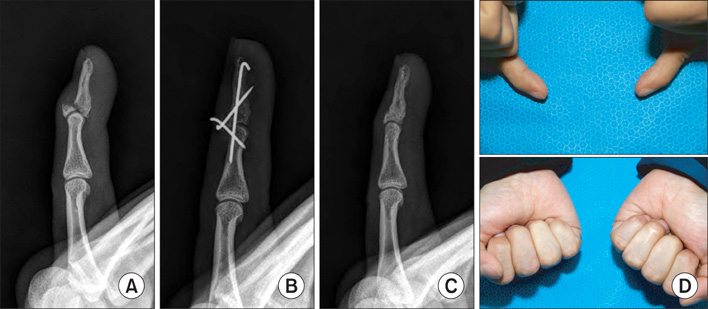
Fig. 3 A 27-year-old man with a 3-week injury of the left fifth finger. (A) A preoperative lateral radiographic finding demonstrates a displaced mallet fracture and a palmar subluxation of the distal interphalangeal joint in the left fifth finger. (B) A postoperative radiograph demonstrates anatomic reduction. (C) A lateral radiograph taken four months after pin removal demonstrates complete bony union. (D) Full active flexion and extension of the injured distal interphalangeal joint in the left fifth digit were regained at the last follow-up.
Cited by 3 articles
-
Reduction Loss after Extension Block Kirschner Wire Fixation for Treatment of Bony Mallet Finger
Byungsung Kim, Jae-Hwi Nho, Ki Jin Jung, Keonhee Yun, Eunseok Park, Sungyong Park
Arch Hand Microsurg. 2018;23(4):239-247. doi: 10.12790/ahm.2018.23.4.239.Anatomical Direct Reduction of Bony Mallet Finger Using Modified-Intrafocal Pinning Technique
Sang-Woo Kang, Ji-Kang Park, Ho-Seung Jung, Jung-Kwon Cha, Kook-Jong Kim
Arch Hand Microsurg. 2018;23(4):248-253. doi: 10.12790/ahm.2018.23.4.248.Extension block pinning combined with traction using towel clamps for effective reduction of mallet fracture: a technical tip
Il Seo, Kang-San Lee, Seungho Chung, Sang-Woo Son, Hyun-Joo Lee
Arch Hand Microsurg. 2023;28(2):93-96. doi: 10.12790/ahm.23.0009.
Reference
-
1. Wehbe MA, Schneider LH. Mallet fractures. J Bone Joint Surg Am. 1984. 66(5):658–669.
Article2. Damron TA, Engber WD. Surgical treatment of mallet finger fractures by tension band technique. Clin Orthop Relat Res. 1994. (300):133–140.
Article3. Jupiter JB, Sheppard JE. Tension wire fixation of avulsion fractures in the hand. Clin Orthop Relat Res. 1987. (214):113–120.
Article4. Stark HH, Gainor BJ, Ashworth CR, Zemel NP, Rickard TA. Operative treatment of intra-articular fractures of the dorsal aspect of the distal phalanx of digits. J Bone Joint Surg Am. 1987. 69(6):892–896.
Article5. Auchincloss JM. Mallet-finger injuries: a prospective, controlled trial of internal and external splintage. Hand. 1982. 14(2):168–173.
Article6. Bischoff R, Buechler U, De Roche R, Jupiter J. Clinical results of tension band fixation of avulsion fractures of the hand. J Hand Surg Am. 1994. 19(6):1019–1026.
Article7. Darder-Prats A, Fernandez-Garcia E, Fernandez-Gabarda R, Darder-Garcia A. Treatment of mallet finger fractures by the extension-block K-wire technique. J Hand Surg Br. 1998. 23(6):802–805.
Article8. Ishiguro T, Itoh Y, Yabe Y, Hashizume N. Extension block with Kirschner wire for fracture dislocation of the distal interphalangeal joint. Tech Hand Up Extrem Surg. 1997. 1(2):95–102.
Article9. Hofmeister EP, Mazurek MT, Shin AY, Bishop AT. Extension block pinning for large mallet fractures. J Hand Surg Am. 2003. 28(3):453–459.
Article10. Inoue G. Closed reduction of mallet fractures using extension-block Kirschner wire. J Orthop Trauma. 1992. 6(4):413–415.
Article11. Yamanaka K, Sasaki T. Treatment of mallet fractures using compression fixation pins. J Hand Surg Br. 1999. 24(3):358–360.
Article12. Kronlage SC, Faust D. Open reduction and screw fixation of mallet fractures. J Hand Surg Br. 2004. 29(2):135–138.
Article13. Crawford GP. The molded polythene splint for mallet finger deformities. J Hand Surg Am. 1984. 9(2):231–237.
Article14. Tetik C, Gudemez E. Modification of the extension block Kirschner wire technique for mallet fractures. Clin Orthop Relat Res. 2002. (404):284–290.
Article15. Lee YH, Kim JY, Chung MS, Baek GH, Gong HS, Lee SK. Two extension block Kirschner wire technique for mallet finger fractures. J Bone Joint Surg Br. 2009. 91(11):1478–1481.
Article
- Full Text Links
-
- Actions
-
Cited
- CITED
-
- Close
- Share
-
- Similar articles
-
- Anatomical Direct Reduction of Bony Mallet Finger Using Modified-Intrafocal Pinning Technique
- Closed Reduction of Mallet Fractures using Extension Black Kirshner Wire
- Extension block pinning combined with traction using towel clamps for effective reduction of mallet fracture: a technical tip
- Evaluation of Fragment Reduction Feasibility When Treating Bony Mallet Finger Using Extension Block K-Wire Technique
- Treatment of Bony Mallet Finger: Closed Reduction Using Extension Block K-wire


