
Meta-analysis and trial sequential analysis of pancreatic stump closure using a hand-sewn or stapler technique in distal pancreatectomy

- Affiliations
-
- 1Department of Hepatobiliary and Pancreatic Surgery, University Hospital Coventry & Warwickshire, Coventry, UK
- 2Department of Hepatobiliary and Pancreatic Surgery, University Hospital of Wales, Cardiff, UK
- 3Department of General Surgery, Faculty of Medicine, Tanta University, Tanta, Egypt
- KMID: 2558660
- DOI: http://doi.org/10.14701/ahbps.24-015
Abstract
- This study aimed to compare outcomes of hand-sewn and stapler closure techniques of pancreatic stump in patients undergoing distal pancreatectomy (DP). Impact of stapler closure reinforcement using mesh on outcomes was also evaluated. Literature search was carried out using multiple data sources to identify studies that compared hand-sewn and stapler closure techniques in management of pancreatic stump following DP. Odds ratio (OR) was determined for clinically relevant postoperative pancreatic fistula (POPF) via random-effects modelling. Subsequently, trial sequential analysis was performed. Thirty-two studies with a total of 4,022 patients undergoing DP with hand-sewn (n = 1,184) or stapler (n = 2,838) closure technique of pancreatic stump were analyzed. Hand-sewn closure significantly increased the risk of clinically relevant POPF compared to stapler closure (OR: 1.56, p = 0.02). When stapler closure was considered, staple line reinforcement significantly reduced formation of such POPF (OR: 0.54, p = 0.002). When only randomized controlled trials were considered, there was no significant difference in clinically relevant POPF between hand-sewn and stapler closure techniques (OR: 1.20, p = 0.64) or between reinforced and standard stapler closure techniques (OR: 0.50, p = 0.08). When observational studies were considered, hand-sewn closure was associated with a significantly higher rate of clinically relevant POPF compared to stapler closure (OR: 1.59, p = 0.03). Moreover, when stapler closure was considered, staple line reinforcement significantly reduced formation of such POPF (OR: 0.55, p = 0.02). Trial sequential analysis detected risk of type 2 error. In conclusion, reinforced stapler closure in DP may reduce risk of clinically relevant POPF compared to hand-sewn closure or stapler closure without reinforcement. Future randomized research is needed to provide stronger evidence.
Figure
-
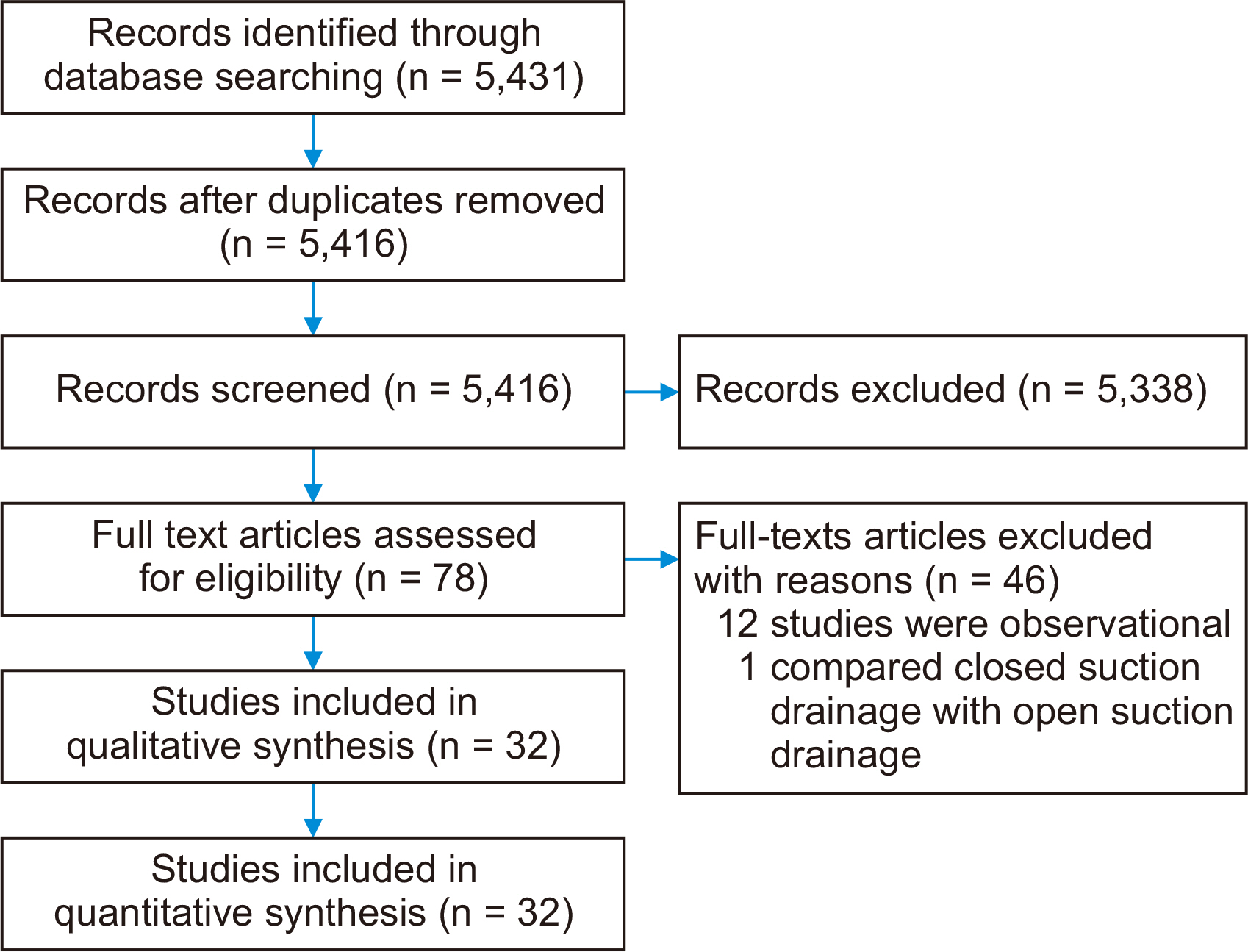
Fig. 1 Study flow diagram.

Fig. 2 Risk of bias summary and graph showing authors’ judgments about each risk of bias item for (A) randomized controlled trials, and (B) observational studies.

Fig. 3 Forest plots of comparison of hand-sewn versus stapler pancreatic stump on clinically relevant postoperative pancreatic fistula. Solid squares denote odds ratio. Horizontal lines represent 95% CIs. Diamond denotes pooled effect size. M-H, Mantel Haenszel test; CI, confidence interval.
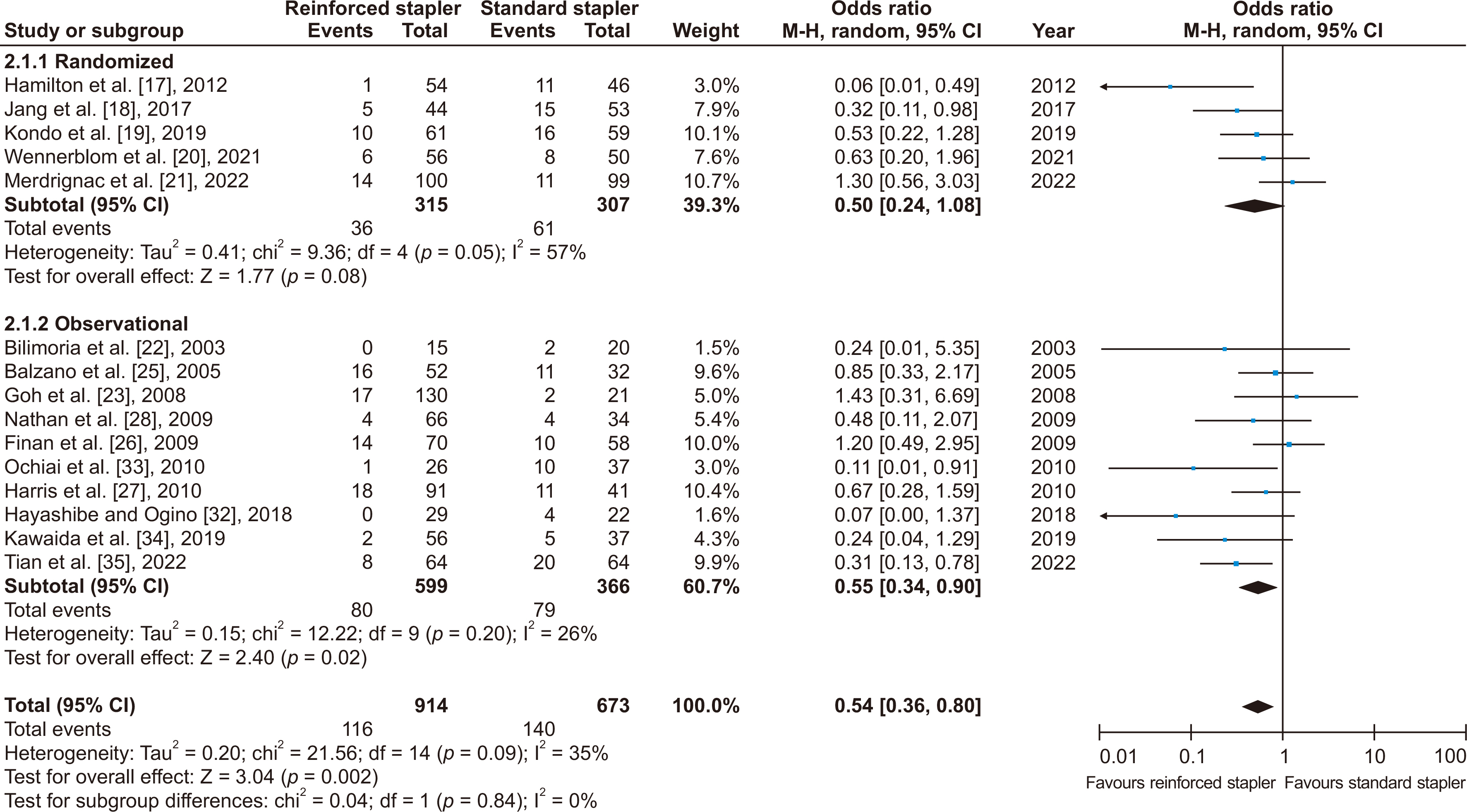
Fig. 4 Forest plots of comparison of reinforced versus standard pancreatic stump on clinically relevant postoperative pancreatic fistula. Solid squares denote odds ratio. Horizontal lines represent 95% CIs. Diamond denotes pooled effect size. M-H, Mantel Haenszel test; CI, confidence interval.
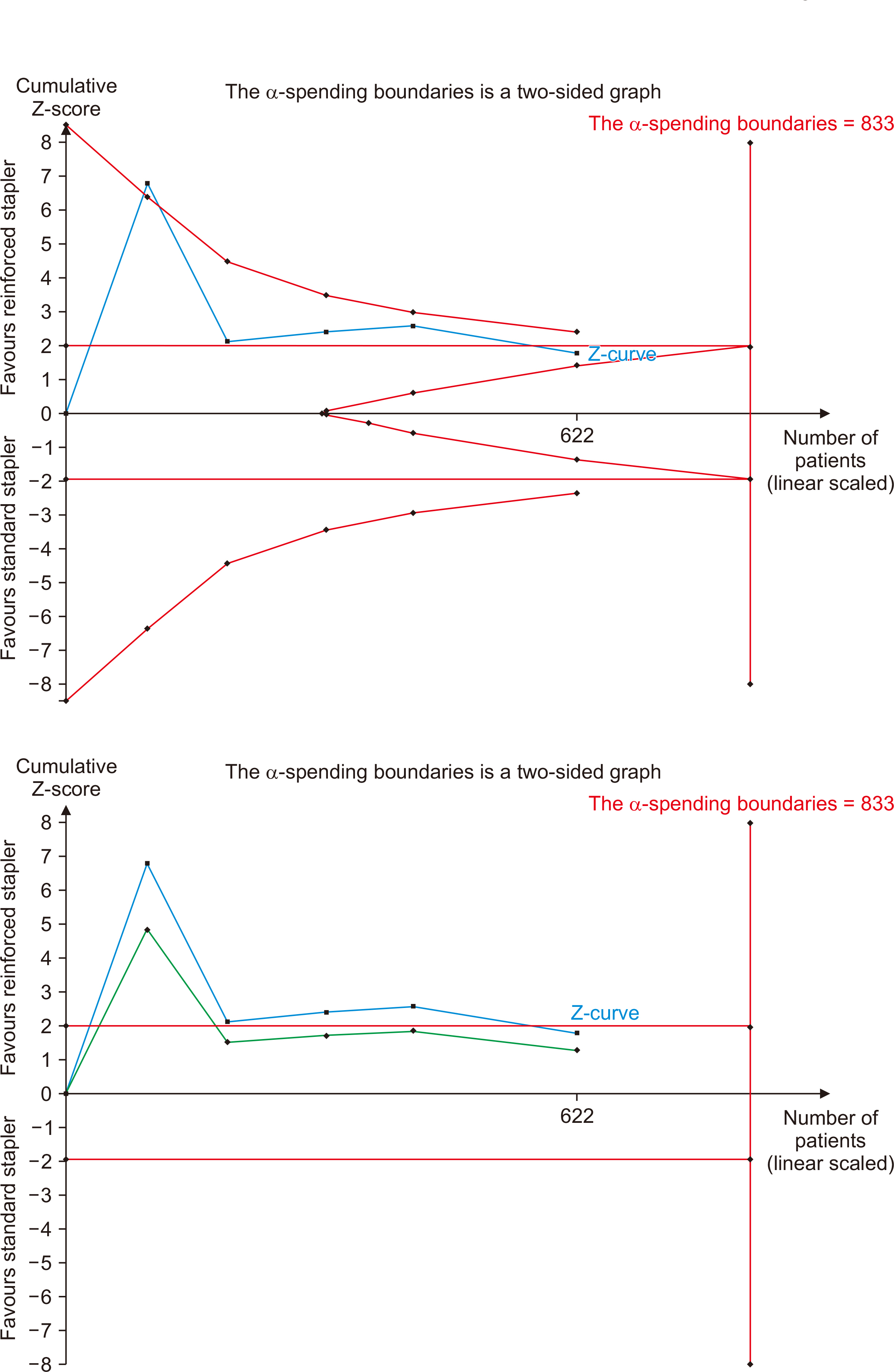
Fig. 5 Results of trial sequential analysis for clinically relevant postoperative pancreatic fistula. Red inward-sloping dashed lines make up trial sequential monitoring boundaries. To the right, outward sloping red dashed lines make up the futility region. Solid blue line is cumulative Z curve. Solid green line presents penalised Z-value.
Reference
-
References
1. Dhanireddy KK, Fishbein TM. Evans SRT, Chahine AA, editors. 2008. Distal pancreatectomy. Surgical pitfalls e-book: prevention and management. Saunders;p. 375–378. DOI: 10.1016/B978-141602951-9.50046-3.2. Hajibandeh S, Ghassemi N, Hajibandeh S, Romman S, Ghassemi A, Laing RW, et al. 2023; Meta-analysis of laparoscopic spleen-preserving distal pancreatectomy versus laparoscopic distal pancreatectomy with splenectomy: an insight into confounding by indication. Surgeon. 22:e13–e25. DOI: 10.1016/j.surge.2023.08.006. PMID: 37673704.3. Xu Y, Jin C, Fu D, Yang F. 2023; External validation of fistula risk scores for postoperative pancreatic fistula after distal pancreatectomy. Surgery. 174:1416–1421. DOI: 10.1016/j.surg.2023.09.007. PMID: 37827899.4. Bassi C, Dervenis C, Butturini G, Fingerhut A, Yeo C, Izbicki J, et al. 2005; Postoperative pancreatic fistula: an international study group (ISGPF) definition. Surgery. 138:8–13. DOI: 10.1016/j.surg.2005.05.001. PMID: 16003309.5. Bassi C, Marchegiani G, Dervenis C, Sarr M, Abu Hilal M, Adham M, et al. 2017; The 2016 update of the international study group (ISGPS) definition and grading of postoperative pancreatic fistula: 11 years after. Surgery. 161:584–591. DOI: 10.1016/j.surg.2016.11.014. PMID: 28040257.6. Bonsdorff A, Ghorbani P, Helanterä I, Tarvainen T, Kontio T, Belfrage H, et al. 2022; Development and external validation of DISPAIR fistula risk score for clinically relevant postoperative pancreatic fistula risk after distal pancreatectomy. Br J Surg. 109:1131–1139. DOI: 10.1093/bjs/znac266. PMID: 35983583. PMCID: PMC10364701.7. De Pastena M, van Bodegraven EA, Mungroop TH, Vissers FL, Jones LR, Marchegiani G, et al. 2023; Distal pancreatectomy fistula risk score (D-FRS): development and international validation. Ann Surg. 277:e1099–e1105. DOI: 10.1097/SLA.0000000000005497. PMID: 35797608.8. Yang F, Jin C, Hao S, Fu D. 2019; Drain contamination after distal pancreatectomy: incidence, risk factors, and association with postoperative pancreatic fistula. J Gastrointest Surg. 23:2449–2458. DOI: 10.1007/s11605-019-04155-7. PMID: 30815778.9. McMillan MT, Christein JD, Callery MP, Behrman SW, Drebin JA, Hollis RH, et al. 2016; Comparing the burden of pancreatic fistulas after pancreatoduodenectomy and distal pancreatectomy. Surgery. 159:1013–1022. DOI: 10.1016/j.surg.2015.10.028. PMID: 26670325.10. Yang F, Jin C, Li J, Di Y, Zhang J, Fu D. 2018; Clinical significance of drain fluid culture after pancreaticoduodenectomy. J Hepatobiliary Pancreat Sci. 25:508–517. DOI: 10.1002/jhbp.589. PMID: 30328297.11. Kollár D, Huszár T, Pohárnok Z, Cselovszky É, Oláh A. 2016; A review of techniques for closure of the pancreatic remnant following distal pancreatectomy. Dig Surg. 33:320–328. DOI: 10.1159/000445017. PMID: 27215609.12. Liberati A, Altman DG, Tetzlaff J, Mulrow C, Gøtzsche PC, Ioannidis JP, et al. 2009; The PRISMA statement for reporting systematic reviews and meta-analyses of studies that evaluate healthcare interventions: explanation and elaboration. BMJ. 339:b2700. DOI: 10.1136/bmj.b2700. PMID: 19622552. PMCID: PMC2714672.13. Higgins JPT, Thomas J, Chandler J, Cumpston M, Li T, Page MJ, et al. Cochrane Handbook for Systematic Reviews of Interventions version 6.1 (updated September 2020) [Internet]. Cochrane;2020. cited 2023 Oct 20. Available from: www.training.cochrane.org/handbook.14. Sterne JA, Hernán MA, Reeves BC, Savović J, Berkman ND, Viswanathan M, et al. 2016; ROBINS-I: a tool for assessing risk of bias in non-randomised studies of interventions. BMJ. 355:i4919. DOI: 10.1136/bmj.i4919. PMID: 27733354. PMCID: PMC5062054.15. Bassi C, Butturini G, Falconi M, Salvia R, Sartori N, Caldiron E, et al. 1999; Prospective randomised pilot study of management of the pancreatic stump following distal resection. HPB (Oxford). 1:203–207. DOI: 10.1016/S1365-182X(17)30671-8.16. Diener MK, Seiler CM, Rossion I, Kleeff J, Glanemann M, Butturini G, et al. 2011; Efficacy of stapler versus hand-sewn closure after distal pancreatectomy (DISPACT): a randomised, controlled multicentre trial. Lancet. 377:1514–1522. DOI: 10.1016/S0140-6736(11)60237-7. PMID: 21529927.17. Hamilton NA, Porembka MR, Johnston FM, Gao F, Strasberg SM, Linehan DC, et al. 2012; Mesh reinforcement of pancreatic transection decreases incidence of pancreatic occlusion failure for left pancreatectomy: a single-blinded, randomized controlled trial. Ann Surg. 255:1037–1042. DOI: 10.1097/SLA.0b013e31825659ef. PMID: 22534422. PMCID: PMC3363360.18. Jang JY, Shin YC, Han Y, Park JS, Han HS, Hwang HK, et al. 2017; Effect of polyglycolic acid mesh for prevention of pancreatic fistula following distal pancreatectomy: a randomized clinical trial. JAMA Surg. 152:150–155. DOI: 10.1001/jamasurg.2016.3644. PMID: 27784046.19. Kondo N, Uemura K, Nakagawa N, Okada K, Kuroda S, Sudo T, et al. 2019; A multicenter, randomized, controlled trial comparing reinforced staplers with bare staplers during distal pancreatectomy (HiSCO-07 trial). Ann Surg Oncol. 26:1519–1527. DOI: 10.1245/s10434-019-07222-0. PMID: 30783854.20. Wennerblom J, Ateeb Z, Jönsson C, Björnsson B, Tingstedt B, Williamsson C, et al. 2021; Reinforced versus standard stapler transection on postoperative pancreatic fistula in distal pancreatectomy: multicentre randomized clinical trial. Br J Surg. 108:265–270. DOI: 10.1093/bjs/znaa113. PMID: 33793753.21. Merdrignac A, Garnier J, Dokmak S, Regenet N, Lesurtel M, Mabrut JY, et al. 2022; Effect of the use of reinforced stapling on the occurrence of pancreatic fistula after distal pancreatectomy: results of the REPLAY (REinforcement of the Pancreas in distaL pAncreatectomY) multicenter randomized clinical trial. Ann Surg. 276:769–775. DOI: 10.1097/SLA.0000000000005618. PMID: 35876371.22. Bilimoria MM, Cormier JN, Mun Y, Lee JE, Evans DB, Pisters PW. 2003; Pancreatic leak after left pancreatectomy is reduced following main pancreatic duct ligation. Br J Surg. 90:190–196. DOI: 10.1002/bjs.4032. PMID: 12555295.23. Goh BK, Tan YM, Chung YF, Cheow PC, Ong HS, Chan WH, et al. 2008; Critical appraisal of 232 consecutive distal pancreatectomies with emphasis on risk factors, outcome, and management of the postoperative pancreatic fistula: a 21-year experience at a single institution. Arch Surg. 143:956–965. DOI: 10.1001/archsurg.143.10.956. PMID: 18936374.24. Ferrone CR, Warshaw AL, Rattner DW, Berger D, Zheng H, Rawal B, et al. 2008; Pancreatic fistula rates after 462 distal pancreatectomies: staplers do not decrease fistula rates. J Gastrointest Surg. 12:1691–1697. discussion 1697–1698. DOI: 10.1007/s11605-008-0636-2. PMID: 18704597. PMCID: PMC3806097.25. Balzano G, Zerbi A, Cristallo M, Di Carlo V. 2005; The unsolved problem of fistula after left pancreatectomy: the benefit of cautious drain management. J Gastrointest Surg. 9:837–842. DOI: 10.1016/j.gassur.2005.01.287. PMID: 15985241.26. Finan KR, Cannon EE, Kim EJ, Wesley MM, Arnoletti PJ, Heslin MJ, et al. 2009; Laparoscopic and open distal pancreatectomy: a comparison of outcomes. Am Surg. 75:671–679. discussion 679–680. DOI: 10.1177/000313480907500807. PMID: 19725289.27. Harris LJ, Abdollahi H, Newhook T, Sauter PK, Crawford AG, Chojnacki KA, et al. 2010; Optimal technical management of stump closure following distal pancreatectomy: a retrospective review of 215 cases. J Gastrointest Surg. 14:998–1005. DOI: 10.1007/s11605-010-1185-z. PMID: 20306151.28. Nathan H, Cameron JL, Goodwin CR, Seth AK, Edil BH, Wolfgang CL, et al. 2009; Risk factors for pancreatic leak after distal pancreatectomy. Ann Surg. 250:277–281. DOI: 10.1097/SLA.0b013e3181ae34be. PMID: 19638926.29. Wellner UF, Makowiec F, Sick O, Hopt UT, Keck T. 2012; Arguments for an individualized closure of the pancreatic remnant after distal pancreatic resection. World J Gastrointest Surg. 4:114–120. DOI: 10.4240/wjgs.v4.i5.114. PMID: 22655125. PMCID: PMC3364336.30. Ceppa EP, McCurdy RM, Becerra DC, Kilbane EM, Zyromski NJ, Nakeeb A, et al. 2015; Does pancreatic stump closure method influence distal pancreatectomy outcomes? J Gastrointest Surg. 19:1449–1456. DOI: 10.1007/s11605-015-2825-0. PMID: 25903852.31. Sepesi B, Moalem J, Galka E, Salzman P, Schoeniger LO. 2012; The influence of staple size on fistula formation following distal pancreatectomy. J Gastrointest Surg. 16:267–274. DOI: 10.1007/s11605-011-1715-3. PMID: 22015618.32. Hayashibe A, Ogino N. 2018; Clinical study for pancreatic fistula after distal pancreatectomy with mesh reinforcement. Asian J Surg. 41:236–240. DOI: 10.1016/j.asjsur.2016.11.001. PMID: 27964997.33. Ochiai T, Sonoyama T, Soga K, Inoue K, Ikoma H, Shiozaki A, et al. 2010; Application of polyethylene glycolic acid felt with fibrin sealant to prevent postoperative pancreatic fistula in pancreatic surgery. J Gastrointest Surg. 14:884–890. DOI: 10.1007/s11605-009-1149-3. PMID: 20177808.34. Kawaida H, Kono H, Amemiya H, Hosomura N, Saito R, Takahashi K, et al. 2019; Use of a reinforced triple-row stapler following distal pancreatectomy reduces the incidence of postoperative pancreatic fistula in patients with a high BMI. Anticancer Res. 39:1013–1018. DOI: 10.21873/anticanres.13207. PMID: 30711989.35. Tian F, Luo MJ, Sun MQ, Lu J, Huang BW, Guo JC. 2022; Staple line lockstitch reinforcement decreases clinically relevant pancreatic fistula following distal pancreatectomy: results of a propensity score matched retrospective analysis. Front Oncol. 12:999002. DOI: 10.3389/fonc.2022.999002. PMID: 36338750. PMCID: PMC9634739.36. Eguchi H, Nagano H, Tanemura M, Takeda Y, Marubashi S, Kobayashi S, et al. 2011; A thick pancreas is a risk factor for pancreaticfistula after a distal pancreatectomy: selection of the closuretechnique according to the thickness. Dig Surg. 28:50–56. DOI: 10.1159/000322406. PMID: 21293132.37. Frozanpor F, Albiin N, Linder S, Segersvärd R, Lundell L, Arnelo U. 2010; Impact of pancreatic gland volume on fistulaformation after pancreatic tail resection. JOP. 11:439–443.38. Kawai M, Tani M, Okada K, Hirono S, Miyazawa M, Shimizu A, et al. 2013; Stump closure of a thick pancreas using stapler closureincreases pancreatic fistula after distal pancreatectomy. Am J Sur. 206:352–359. DOI: 10.1016/j.amjsurg.2012.11.023. PMID: 23806829.39. Kah Heng CA, Salleh I, San TS, Ying F, Su-Ming T. 2010; Pancreatic fistula after distal pancreatectomy: incidence, risk factors and management. ANZ J Surg. 80:619–623. DOI: 10.1111/j.1445-2197.2010.05337.x. PMID: 20840405.40. Murata Y, Maeda K, Ito T, Gyoten K, Hayasaki A, Iizawa Y, et al. 2023; Efficacy of reinforced stapler versus hand-sewn closure of the pancreatic stump during pure laparoscopic distal pancreatectomy to reduce pancreatic fistula. Surg Laparosc Endosc Percutan Tech. 33:99–107. DOI: 10.1097/SLE.0000000000001151. PMID: 36821651.41. Palmeri M, Furbetta N, Di Franco G, Gianardi D, Guadagni S, Bianchini M, et al. 2023; Comparison of different pancreatic stump management strategies during robot-assisted distal pancreatectomy. Int J Med Robot. 19:e2470. DOI: 10.1002/rcs.2470. PMID: 36256862.42. Chikhladze S, Makowiec F, Küsters S, Riediger H, Sick O, Fichtner-Feigl S, et al. 2020; The rate of postoperative pancreatic fistula after distal pancreatectomy is independent of the pancreatic stump closure technique - a retrospective analysis of 284 cases. Asian J Surg. 43:227–233. DOI: 10.1016/j.asjsur.2019.03.009. PMID: 30982560.43. Futagawa Y, Takano Y, Furukawa K, Kanehira M, Onda S, Sakamoto T, et al. 2017; Comparison of outcomes with hand-sewn versus stapler closure of pancreatic stump in distal pancreatectomy. Anticancer Res. 37:2515–2521. DOI: 10.21873/anticanres.11593. PMID: 28476821.44. Yoshioka R, Saiura A, Koga R, Seki M, Kishi Y, Morimura R, et al. 2010; Risk factors for clinical pancreatic fistula after distal pancreatectomy: analysis of consecutive 100 patients. World J Surg. 34:121–125. DOI: 10.1007/s00268-009-0300-3. PMID: 20020297.45. Ban D, Shimada K, Konishi M, Saiura A, Hashimoto M, Uesaka K. 2012; Stapler and nonstapler closure of the pancreatic remnant after distal pancreatectomy: multicenter retrospective analysis of 388 patients. World J Surg. 36:1866–1873. DOI: 10.1007/s00268-012-1595-z. PMID: 22526040.46. Tieftrunk E, Demir IE, Schorn S, Sargut M, Scheufele F, Calavrezos L, et al. 2018; Pancreatic stump closure techniques and pancreatic fistula formation after distal pancreatectomy: meta-analysis and single-center experience. PLoS One. 13:e0197553. DOI: 10.1371/journal.pone.0197553. PMID: 29897920. PMCID: PMC5999073.47. Watanabe Y, Horiuchi A, Yoshida M, Yamamoto Y, Sugishita M, Sato K, et al. 2007; Usefulness of linear stapling device in distal pancreatic resection. Hepatogastroenterology. 54:1315–1318.48. Ratnayake CBB, Wells C, Hammond J, French JJ, Windsor JA, Pandanaboyana S. 2019; Network meta-analysis comparing techniques and outcomes of stump closure after distal pancreatectomy. Br J Surg. 106:1580–1589. DOI: 10.1002/bjs.11291. PMID: 31626341.
- Full Text Links
-
- Actions
-
Cited
- CITED
-
- Close
- Share
-
- Similar articles
-
- Is there any different risk factor for clinical relevant pancreatic fistula according to the stump closure method following left-sided pancreatectomy?
- Factors Associated with Morbidity and Mortality in Distal Pancreatectomy
- Trial sequential analysis: novel approach for meta-analysis
- Utilization of end to side inverted mattress pancreaticojejunostomy for Duval procedure: A case report
- Current status of robotic surgery for pancreatic tumors


