
Korean Circ J.
2019 Aug;49(8):645-656. 10.4070/kcj.2019.0185.
The Role of Novel Oral Anticoagulants and Antiplatelet Therapy after Percutaneous Coronary Intervention: Individualizing Therapy to Optimize Outcomes

- Affiliations
-
- 1MedStar Washington Hospital Center, Washington, D.C., USA.
- 2St. Francis Hospital, The Heart Center, Roslyn, NY, USA.
- 3Ronald Reagan UCLA Medical Center, Los Angeles, CA, USA. MSLee@mednet.ucla.edu
- KMID: 2456861
- DOI: http://doi.org/10.4070/kcj.2019.0185
Abstract
- The number of patients undergoing percutaneous coronary intervention (PCI) who mandate additional oral anticoagulant therapy has been increasing. Dual antiplatelet therapy (DAPT) is associated with reduced ischemic events including stent thrombosis, myocardial infarction and stroke following PCI. However, the tradeoff is an increased risk for bleeding while on DAPT. The addition of a novel oral anticoagulant (NOAC) further increases the likelihood of bleeding while on antiplatelet therapy. Thus, the overall risks and benefits for each patient undergoing PCI on NOAC must be assessed and therapy individualized to ensure optimal therapy for each unique situation. Patients on NOAC undergoing PCI should undergo routine assessment with intravascular imaging as the role of high-risk lesion-related features have increased importance prior to determining optimal duration of treatment with DAPT. We review the best practices for the pharmacologic management of patients requiring anticoagulation with NOAC who are treated with PCI and require antiplatelet therapy.
Keyword
MeSH Terms
Figure
-

Figure 1 Risk-benefit assessment for individualized approach to pharmacotherapy following PCI. PCI = percutaneous coronary intervention.
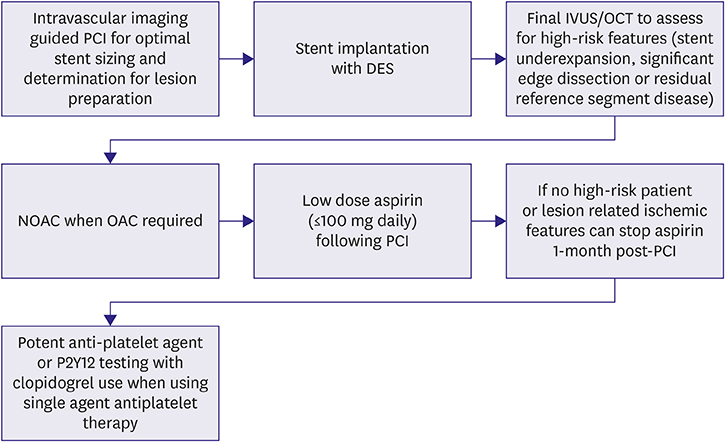
Figure 2 Approach to patients requiring PCI on oral anticoagulant therapy. DAPT = dual antiplatelet therapy; DES = drug-eluting stent; IVUS = intravascular ultrasound; NOAC = novel oral anticoagulant; OAC = oral anticoagulant; OCT = optical coherence tomography; PCI = percutaneous coronary intervention.
Reference
-
1. Valgimigli M, Bueno H, Byrne RA, et al. 2017 ESC focused update on dual antiplatelet therapy in coronary artery disease developed in collaboration with EACTS: the task force for dual antiplatelet therapy in coronary artery disease of the European Society of Cardiology (ESC) and of the European Association for Cardio-Thoracic Surgery (EACTS). Eur Heart J. 2018; 39:213–260.2. Mozaffarian D, Benjamin EJ, Go AS, et al. Heart disease and stroke statistics--2015 update: a report from the American Heart Association. Circulation. 2015; 131:e29–e322.3. Miyasaka Y, Barnes ME, Gersh BJ, et al. Secular trends in incidence of atrial fibrillation in Olmsted County, Minnesota, 1980 to 2000, and implications on the projections for future prevalence. Circulation. 2006; 114:119–125.
Article4. Degheim G, Berry A, Zughaib M. Off label use of direct oral anticoagulants for left ventricular thrombus. Is it appropriate? Am J Cardiovasc Dis. 2017; 7:98–101.5. Skelley JW, White CW, Thomason AR. The use of direct oral anticoagulants in inherited thrombophilia. J Thromb Thrombolysis. 2017; 43:24–30.
Article6. Connolly SJ, Ezekowitz MD, Yusuf S, et al. Dabigatran versus warfarin in patients with atrial fibrillation. N Engl J Med. 2009; 361:1139–1151.
Article7. Patel MR, Mahaffey KW, Garg J, et al. Rivaroxaban versus warfarin in nonvalvular atrial fibrillation. N Engl J Med. 2011; 365:883–891.
Article8. Granger CB, Alexander JH, McMurray JJ, et al. Apixaban versus warfarin in patients with atrial fibrillation. N Engl J Med. 2011; 365:981–992.9. Giugliano RP, Ruff CT, Braunwald E, et al. Edoxaban versus warfarin in patients with atrial fibrillation. N Engl J Med. 2013; 369:2093–2104.
Article10. Kearon C, Akl EA, Ornelas J, et al. Antithrombotic therapy for VTE disease: CHEST guideline and expert panel report. Chest. 2016; 149:315–352.11. Steffel J, Verhamme P, Potpara TS, et al. The 2018 European Heart Rhythm Association practical guide on the use of non-vitamin K antagonist oral anticoagulants in patients with atrial fibrillation. Eur Heart J. 2018; 39:1330–1393.12. Lee JM, Kim TH, Cha MJ, et al. Gender-related differences in management of nonvalvular atrial fibrillation in an Asian population. Korean Circ J. 2018; 48:519–528.
Article13. Joung B. Real-world data and recommended dosage of non-vitamin K oral anticoagulants for Korean patients. Korean Circ J. 2017; 47:833–841.
Article14. Kang J, Park KW, Palmerini T, et al. Racial differences in ischaemia/bleeding risk trade-off during anti-platelet therapy: individual patient level landmark meta-analysis from seven RCTs. Thromb Haemost. 2019; 119:149–162.
Article15. Lip GY, Frison L, Halperin JL, Lane DA. Comparative validation of a novel risk score for predicting bleeding risk in anticoagulated patients with atrial fibrillation: the HAS-BLED (hypertension, abnormal renal/liver function, stroke, bleeding history or predisposition, labile INR, elderly, drugs/alcohol concomitantly) score. J Am Coll Cardiol. 2011; 57:173–180.16. Costa F, van Klaveren D, James S, et al. Derivation and validation of the predicting bleeding complications in patients undergoing stent implantation and subsequent dual antiplatelet therapy (PRECISE-DAPT) score: a pooled analysis of individual-patient datasets from clinical trials. Lancet. 2017; 389:1025–1034.
Article17. Yoshida R, Ishii H, Morishima I, et al. Performance of HAS-BLED, ORBIT, PRECISE-DAPT, and PARIS risk score for predicting long-term bleeding events in patients taking an oral anticoagulant undergoing percutaneous coronary intervention. J Cardiol. 2019; 73:479–487.
Article18. Valle JA, Shetterly S, Maddox TM, et al. Postdischarge bleeding after percutaneous coronary intervention and subsequent mortality and myocardial infarction: insights from the HMO Research Network-Stent Registry. Circ Cardiovasc Interv. 2016; 9:e003519.
Article19. Généreux P, Giustino G, Witzenbichler B, et al. Incidence, predictors, and impact of post-discharge bleeding after percutaneous coronary intervention. J Am Coll Cardiol. 2015; 66:1036–1045.20. Kazi DS, Leong TK, Chang TI, Solomon MD, Hlatky MA, Go AS. Association of spontaneous bleeding and myocardial infarction with long-term mortality after percutaneous coronary intervention. J Am Coll Cardiol. 2015; 65:1411–1420.21. Konigstein M, Madhavan MV, Ben-Yehuda O, et al. Incidence and predictors of target lesion failure in patients undergoing contemporary DES implantation-individual patient data pooled analysis from 6 randomized controlled trials. Am Heart J. 2019; 213:105–111.
Article22. Rozemeijer R, Wing Wong C, Leenders G, et al. Incidence, angiographic and clinical predictors, and impact of stent thrombosis: a 6-year survey of 6,545 consecutive patients. Neth Heart J. 2019; 27:321–329.23. Shlofmitz E, Shlofmitz RA, Galougahi KK, et al. Algorithmic approach for optical coherence tomography-guided stent implantation during percutaneous coronary intervention. Interv Cardiol Clin. 2018; 7:329–344.
Article24. Larsen TB, Potpara T, Dagres N, et al. Preference for oral anticoagulation therapy for patients with atrial fibrillation in Europe in different clinical situations: results of the European Heart Rhythm Association Survey. Europace. 2015; 17:819–824.
Article25. Cutlip DE, Garratt KN, Novack V, et al. 9-month clinical and angiographic outcomes of the COBRA Polyzene-F nanocoated coronary stent system. JACC Cardiovasc Interv. 2017; 10:160–167.
Article26. Varenne O, Cook S, Sideris G, et al. Drug-eluting stents in elderly patients with coronary artery disease (SENIOR): a randomised single-blind trial. Lancet. 2018; 391:41–50.
Article27. Neumann FJ, Sousa-Uva M, Ahlsson A, et al. 2018 ESC/EACTS guidelines on myocardial revascularization. Eur Heart J. 2019; 40:87–165.28. Jang JY, Shin DH, Kim JS, et al. Optimal duration of DAPT after second-generation drug-eluting stent in acute coronary syndrome. PLoS One. 2018; 13:e0207386.
Article29. Watanabe H. STOPDAPT-2 trial. In : American College of Cardiology Annual Scientific Session (ACC 2019); 2019 Mar 18; Mon, USA. New Orleans (LA): American College of Cardiology;2019.30. Vranckx P, Valgimigli M, Jüni P, et al. Ticagrelor plus aspirin for 1 month, followed by ticagrelor monotherapy for 23 months vs aspirin plus clopidogrel or ticagrelor for 12 months, followed by aspirin monotherapy for 12 months after implantation of a drug-eluting stent: a multicentre, open-label, randomised superiority trial. Lancet. 2018; 392:940–949.31. Hahn JY, Song YB, Oh JH, et al. 6-month versus 12-month or longer dual antiplatelet therapy after percutaneous coronary intervention in patients with acute coronary syndrome (SMART-DATE): a randomised, open-label, non-inferiority trial. Lancet. 2018; 391:1274–1284.32. 2018 ESC/EACTS guidelines on myocardial revascularization. Rev Esp Cardiol (Engl Ed). 2019; 72:73.33. Parodi G, Marcucci R, Valenti R, et al. High residual platelet reactivity after clopidogrel loading and long-term cardiovascular events among patients with acute coronary syndromes undergoing PCI. JAMA. 2011; 306:1215–1223.
Article34. Trenk D, Stone GW, Gawaz M, et al. A randomized trial of prasugrel versus clopidogrel in patients with high platelet reactivity on clopidogrel after elective percutaneous coronary intervention with implantation of drug-eluting stents: results of the TRIGGER-PCI (Testing Platelet Reactivity In Patients Undergoing Elective Stent Placement on Clopidogrel to Guide Alternative Therapy With Prasugrel) study. J Am Coll Cardiol. 2012; 59:2159–2164.35. Price MJ, Endemann S, Gollapudi RR, et al. Prognostic significance of post-clopidogrel platelet reactivity assessed by a point-of-care assay on thrombotic events after drug-eluting stent implantation. Eur Heart J. 2008; 29:992–1000.
Article36. Price MJ, Berger PB, Teirstein PS, et al. Standard- vs high-dose clopidogrel based on platelet function testing after percutaneous coronary intervention: the GRAVITAS randomized trial. JAMA. 2011; 305:1097–1105.37. Price MJ, Berger PB, Angiolillo DJ, et al. Evaluation of individualized clopidogrel therapy after drug-eluting stent implantation in patients with high residual platelet reactivity: design and rationale of the GRAVITAS trial. Am Heart J. 2009; 157:818–824. 824.e1
Article38. Lee MS, Shlofmitz E, Haag E, et al. Optimal same-day platelet inhibition in patients receiving drug-eluting stents with or without previous maintenance thienopyridine therapy: from the Evaluation of Platelet Inhibition in Patients Having A VerifyNow Assay (EPIPHANY) trial. Am J Cardiol. 2017; 119:991–995.39. Lee SH, Kim BK, Oh J, et al. Successful prasugrel rescue therapy in clopidogrel resistant patients who had recurrent stent thrombosis of drug-eluting-stent: the role of prasugrel in clopidogrel nonresponders. Korean Circ J. 2013; 43:343–346.
Article40. Park KH, Jeong MH, Kim HK, et al. Comparison of prasugrel versus clopidogrel in Korean patients with acute myocardial infarction undergoing successful revascularization. J Cardiol. 2018; 71:36–43.
Article41. Saito S, Isshiki T, Kimura T, et al. Efficacy and safety of adjusted-dose prasugrel compared with clopidogrel in Japanese patients with acute coronary syndrome: the PRASFIT-ACS study. Circ J. 2014; 78:1684–1692.42. Oldgren J, Steg PG, Hohnloser SH, et al. Dabigatran dual therapy with ticagrelor or clopidogrel after percutaneous coronary intervention in atrial fibrillation patients with or without acute coronary syndrome: a subgroup analysis from the RE-DUAL PCI trial. Eur Heart J. 2019; 40:1553–1562.
Article43. Cannon CP, Bhatt DL, Oldgren J, et al. Dual antithrombotic therapy with dabigatran after PCI in atrial fibrillation. N Engl J Med. 2017; 377:1513–1524.
Article44. Gibson CM, Mehran R, Bode C, et al. Prevention of bleeding in patients with atrial fibrillation undergoing PCI. N Engl J Med. 2016; 375:2423–2434.
Article45. Lopes RD, Heizer G, Aronson R, et al. Antithrombotic therapy after acute coronary syndrome or PCI in atrial fibrillation. N Engl J Med. 2019; 380:1509–1524.
Article46. Hong SJ, Kim BK, Shin DH, et al. Effect of intravascular ultrasound-guided vs angiography-guided everolimus-eluting stent implantation: the IVUS-XPL randomized clinical trial. JAMA. 2015; 314:2155–2163.47. Zhang J, Gao X, Kan J, et al. Intravascular ultrasound versus angiography-guided drug-eluting stent implantation: the ULTIMATE trial. J Am Coll Cardiol. 2018; 72:3126–3137.48. Choi KH, Song YB, Lee JM, et al. Impact of intravascular ultrasound-guided percutaneous coronary intervention on long-term clinical outcomes in patients undergoing complex procedures. JACC Cardiovasc Interv. 2019; 12:607–620.49. Maehara A, Mintz GS, Witzenbichler B, et al. Relationship between intravascular ultrasound guidance and clinical outcomes after drug-eluting stents. Circ Cardiovasc Interv. 2018; 11:e006243.
Article50. Shlofmitz E, Kuku KO, Waksman R, Garcia-Garcia HM. Intravascular ultrasound-guided drug-eluting stent implantation. Minerva Cardioangiol. 2019.
Article51. Shlofmitz E, Hashim H. Avoiding patient-stent mismatch: incorporating optical coherence tomography into routine practice. Cardiovasc Revasc Med. 2019; 20:273–274.
Article52. Fujii K, Carlier SG, Mintz GS, et al. Stent underexpansion and residual reference segment stenosis are related to stent thrombosis after sirolimus-eluting stent implantation: an intravascular ultrasound study. J Am Coll Cardiol. 2005; 45:995–998.
Article53. Okabe T, Mintz GS, Buch AN, et al. Intravascular ultrasound parameters associated with stent thrombosis after drug-eluting stent deployment. Am J Cardiol. 2007; 100:615–620.
Article54. Choi SY, Witzenbichler B, Maehara A, et al. Intravascular ultrasound findings of early stent thrombosis after primary percutaneous intervention in acute myocardial infarction: a Harmonizing Outcomes with Revascularization and Stents in Acute Myocardial Infarction (HORIZONS-AMI) substudy. Circ Cardiovasc Interv. 2011; 4:239–247.55. Liu X, Doi H, Maehara A, et al. A volumetric intravascular ultrasound comparison of early drug-eluting stent thrombosis versus restenosis. JACC Cardiovasc Interv. 2009; 2:428–434.
Article56. Liu X, Tsujita K, Maehara A, et al. Intravascular ultrasound assessment of the incidence and predictors of edge dissections after drug-eluting stent implantation. JACC Cardiovasc Interv. 2009; 2:997–1004.
Article57. Levine GN, Bates ER, Bittl JA, et al. 2016 ACC/AHA guideline focused update on duration of dual antiplatelet therapy in patients with coronary artery disease: a report of the American College of Cardiology/American Heart Association task force on clinical practice guidelines. J Am Coll Cardiol. 2016; 68:1082–1115.58. Brener SJ, Kirtane AJ, Stuckey TD, et al. The impact of timing of ischemic and hemorrhagic events on mortality after percutaneous coronary intervention: the ADAPT-DES study. JACC Cardiovasc Interv. 2016; 9:1450–1457.
- Full Text Links
-
- Actions
-
Cited
- CITED
-
- Close
- Share
-
- Similar articles
-
- De-escalation strategies of dual antiplatelet therapy in patients undergoing percutaneous coronary intervention for acute coronary syndrome
- Antithrombotic Strategy in Atrial Fibrillation Patients Undergoing Percutaneous Coronary Intervention
- Perioperative management for patients undergoing noncardiac surgery after percutaneous coronary intervention
- Antiplate Agents
- The Role of P2Y12 Inhibitor Monotherapy in Patients With Coronary Artery Disease Undergoing Percutaneous Coronary Intervention


