
Dement Neurocogn Disord.
2016 Dec;15(4):103-109. 10.12779/dnd.2016.15.4.103.
Depression and Cognition
- Affiliations
-
- 1Department of Neurology, Hyoja Geriatric Hospital, Yongin, Korea. kwakdr@gmail.com
- 2Department of Neurology, Seoul Veterans Hospital, Seoul, Korea.
- 3Department of Psychiatry, College of Medicine, Catholic Kwandong University, Gangneung, Korea.
- KMID: 2442834
- DOI: http://doi.org/10.12779/dnd.2016.15.4.103
Abstract
- Depression is a relatively common agonizing psychiatric disorder that affects the way we feel and think about ourselves and the world around us. Cognitive theories of depression have long posited that various cognitive biases are involved in the development and recurrence of depression. However, the current cognitive theory of depression has been reformulated and expanded from the previous cognitive model of depression based on the results from pharmacological, neuroimaging and neurocognitive studies. This review summarizes the evidence for cognitive dysfunctions in depression and the related pharmacological, neuroanatomical and genetic aspects which aim to integrate our knowledge about the cognitive aspects of depression and its treatment. The newly formulated cognitive theory of depression provides directions for future investigation to identify people at risk, to minimize recurrence, and to maximize long-term beneficial outcomes for those suffering from depression.
Keyword
Figure
-
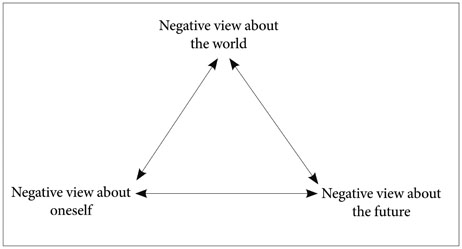
Fig. 1 Three negative schemas, cognition about the self, the world, and the future.
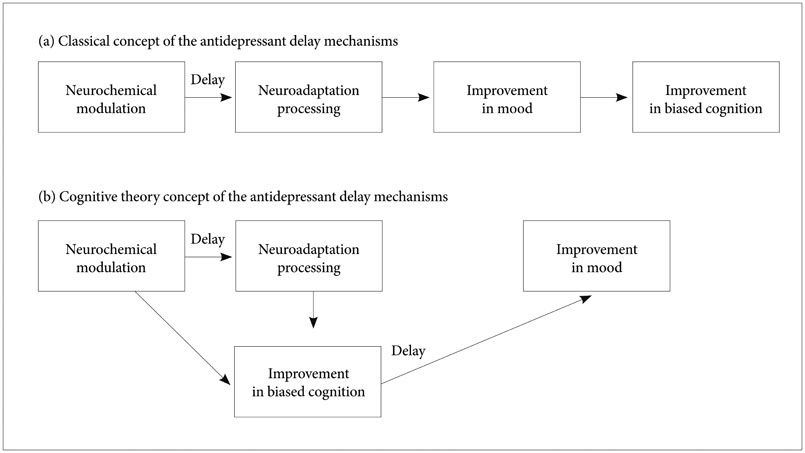
Fig. 2 Different view of the antidepressant delaying mechanism between the classical and cognitive theory concepts.
Reference
-
1. Beck AT. Cognitive Therapy and the Emotional Disorders. 2nd ed. New York: International Universities Press;1976.2. Roiser JP, Elliott R, Sahakian BJ. Cognitive mechanisms of treatment in depression. Neuropsychopharmacology. 2012; 37:117–136.
Article3. Boland RJ, Keller MB. Course and outcome of depression. In : Gotlib IH, Hammen CL, editors. Handbook of Depression. 2nd ed. New York: Guilford;2009. p. 23–43.4. Harmer CJ, Goodwin GM, Cowen PJ. Why do antidepressants take so long to work? A cognitive neuropsychological model of antidepressant drug action. Br J Psychiatry. 2009; 195:102–108.
Article5. Hollon SD, Jarrett RB, Nierenberg AA, Thase ME, Trivedi M, Rush AJ. Psychotherapy and medication in the treatment of adult and geriatric depression: which monotherapy or combined treatment? J Clin Psychiatry. 2005; 66:455–468.
Article6. Burt DB, Zembar MJ, Niederehe G. Depression and memory impairment: a meta-analysis of the association, its pattern, and specificity. Psychol Bull. 1995; 117:285–305.
Article7. Ellenbogen MA, Schwartzman AE. Selective attention and avoidance on a pictorial cueing task during stress in clinically anxious and depressed participants. Behav Res Ther. 2009; 47:128–138.
Article8. Mathews A, MacLeod C. Cognitive vulnerability to emotional disorders. Annu Rev Clin Psychol. 2005; 1:167–195.
Article9. Taylor Tavares JV, Clark L, Furey ML, Williams GB, Sahakian BJ, Drevets WC. Neural basis of abnormal response to negative feedback in unmedicated mood disorders. Neuroimage. 2008; 42:1118–1126.
Article10. Hammar A, Ardal G. Cognitive functioning in major depression--a summary. Front Hum Neurosci. 2009; 3:26.11. Rogers MA, Kasai K, Koji M, Fukuda R, Iwanami A, Nakagome K, et al. Executive and prefrontal dysfunction in unipolar depression: a review of neuropsychological and imaging evidence. Neurosci Res. 2004; 50:1–11.
Article12. Ottowitz WE, Dougherty DD, Savage CR. The neural network basis for abnormalities of attention and executive function in major depressive disorder: implications for application of the medical disease model to psychiatric disorders. Harv Rev Psychiatry. 2002; 10:86–99.
Article13. Clark L, Sarna A, Goodwin GM. Impairment of executive function but not memory in first-degree relatives of patients with bipolar I disorder and in euthymic patients with unipolar depression. Am J Psychiatry. 2005; 162:1980–1982.
Article14. Taylor Tavares JV, Clark L, Cannon DM, Erickson K, Drevets WC, Sahakian BJ. Distinct profiles of neurocognitive function in unmedicated unipolar depression and bipolar II depression. Biol Psychiatry. 2007; 62:917–924.
Article15. Beats BC, Sahakian BJ, Levy R. Cognitive performance in tests sensitive to frontal lobe dysfunction in the elderly depressed. Psychol Med. 1996; 26:591–603.
Article16. Robbins TW. Dissociating executive functions of the prefrontal cortex. In : Roberts AC, Robbins TW, Weiskrantz L, editors. The Prefrontal Cortex: Executive and Cognitive Functions. Oxford: Oxford University Press;1998. p. 117–130.17. Elliott R, Baker SC, Rogers RD, O’Leary DA, Paykel ES, Frith CD, et al. Prefrontal dysfunction in depressed patients performing a complex planning task: a study using positron emission tomography. Psychol Med. 1997; 27:931–942.
Article18. Okada G, Okamoto Y, Morinobu S, Yamawaki S, Yokota N. Attenuated left prefrontal activation during a verbal fluency task in patients with depression. Neuropsychobiology. 2003; 47:21–26.
Article19. Harvey PO, Fossati P, Pochon JB, Levy R, Lebastard G, Lehéricy S, et al. Cognitive control and brain resources in major depression: an fMRI study using the n-back task. Neuroimage. 2005; 26:860–869.
Article20. Hugdahl K, Rund BR, Lund A, Asbjørnsen A, Egeland J, Ersland L, et al. Brain activation measured with fMRI during a mental arithmetic task in schizophrenia and major depression. Am J Psychiatry. 2004; 161:286–293.
Article21. Wagner G, Sinsel E, Sobanski T, Köhler S, Marinou V, Mentzel HJ, et al. Cortical inefficiency in patients with unipolar depression: an event-related FMRI study with the Stroop task. Biol Psychiatry. 2006; 59:958–965.
Article22. Gould NF, Holmes MK, Fantie BD, Luckenbaugh DA, Pine DS, Gould TD, et al. Performance on a virtual reality spatial memory navigation task in depressed patients. Am J Psychiatry. 2007; 164:516–519.
Article23. Gorwood P, Corruble E, Falissard B, Goodwin GM. Toxic effects of depression on brain function: impairment of delayed recall and the cumulative length of depressive disorder in a large sample of depressed outpatients. Am J Psychiatry. 2008; 165:731–739.
Article24. Martinez-Aran A, Vieta E, Torrent C, Sanchez-Moreno J, Goikolea JM, Salamero M, et al. Functional outcome in bipolar disorder: the role of clinical and cognitive factors. Bipolar Disord. 2007; 9:103–113.
Article25. Campbell S, Marriott M, Nahmias C, MacQueen GM. Lower hippocampal volume in patients suffering from depression: a meta-analysis. Am J Psychiatry. 2004; 161:598–607.
Article26. Deckersbach T, Dougherty DD, Savage C, McMurrich S, Fischman AJ, Nierenberg A, et al. Impaired recruitment of the dorsolateral prefrontal cortex and hippocampus during encoding in bipolar disorder. Biol Psychiatry. 2006; 59:138–146.
Article27. Stockmeier CA, Mahajan GJ, Konick LC, Overholser JC, Jurjus GJ, Meltzer HY, et al. Cellular changes in the postmortem hippocampus in major depression. Biol Psychiatry. 2004; 56:640–650.
Article28. Matt GE, Vázquez C, Campbell WK. Mood-congruent recall of affectively toned stimuli: a meta-analytic review. Clin Psychol Rev. 1992; 12:227–255.
Article29. Brittlebank AD, Scott J, Williams JM, Ferrier IN. Autobiographical memory in depression: state or trait marker? Br J Psychiatry. 1993; 162:118–121.
Article30. Lembke A, Ketter TA. Impaired recognition of facial emotion in mania. Am J Psychiatry. 2002; 159:302–304.
Article31. Murphy FC, Sahakian BJ, Rubinsztein JS, Michael A, Rogers RD, Robbins TW, et al. Emotional bias and inhibitory control processes in mania and depression. Psychol Med. 1999; 29:1307–1321.
Article32. Elliott R, Sahakian BJ, Herrod JJ, Robbins TW, Paykel ES. Abnormal response to negative feedback in unipolar depression: evidence for a diagnosis specific impairment. J Neurol Neurosurg Psychiatry. 1997; 63:74–82.
Article33. Bremner JD, Vythilingam M, Vermetten E, Vaccarino V, Charney DS. Deficits in hippocampal and anterior cingulate functioning during verbal declarative memory encoding in midlife major depression. Am J Psychiatry. 2004; 161:637–645.
Article34. Fales CL, Barch DM, Rundle MM, Mintun MA, Snyder AZ, Cohen JD, et al. Altered emotional interference processing in affective and cognitive-control brain circuitry in major depression. Biol Psychiatry. 2008; 63:377–384.
Article35. De Raedt R, Koster EH. Understanding vulnerability for depression from a cognitive neuroscience perspective: a reappraisal of attentional factors and a new conceptual framework. Cogn Affect Behav Neurosci. 2010; 10:50–70.
Article36. Homberg JR, Lesch KP. Looking on the bright side of serotonin transporter gene variation. Biol Psychiatry. 2011; 69:513–519.
Article37. Disner SG, Beevers CG, Haigh EA, Beck AT. Neural mechanisms of the cognitive model of depression. Nat Rev Neurosci. 2011; 12:467–477.
Article38. Kwak YT, Yang Y, Koo MS. Depression in Alzheimer’s disease. Dement Neurocogn Disord. 2014; 13:27–36.
Article39. Rovner BW, Broadhead J, Spencer M, Carson K, Folstein MF. Depression and Alzheimer’s disease. Am J Psychiatry. 1989; 146:350–353.
Article40. Rubin EH, Kinscherf DA, Grant EA, Storandt M. The influence of major depression on clinical and psychometric assessment of senile dementia of the Alzheimer type. Am J Psychiatry. 1991; 148:1164–1171.
Article41. Wefel JS, Hoyt BD, Massma PJ. Neuropsychological functioning in depressed versus nondepressed participants with Alzheimer’s disease. Clin Neuropsychol. 1999; 13:249–257.
Article42. Lopez OL, Boller F, Becker JT, Miller M, Reynolds CF 3rd. Alzheimer’s disease and depression: neuropsychological impairment and progression of the illness. Am J Psychiatry. 1990; 147:855–860.
Article43. Yang Y, Kwak YT. The neuropsychological characteristics in early stage of Alzheimer’s patients with depression. Dement Neurocogn Disord. 2016; 15:37–42.
Article44. Yang Y, Kwak YT. The effects of donepezil on 15-item geriatric depression scale structure in patients with Alzheimer disease. Dement Geriatr Cogn Dis Extra. 2016; 6:437–446.
Article45. Satel SL, Nelson JC. Stimulants in the treatment of depression: a critical overview. J Clin Psychiatry. 1989; 50:241–249.46. Harmer CJ, Shelley NC, Cowen PJ, Goodwin GM. Increased positive versus negative affective perception and memory in healthy volunteers following selective serotonin and norepinephrine reuptake inhibition. Am J Psychiatry. 2004; 161:1256–1263.
Article
- Full Text Links
-
- Actions
-
Cited
- CITED
-
- Close
- Share
-
- Similar articles
-
- Effects of Negative Automatic Thoughts on Depression in Adolescence
- Effects of Irrational Parenthood Cognition, Family Support, and Resilience on Depression of Infertile Women
- The Effects of Multidimensional Program on Cognition, Physical Function and Depression for Institutionalized Elderly
- The Effects of a Cognitive Behavior Program on Cognition, Depression, and Activities of Daily Living in Elderly with Cognitive Impairment
- Affecting Factors of Homebound Bedridden Elderly's Depression


