
Beneficial Effect of Low Fluence 1,064 nm Q-Switched Neodymium:Yttrium-Aluminum-Garnet Laser in the Treatment of Senile Lentigo
- Affiliations
-
- 1Department of Dermatology, Kangbuk Samsung Hospital, Sungkyunkwan University School of Medicine, Seoul, Korea. susini@naver.com
- KMID: 2388940
- DOI: http://doi.org/10.5021/ad.2017.29.4.427
Abstract
- BACKGROUND
Low fluence 1,064 nm Q-switched (QS) Neodymium:Yttrium-Aluminum-Garnet (Nd:YAG) laser treatment, also known as laser toning, is widely used for pigmentary disorders. There has been no reliable evaluation of the effect of low fluence 1,064 nm QS Nd:YAG laser for senile lentigo.
OBJECTIVE
To investigate the beneficial effect of low fluence 1,064 nm QS Nd:YAG laser in the treatment of senile lentigo on the face.
METHODS
A retrospective review was conducted on patients treated only with repetitive low fluence 1,064 nm QS Nd:YAG laser. Among them, 12 patients with multiple senile lentigines before treatment were included. All side effects were recorded to assess the safety of the modality.
RESULTS
Mean age was 56.1±7.8 years old and male-to-female ratio was 1:11. Mean treatment fluence was 1.62±0.16 J/cm² and mean total treatment session was 8.8±2.6. Mean interval period between each session was 28.0±11.4 days and mean treatment session to reach marked and near total improvement was 8.7±2.8. At the final visit, seven of 12 (58.3%) patients reached marked and near total improvement, and three of 12 (25.0%) reached moderate improvement. No side effects occurred.
CONCLUSION
Repetitive low fluence 1,064 nm QS Nd:YAG laser treatment may be an effective and safe optional modality for senile lentigo.
Keyword
Figure
-
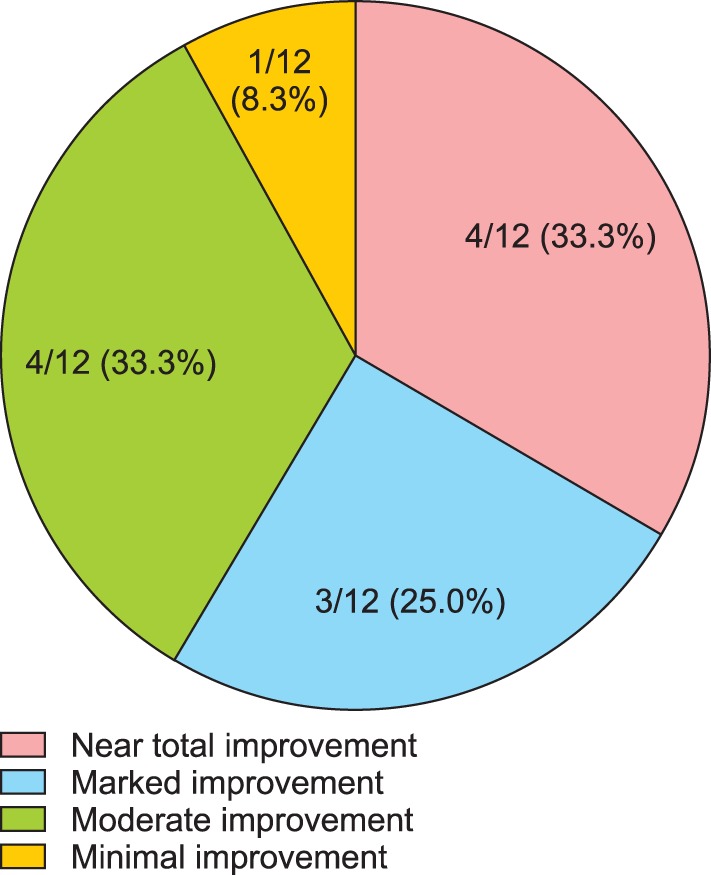
Fig. 1 Clinical improvement at the final visit (n=12).
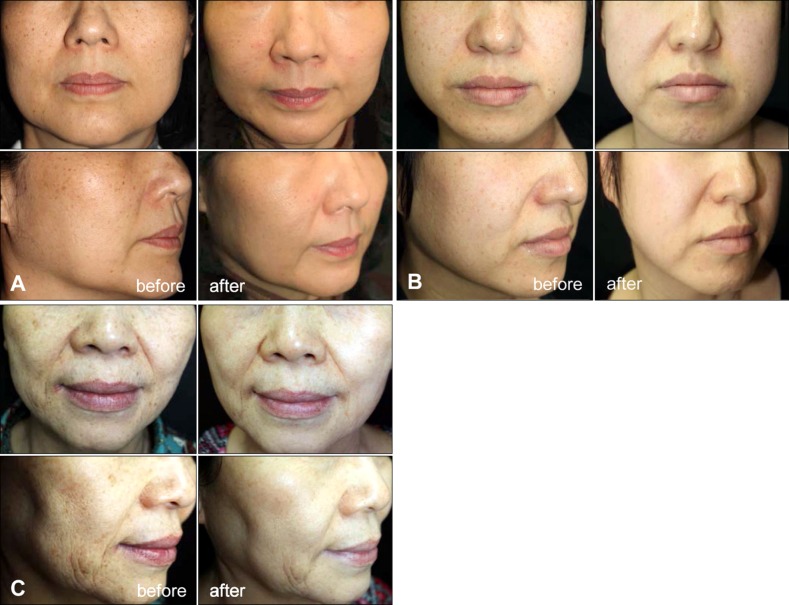
Fig. 2 Clinical images of near total improvement cases. (A) No. 3 patient before treatment (left) and at 7-month visit after 9 sessions of Neodymium:Yttrium-Aluminum-Garnet laser treatment (right), (B) No. 10 patient before treatment (left) and at 5-month visit after 10 sessions of laser treatment (right), and (C) No. 12 patient before treatment (left) and at 14-month visit after 12 sessions of laser treatment (right).
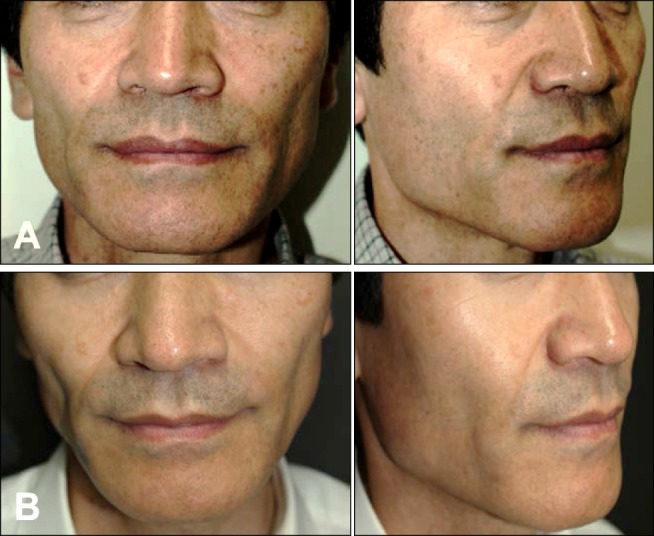
Fig. 3 Clinical image of marked improvement case (No. 7 patient) (A) before treatment and (B) at 5-month visit after 9 sessions of Neodymium:Yttrium-Aluminum-Garnet laser treatment on the face.
Cited by 1 articles
-
Analysis of Clinical Features and Treatment Outcomes Using 1,064-nm Nd-YAG Laser with Topical Hydroquinone in Patients with Riehl's Melanosis: A Retrospective Study in 10 Patients
Chong Won Choi, Gwanghyun Jo, Dong Hun Lee, Seong Jin Jo, Cheol Lee, Je-Ho Mun
Ann Dermatol. 2019;31(2):127-132. doi: 10.5021/ad.2019.31.2.127.
Reference
-
1. Chung JH. Photoaging in Asians. Photodermatol Photoimmunol Photomed. 2003; 19:109–121. PMID: 12914595.
Article2. Situm M, Bulat V, Buljan M, Puljiz Z, Situm V, Bolanca Z. Senile lentigo--cosmetic or medical issue of the elderly population. Coll Antropol. 2010; 34(Suppl 2):85–88. PMID: 21302707.3. Ho SG, Chan NP, Yeung CK, Shek SY, Kono T, Chan HH. A retrospective analysis of the management of freckles and lentigines using four different pigment lasers on Asian skin. J Cosmet Laser Ther. 2012; 14:74–80. PMID: 22372516.
Article4. Kar HK, Gupta L. 1064 nm Q switched Nd: YAG laser treatment of nevus of Ota: an Indian open label prospective study of 50 patients. Indian J Dermatol Venereol Leprol. 2011; 77:565–570. PMID: 21860154.
Article5. Choi CW, Kim HJ, Lee HJ, Kim YH, Kim WS. Treatment of nevus of Ota using low fluence Q-switched Nd:YAG laser. Int J Dermatol. 2014; 53:861–865. PMID: 23834371.
Article6. Kadono S, Manaka I, Kawashima M, Kobayashi T, Imokawa G. The role of the epidermal endothelin cascade in the hyperpigmentation mechanism of lentigo senilis. J Invest Dermatol. 2001; 116:571–577. PMID: 11286625.
Article7. Elder DE, Elenitsas R, Murphy GF, Xu X. Benign pigmented lesions and malignant melanoma. In : Elder DE, Elenitsas R, Rosenbach M, Murphy GF, Rubin AI, Xu X, editors. Lever's histopathology of the skin. 11th ed. Philadelphia: Wolters Kluwer;2015. p. 853–968.8. Stankiewicz K, Chuang G, Avram M. Lentigines, laser, and melanoma: a case series and discussion. Lasers Surg Med. 2012; 44:112–116. PMID: 22334294.
Article9. Lee WJ, Han SS, Chang SE, Lee MW, Choi JH, Moon KC, et al. Q-Switched Nd:YAG laser therapy of acquired bilateral nevus of Ota-like macules. Ann Dermatol. 2009; 21:255–260. PMID: 20523799.
Article10. Wang CC, Sue YM, Yang CH, Chen CK. A comparison of Q-switched alexandrite laser and intense pulsed light for the treatment of freckles and lentigines in Asian persons: a randomized, physician-blinded, split-face comparative trial. J Am Acad Dermatol. 2006; 54:804–810. PMID: 16635661.
Article11. Kim JS, Nam CH, Kim JY, Gye JW, Hong SP, Kim MH, et al. Objective evaluation of the effect of Q-Switched Nd:YAG (532 nm) laser on solar lentigo by using a colorimeter. Ann Dermatol. 2015; 27:326–328. PMID: 26082593.
Article12. Cho SB, Kim JS, Kim MJ. Melasma treatment in Korean women using a 1064-nm Q-switched Nd:YAG laser with low pulse energy. Clin Exp Dermatol. 2009; 34:e847–e850. PMID: 19817757.
Article13. Na SY, Cho S, Lee JH. Intense pulsed light and low-fluence Q-Switched Nd:YAG laser treatment in melasma patients. Ann Dermatol. 2012; 24:267–273. PMID: 22879709.
Article14. Kim JH, Kim H, Park HC, Kim IH. Subcellular selective photothermolysis of melanosomes in adult zebrafish skin following 1064-nm Q-switched Nd:YAG laser irradiation. J Invest Dermatol. 2010; 130:2333–2335. PMID: 20463692.
Article15. Kim SD, Kim SW, Huh CH, Suh DH, Eun HC. Changes of biophysical properties of the skin measured by non-invasive techniques after Q-switched Nd-YAG laser therapy in patients with nevus of Ota. Skin Res Technol. 2001; 7:262–271. PMID: 11737822.
- Full Text Links
-
- Actions
-
Cited
- CITED
-
- Close
- Share
-
- Similar articles
-
- Partial Unilateral Lentiginosis Successfully Treated with a High-fluence 1,064-nm Q-switched Neodymium:Yttriumaluminum-garnet Laser
- Perioral Hyperpigmentation Treated with 1,064-nm Q-switched Neodymium:Yttrium-aluminum-garnet Laser Toning
- Hypopigmentation Induced by Frequent Low-Fluence, Large-Spot-Size QS Nd:YAG Laser Treatments
- Macular Pigmentation Following Low Fluence Nd:YAG Laser Procedure at Sites of Gold Thread Implantation
- A Split-Face, Single-Blinded, Randomized Controlled Comparison of 532 nm Picosecond Neodymium-Doped Yttrium Aluminum Garnet Laser versus 532 nm Q-Switched Neodymium-Doped Yttrium Aluminum Garnet Laser in the Treatment of Solar Lentigines


