A Trainable Hearing Aid Algorithm Reflecting Individual Preferences for Degree of Noise-Suppression, Input Sound Level, and Listening Situation
- Affiliations
-
- 1Institute of Biomedical Engineering, Hanyang University, Seoul, Korea. iykim@hanyang.ac.kr
- 2Department of Biomedical Engineering, Hanyang University, Seoul, Korea.
- 3Department of Medical Device Management & Research, Samsung Advanced Institute for Health Science & Technology, Sungkyunkwan University, Seoul, Korea.
- 4S/W Solution Lab, Samsung Advanced Institute of Technology, Yongin, Korea.
- 5Department of Otolaryngology-Head and Neck Surgery, Samsung Medical Center, Sungkyunkwan University School of Medicine, Seoul, Korea.
- KMID: 2376409
- DOI: http://doi.org/10.21053/ceo.2015.01690
Abstract
OBJECTIVES
In an effort to improve hearing aid users' satisfaction, recent studies on trainable hearing aids have attempted to implement one or two environmental factors into training. However, it would be more beneficial to train the device based on the owner's personal preferences in a more expanded environmental acoustic conditions. Our study aimed at developing a trainable hearing aid algorithm that can reflect the user's individual preferences in a more extensive environmental acoustic conditions (ambient sound level, listening situation, and degree of noise suppression) and evaluated the perceptual benefit of the proposed algorithm.
METHODS
Ten normal hearing subjects participated in this study. Each subjects trained the algorithm to their personal preference and the trained data was used to record test sounds in three different settings to be utilized to evaluate the perceptual benefit of the proposed algorithm by performing the Comparison Mean Opinion Score test.
RESULTS
Statistical analysis revealed that of the 10 subjects, four showed significant differences in amplification constant settings between the noise-only and speech-in-noise situation (P<0.05) and one subject also showed significant difference between the speech-only and speech-in-noise situation (P<0.05). Additionally, every subject preferred different β settings for beamforming in all different input sound levels.
CONCLUSION
The positive findings from this study suggested that the proposed algorithm has potential to improve hearing aid users' personal satisfaction under various ambient situations.
MeSH Terms
Figure
-

Fig. 1. Overall schematic of the proposed algorithm for a trainable hearing aid that can reflect the variations in all of the ISL, LS, and DNS conditions. MIC, microphone; S/I, signal interface; U/I, user interface; LS, listening situation; ISL, input sound level; DNS, degree of noise suppression; NO, normal operation; BF, beamforming; WDRC, wide dynamic-range compression; OVA, output volume adjustment; AMP, amplification constant in OVA; DB, database.

Fig. 2. Amplification constant (AMP) variation patterns when both training and verification were performed using TS_1 (unit: dB): (A) Speech-only. (B) Noise-only. (C) Speech-in-noise. Dotted line indicates data collected during training. Solid line indicates amplification output by the proposed algorithm. SPL, sound pressure level.
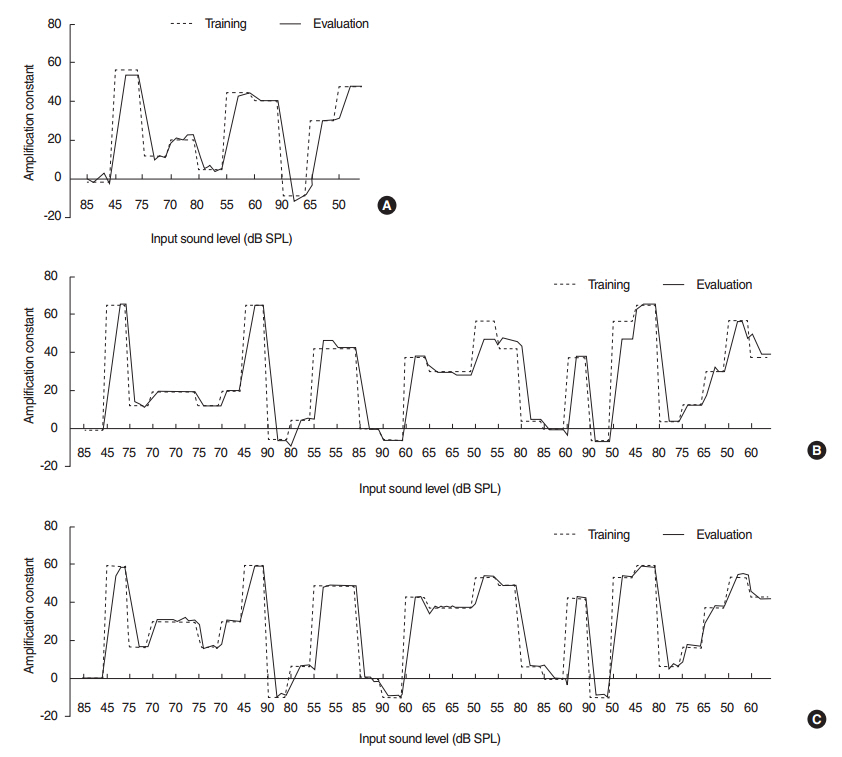
Fig. 3. Amplification constant (AMP) variation patterns when training was performed using TS_1 and verification using TS_2 (unit: dB): (A) Speech-only. (B) Noise-only. (C) Speech-in-noise. Dotted line indicates data collected during training. Solid line indicates amplification output by the proposed algorithm. SPL, sound pressure level.
Reference
-
1. World Health Organization. WHO global estimates on prevalence of hearing loss: morality and burden of diseases and prevention of blindness and deafness WHO, 2012. Geneva: World Health Organization;2012.2. McPherson B. Innovative technology in hearing instruments: matching needs in the developing world. Trends Amplif. 2011; Dec. 15(4):209–14.3. Kochkin S. MarkeTrak VII: customer satisfaction with hearing instruments in the digital age. Hearing J. 2005; Sep. 58(9):30.4. Chalupper J, Junius D, Powers T. Algorithm lets users train aid to optimize compression, frequency shape, and gain. Hearing J. 2009; Aug. 62(8):26.
Article5. Lamarche L, Giguere C, Gueaieb W, Aboulnasr T, Othman H. Adaptive environment classification system for hearing aids. J Acoust Soc Am. 2010; May. 127(5):3124–35.
Article6. Taylor B. Advanced user control optimizes real-world listening preferences. Hearing J. 2011; Mar. 64(3):26.
Article7. Dillon H, Zakis JA, McDermott H, Keidser G, Dreschler W, Convery E. The trainable hearing aid: what will it do for clients and clinicians. Hearing J. 2006; Apr. 59(4):30.8. Kochkin S. MarkeTrak VII: obstacles to adult non-user adoption of hearing aids. Hearing J. 2007; Apr. 60(4):24–51.9. Dreschler WA, Keidser G, Convery E, Dillon H. Client-based adjustments of hearing aid gain: the effect of different control configurations. Ear Hear. 2008; Apr. 29(2):214–27.
Article10. Boymans M, Dreschler WA. Audiologist-driven versus patient-driven fine tuning of hearing instruments. Trends Amplif. 2012; Mar. 16(1):49–58.
Article11. Zakis JA, Dillon H, McDermott HJ. The design and evaluation of a hearing aid with trainable amplification parameters. Ear Hear. 2007; Dec. 28(6):812–30.
Article12. Keidser G, Dillon H, Convery E. The effect of the base line response on self-adjustments of hearing aid gain. J Acoust Soc Am. 2008; Sep. 124(3):1668–81.
Article13. Keidser G, Alamudi K. Real-life efficacy and reliability of training a hearing aid. Ear Hear. 2013; Sep. 34(5):619–29.
Article14. Nielsen JB, Nielsen J, Larsen J. Perception-based personalization of hearing aids using Gaussian processes and active learning. IEEE/ACM Trans Audio Speech Lang Process. 2015; Jan. 23(1):162–73.
Article15. Walden BE, Surr RK, Grant KW, Van Summers W, Cord MT, Dyrlund O. Effect of signal-to-noise ratio on directional microphone benefit and preference. J Am Acad Audiol. 2005; Oct. 16(9):662–76.
Article16. Teutsch H, Elko GW. First- and second-order adaptive differential microphone arrays. In : Proceedings of the 7th International Workshop on Acoustic Echo and Noise Control; 2001 Sep 10-13; Darmstadt, Germany. 35–8.17. Yook S, Nam KW, Kim H, Hong SH, Jang DP, Kim IY. An environment-adaptive management algorithm for hearing-support devices incorporating listening situation and noise type classifiers. Artif Organs. 2015; Apr. 39(4):361–8.
Article18. Schaub A. Digital hearing aids. New York (NY): Thieme Medical Publishers Inc.;2008.19. Buchler M, Allegro S, Launer S, Norbert D. Sound classification in hearing aids inspired by auditory scene analysis. EURASIP J Appl Signal Process. 2005; Jan. 18:2991–3002.20. International Telecommunication Union. P.800: methods for subjective determination of transmission quality [Internet]. Geneva: International Telecommunication Union;c2008. [cited 2016 Jun 1]. Available from: https://www.itu.int/rec/T-REC-P.800-199608-I/en.21. Ricketts TA, Hornsby BW. Sound quality measures for speech in noise through a commercial hearing aid implementing digital noise reduction. J Am Acad Audiol. 2005; May. 16(5):270–7.
Article22. Mueller HG, Hornsby BW, Weber JE. Using trainable hearing aids to examine real-world preferred gain. J Am Acad Audiol. 2008; Nov-Dec. 19(10):758–73.
Article23. Byrne D, Dillon H, Ching T, Katsch R, Keidser G. NAL-NL1 procedure for fitting nonlinear hearing aids: characteristics and comparisons with other procedures. J Am Acad Audiol. 2001; Jan. 12(1):37–51.24. Pierce JL, Kostova T, Dirks KT. The state of psychological ownership: integrating and extending a century of research. Rev Gen Psychol. 2003; Mar. 7(1):84–107.
Article
- Full Text Links
-
- Actions
-
Cited
- CITED
-
- Close
- Share
-
- Similar articles
-
- The Effects of Hearing Aid Digital Noise Reduction and Directionality on Acceptable Noise Level
- Advantages of Binaural Amplification to Acceptable Noise Level of Directional Hearing Aid Users
- Effect of Active Noise Cancelling Earphones on Preferred Listening Level When Listening to Portable Music Players in Noisy Environments
- Subjective Satisfaction in Hearing Aid Users by APHAB
- Hearing Performance Benefits of a Programmable Power Baha(R) Sound Processor with a Directional Microphone for Patients with a Mixed Hearing Loss