J Korean Ophthalmol Soc.
2014 Apr;55(4):480-485.
Higher-Order Aberrations and Visual Acuity with Wavefront-Guided and Wavefront-Optimized Ablation in Laser Keratorefractive Surgery
- Affiliations
-
- 1Department of Ophthalmology, Saevit Eye Hospital, Goyang, Korea. zenith716@hanmail.net
Abstract
- PURPOSE
To compare higher-order aberrations (HOAs) and visual acuity after wavefront-guided and wavefront-optimized laser keratorefractive surgery.
METHODS
This retrospective study consisted of consecutive cases of eyes that underwent wavefront-guided (VISX S4 CustomVue(R)) or wavefront-optimized (WaveLight(R) EX500) laser assisted in situ keratomileusis (LASIK) or photorefractive keratectomy (PRK). Preoperative and postoperative uncorrected visual acuity (UCVA), best corrected visual acuity (BCVA), manifest refraction spherical equivalent (MRSE), and preoperative and 3 month postoperative HOAs were compared.
RESULTS
There were no statistical differences in UCVA, BCVA, MRSE, or total HOAs in either the LASIK and PRK groups (all p > 0.05). Induced amount of spherical aberration (SA) was significantly lower in the wavefront-optimized LASIK and PRK than wavefront-guided LASIK and PRK.
CONCLUSIONS
In laser keratorefractive surgery, wavefront-guided and wavefront-optimized platforms produced equivalent visual outcomes and no differences in total HOAs. However, the wavefront-optimized platform caused less spherical aberration 3 months after operation.
MeSH Terms
Figure
-
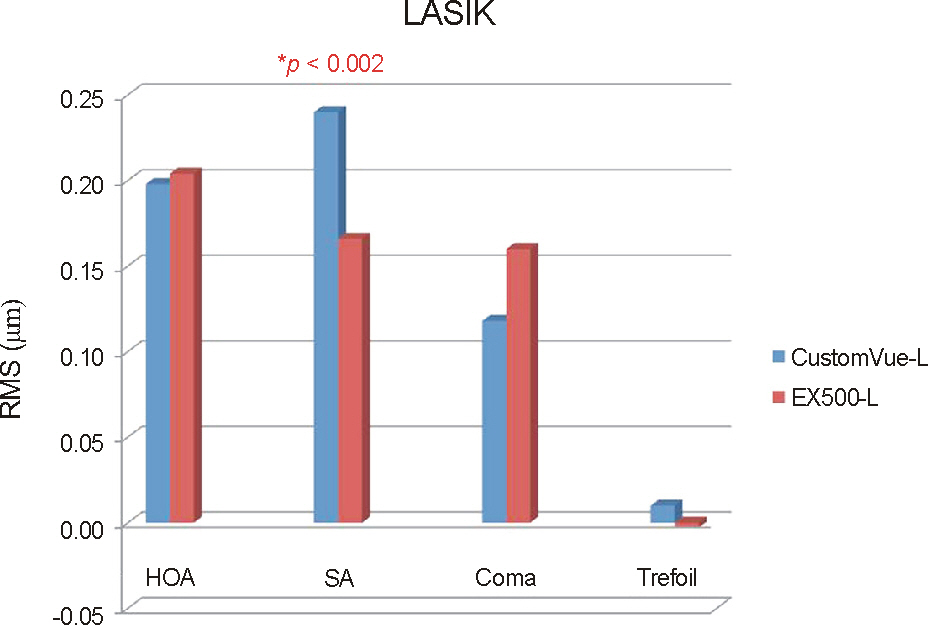
Figure 1. Postoperative changes in HOAs by group in LASIK. HOA = higher-order aberration; SA = spherical aberration.
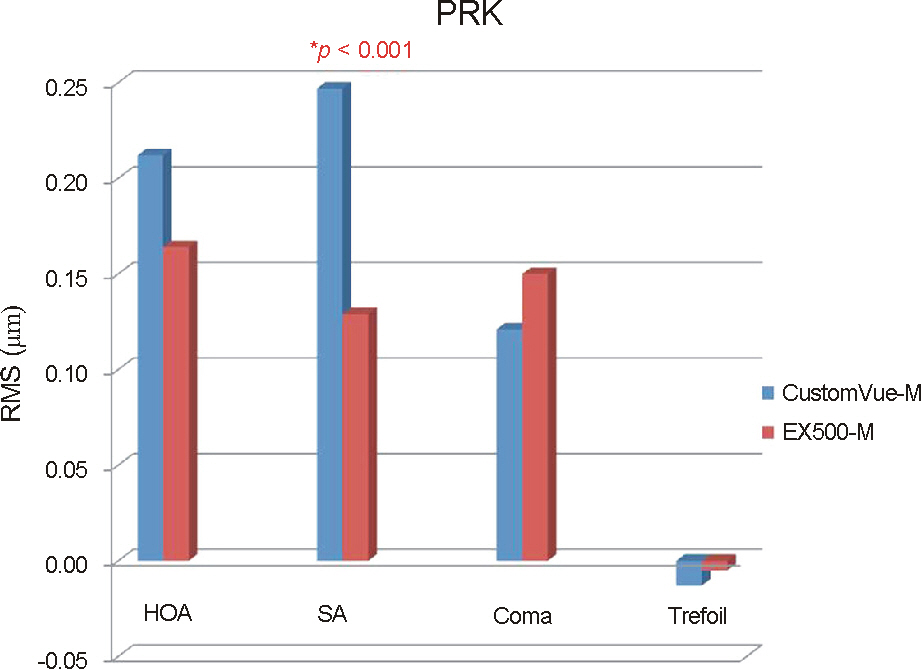
Figure 2. Postoperative changes in HOAs by group in PRK. HOA = higher-order aberration; SA = spherical aberration.
Reference
-
References
1. Netto MV, Dupps W Jr, Wilson SE. Wavefront-guided ablation: evidence for efficacy compared to traditional ablation. Am J Ophthalmol. 2006; 141:360–8.
Article2. Thibos LN, Applegate RA, Schwiegerling JT, Webb R. Standards for reporting the optical aberrations of eyes. J Refract Surg. 2002; 18:S652–60.
Article3. Netto MV, Ambrósio R Jr, Shen TT, Wilson SE. Wavefront analysis in normal refractive surgery candidates. J Refract Surg. 2005; 21:332–8.
Article4. Yoon G, Macrae S, Williams DR, Cox IG. Causes of spherical aberration induced by laser refractive surgery. J Cataract Refract Surg. 2005; 31:127–35.
Article5. Roberts C. Biomechanics of the cornea and wavefront-guided laser refractive surgery. J Refract Surg. 2002; 18:S589–92.
Article6. Ahn SM, Seok SS, Park CY. Considering spherical aberration in choosing the wavefront map for laser vision correction. J Korean Ophthalmol Soc. 2011; 52:147–56.
Article7. Miraftab M, Seyedian MA, Hashemi H. Wavefront-guided vs wavefront-optimized LASIK: a randomized clinical trial comparing contralateral eyes. J Refract Surg. 2011; 27:245–50.
Article8. Buzzonetti L, Iarossi G, Valente P, et al. Comparison of wavefront aberration changes in the anterior corneal surface after laser-as-sisted subepithelial keratectomy and laser in situ keratomileusis: preliminary study. J Cataract Refract Surg. 2004; 30:1929–33.
Article9. Chalita MR, Chavala S, Xu M, Krueger RR. Wavefront analysis in post-LASIK eyes and its correlation with visual symptoms, refraction, and topography. Ophthalmology. 2004; 111:447–53.
Article10. Perez-Straziota CE, Randleman JB, Stulting RD. Visual acuity and higher-order aberrations with wavefront-guided and wavefront-optimized laser in situ keratomileusis. J Cataract Refrac Surg. 2010; 36:437–41.
Article11. Padmanabhan P, Mrochen M, Basuthkar S, et al. Wavefront-guided versus wavefront-optimized laser in situ keratomileusis: contralateral comparative study. J Cataract Refract Surg. 2008; 34:389–97.
Article12. Racine L, Wang L, Koch DD. Size of corneal topographic effective optical zone: comparison of standard and customized myopic laser in situ keratomileusis. Am J Ophthalmol. 2006; 142:227–32.
Article13. Zhou C, Chai X, Yuan L, et al. Corneal higher-order aberrations after customized aspheric ablation and conventional ablation for myopic correction. Curr Eye Res. 2007; 32:431–8.
Article14. Brint SF. Higher order aberrations after LASIK for myopia with al-con and wavelight lasers: a prospective randomized trial. J Refract Surg. 2005; 21:S799–803.
Article15. Stonecipher KG, Kezirian GM. Wavefront-optimized versus wavefront-guided LASIK for myopic astigmatism with the ALLEGRETTO WAVE: three-month results of a prospective FDA trial. J Refract Surg. 2008; 24:S424–30.16. Mrochen M, Kaemmerer M, Seiler T. Clinical results of wavefront-guided laser in situ keratomileusis 3 months after surgery. J Cataract Refract Surg. 2001; 27:201–7.
Article17. Hong JT, Lee JE, Kim JY, et al. Clinical results of wavefront-guided LASIK. J Korean Ophthalmol Soc. 2010; 51:1438–44.
Article18. Lee SM, Lee MJ, Kim MK, et al. Comparison of changes in high-er-order aberrations between conventional and wavefront-guided PRK. J Korean Ophthalmol Soc. 2007; 48:1028–35.19. Moshirfar M, Espandar L, Meyer JJ, et al. Prospective randomized trial of wavefront-guided laser in situ keratomileusis with the CustomCornea and CustomVue laser systems. J Cataract Refract Surg. 2007; 33:1727–33.
Article20. Awwad ST, Bowman RW, Cavanagh HD, McCulley JP. Wavefront-guided LASIK for myopia using the LADAR CustomCornea and the VISX CustomVue. J Refract Surg. 2007; 23:26–38.
Article21. Tran DB, Shah V. Higher order aberrations comparison in fellow eyes following intraLase LASIK with wavelight allegretto and customcornea LADArvision4000 systems. J Refract Surg. 2006; 22:S961–4.
Article22. Kulkamthorn T, Silao JN, Torres LF, et al. Wavefront-guided laser in situ keratomileusis in the treatment of high myopia by using the CustomVue wavefront platform. Cornea. 2008; 27:787–90.
Article23. Reinstein DZ, Neal DR, Vogelsang H, et al. Optimized and wavefront guided corneal refractive surgery using the Carl Zeiss Meditec platform: the WASCA aberrometer, CRS-Master, and MEL80 excimer laser. Ophthalmol Clin North Am. 2004; 17:191–210.
Article
- Full Text Links
-
- Actions
-
Cited
- CITED
-
- Close
- Share
-
- Similar articles
-
- Comparison of Wavefront Guided Customized Ablation vs. Conventional Ablation
- Comparison of Higher-order Aberrations (HOAs) between Wavefront-guided Laser in Situ Keratomileusis and Laser Epithelial Keratomileusis
- Change of High-order Aberration after Wavefront-guided LASIK and LASEK
- Comparison of Corneal Wavefront-optimized and Wavefront-guided Alcohol-assisted Photorefractive Keratectomy Using Schwind Amaris 750S Laser for Myopia
- Comparison of Outcomes after Wavefront-optimized and Topography-guided Transepithelial Photorefractive Keratectomy