
Korean J Urol.
2011 Dec;52(12):829-834.
Outcomes of Transurethral Removal of Intravesical or Intraurethral Mesh Following Midurethral Sling Surgery
- Affiliations
-
- 1Department of Urology, Samsung Changwon Hospital, Sungkyunkwan University School of Medicine, Changwon, Korea. ysuro.lee@samsung.com
Abstract
- PURPOSE
To present outcomes of transurethral removal (TUR) of intravesical or intraurethral mesh after midurethral slings.
MATERIALS AND METHODS
This was a retrospective chart review of 23 consecutive women: 20 with intravesical mesh and 3 with intraurethral mesh.
RESULTS
To remove the mesh, transurethral resection with an electrode loop (TUR-E) was used in 16 women and transurethral resection with a holmium laser (TUR-H) was used in 7. The median follow-up was 2.1 months. Twenty-six percent of the women (6/23) had a mesh remnant: 6.2% (1/16) of the women treated with TUR-E and 71.4% (5/7) of the women treated with TUR-H. Of the 5 women treated with TUR-H, 3 underwent concomitant transvaginal removal. On the follow-up cystoscopic exam, a mesh remnant was observed in 3 women (1 treated with TUR-E and 2 treated with TUR-H). Vesico-vaginal fistulas were found in 2 women during and after TUR-E, respectively. Stress urinary incontinence recurred in 1 woman.
CONCLUSIONS
TUR-E has a high success rate but carries a risk of bladder perforation. Complete resection using TUR-H depends on the location of the mesh and the range of motion of the instrument.
Keyword
MeSH Terms
Figure
-

FIG. 1 Pictures of the transurethral resection with an electrode loop for intravesical mesh. (A) Preoperative finding: stone encrustation. (B) Postoperative finding: no mesh remained and perivesical fat was seen.

FIG. 2 Pictures of the transurethral resection with a holmium laser for intravesical mesh. (A) Preoperative finding: stone encrustation. (B) Postoperative finding: no mesh remained.
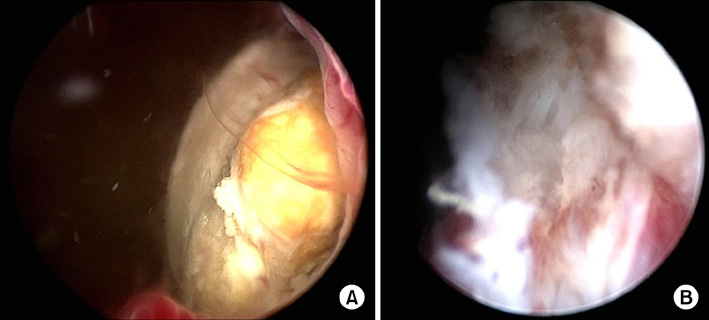
FIG. 3 Pictures of the combined transvaginal and transurethral resection with a holmium laser for intraurethral mesh. (A) Preoperative finding: stone encrustation. (B) Postoperative finding: no mesh remained after transvaginal removal.
Reference
-
1. Lee YS, Lee HN, Lee KS. The evolution of surgical treatment for female stress urinary incontinence: era of mid-urethral slings. Korean J Urol. 2010. 51:223–232.2. Abouassaly R, Steinberg JR, Lemieux M, Marois C, Gilchrist LI, Bourque JL, et al. Complications of tension-free vaginal tape surgery: a multi-institutional review. BJU Int. 2004. 94:110–113.3. Novara G, Galfano A, Boscolo-Berto R, Secco S, Cavalleri S, Ficarra V, et al. Complication rates of tension-free midurethral slings in the treatment of female stress urinary incontinence: a systematic review and meta-analysis of randomized controlled trials comparing tension-free midurethral tapes to other surgical procedures and different devices. Eur Urol. 2008. 53:288–308.4. Meschia M, Pifarotti P, Bernasconi F, Guercio E, Maffiolini M, Magatti F, et al. Tension-Free vaginal tape: analysis of outcomes and complications in 404 stress incontinent women. Int Urogynecol J Pelvic Floor Dysfunct. 2001. 12:Suppl 2. S24–S27.5. McLennan MT, Melick CF. Bladder perforation during tension-free vaginal tape procedures: analysis of learning curve and risk factors. Obstet Gynecol. 2005. 106:1000–1004.6. Gold RS, Groutz A, Pauzner D, Lessing J, Gordon D. Bladder perforation during tension-free vaginal tape surgery: does it matter? J Reprod Med. 2007. 52:616–618.7. Koelbl H, Stoerer S, Seliger G, Wolters M. Transurethral penetration of a tension-free vaginal tape. BJOG. 2001. 108:763–765.8. Baracat F, Mitre AI, Kanashiro H, Montellato NI. Endoscopic treatment of vesical and urethral perforations after tension-free vaginal tape (TVT) procedure for female stress urinary incontinence. Clinics (Sao Paulo). 2005. 60:397–400.9. Starkman JS, Wolter C, Gomelsky A, Scarpero HM, Dmochowski RR. Voiding dysfunction following removal of eroded synthetic mid urethral slings. J Urol. 2006. 176:1040–1044.10. Doumouchtsis SK, Lee FY, Bramwell D, Fynes MM. Evaluation of holmium laser for managing mesh/suture complications of continence surgery. BJU Int. 2011. 108:1472–1478.11. Volkmer BG, Nesslauer T, Rinnab L, Schradin T, Hautmann RE, Gottfried HW. Surgical intervention for complications of tension-free vaginal tape procedure. J Urol. 2003. 169:570–574.12. Deng DY, Rutman M, Raz S, Rodriguez LV. Presentation and management of major complications of midurethral slings: Are complications under-reported? Neurourol Urodyn. 2007. 26:46–52.13. Irer B, Aslan G, Cimen S, Bozkurt O, Celebi I. Development of vesical calculi following tension-free vaginal tape procedure. Int Urogynecol J Pelvic Floor Dysfunct. 2005. 16:245–246.14. Kielb SJ, Clemens JQ. Endoscopic excision of intravesical tension-free vaginal tape with laparoscopic instrument assistance. J Urol. 2004. 172:971.15. Jorion JL. Endoscopic treatment of bladder perforation after tension-free vaginal tape procedure. J Urol. 2002. 168:197.16. Giri SK, Drumm J, Flood HD. Endoscopic holmium laser excision of intravesical tension-free vaginal tape and polypropylene suture after anti-incontinence procedures. J Urol. 2005. 174:1306–1307.17. Frenkl TL, Rackley RR, Vasavada SP, Goldman HB. Management of iatrogenic foreign bodies of the bladder and urethra following pelvic floor surgery. Neurourol Urodyn. 2008. 27:491–495.18. Hodroff M, Portis A, Siegel SW. Endoscopic removal of intravesical polypropylene sling with the holmium laser. J Urol. 2004. 172:1361–1362.19. Feiner B, Auslender R, Mecz Y, Lissak A, Stein A, Abramov Y. Removal of an eroded transobturator tape from the bladder using laser cystolithotripsy and cystoscopic resection. Urology. 2009. 73:681.e15–681.e16.20. Doumouchtsis SK, Lee FY, Bramwell D, Fynes MM. Evaluation of holmium laser for managing mesh/suture complications of continence surgery. BJU Int. 2011. 108:1472–1478.21. Oh TH, Ryu DS. Transurethral resection of intravesical mesh after midurethral sling procedures. J Endourol. 2009. 23:1333–1337.
- Full Text Links
-
- Actions
-
Cited
- CITED
-
- Close
- Share
-
- Similar articles
-
- Recurrent Urinary Tract Infection from Urethral Mesh Erosion after Midurethral Mesh Sling Surgery
- Twenty-Five Years of the Midurethral Sling: Lessons Learned
- Second-Line Surgical Management After Midurethral Sling Failure
- Causes of Reoperation after Midurethral Sling Procedures in Female Stress Urinary Incontinence
- Current Overview of Surgical Options for Female Stress Urinary Incontinence


