
Diagnosis of the Deep Vein Thrombosis with Multidetector-Row Computed Tomographic Venography after Total Knee Arthroplasty
- Affiliations
-
- 1Department of Orthopedics, Chonnam National University Medical School, Center for Joint Disease,Chonnam National University Hwasun Hospital, Jeonnam, Korea. eksong@chonnam.ac.kr
- KMID: 2186444
- DOI: http://doi.org/10.4055/jkoa.2008.43.3.294
Abstract
-
PURPOSE: Using the 64-channel multidetector-row computed tomographic venography (MDCT venography), we tried to know the incidence of the deep vein thrombosis (DVT) after total knee arthroplasty and the effectiveness of MDCT venography.
MATERIALS AND METHODS
From April 2006 to December 2006, two groups of 280 consecutive patients, who underwent primary total knee arthroplasty, were enrolled in this study. We performed antithrombotic chemotherapy on the patients who were confirmed to have symptomatic DVT.
RESULTS
For the first 140 consecutive cases, DVT was found in 48 (34%) patients and only 5 (3.6%) showed clinical symptoms of DVT. For the next 140 cases, 12 (8.6%) cases showed symptoms of DVT and in them 7 (5.0%) of these cases was diagnosed with symptomatic DVT. All the patients had recovered at the last follow-up and no other complications occurred in our series.
CONCLUSION
Sixty four-channel MDCT venography is valuable as a diagnostic test for DVT after total knee arthroplasty in terms of efficacy and accuracy. Antithrombotic chemotherapy is recommended
MeSH Terms
Figure
-
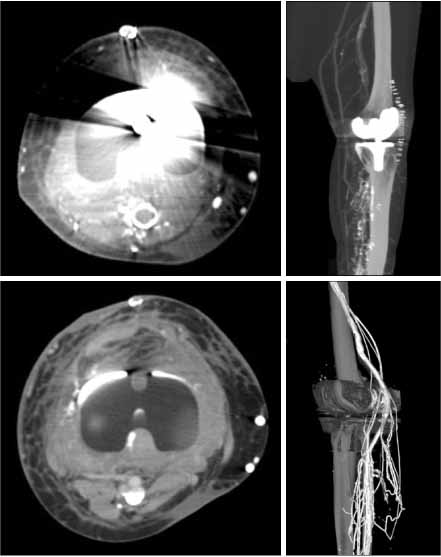
Fig. 1 A 64-year old woman, who underwent total knee arthroplasty on her right knee, was diagnosed with deep vein thrombosis in the popliteal area by multidetector-row computed tomographic venography.
Cited by 2 articles
-
Comparison of Hematologic Changes between Rivaroxaban and Aspirin for Venous Thromboembolism Prophylaxis after Total Knee Arthroplasty
Moo-Ho Song, Bu-Hwan Kim, Seong-Jun Ahn, Seong-Ho Yoo, Yeong-Joon Kim
J Korean Orthop Assoc. 2012;47(6):410-415. doi: 10.4055/jkoa.2012.47.6.410.Comparison of Hematologic Changes between Rivaroxaban and Aspirin for Venous Thromboembolism Prophylaxis after Total Knee Arthroplasty
Moo-Ho Song, Bu-Hwan Kim, Seong-Jun Ahn, Seong-Ho Yoo, Yeong-Joon Kim
J Korean Orthop Assoc. 2012;47(6):410-415. doi: 10.4055/jkoa.2012.47.6.410.
Reference
-
1. Coche EE, Hamoir XL, Hammer FD, Hainaut P, Goffette PP. Using dual-detector helical CT angiography to detect deep vein thrombosis in patients with suspicion of pulmonary embolism: diagnostic value and additional findings. AJR Am J Roentgenol. 2001. 176:1035–1039.2. Cohen SH, Ehrlich GE, Kauffman MS, Cope C. Thrombophlebitis following knee surgery. J Bone Joint Surg Am. 1973. 55:106–112.
Article3. Duwe KM, Shiau M, Budorick NE, Austin JH, Berkmen YM. Evaluation of the lower extremity veins in patients with suspected pulmonary embolism: a retrospective comparison of helical CT venography and sonography. 2000 ARRS Executive Council Award I. American Roentgen Ray Society. AJR Am J Roentgenol. 2000. 175:1525–1531.4. Elias A, Aptel I, Huc B, et al. D-dimer test and diagnosis of deep vein thrombosis: a comparative study of 7 assays. Thromb Haemost. 1996. 76:518–522.
Article5. Geerts WH, Heit JA, Clagett GP, et al. Prevention of venous thromboembolism. Chest. 2001. 119:Suppl 1. S132–S175.
Article6. Khaw FM, Moran CG, Pinder IM, Smith SR. The incidence of fatal pulmonary embolism after knee replacement with no prophylactic anticoagulation. J Bone Joint Surg Br. 1993. 75:940–941.
Article7. Kim YH. The incidence of deep vein thrombosis after cementless and cemented knee replacements. J Bone Joint Surg Br. 1990. 72:779–783.8. Kim YH, Kim JS. Incidence and natural history of deep-vein thrombosis after total knee arthroplasty. A prospective, randomized study. J Bone Joint Surg Br. 2002. 84:566–570.9. Kim YH, Suh JS. Low incidence of deep-vein thrombosis after cementless total hip replacement. J Bone Joint Surg Am. 1988. 70:878–882.
Article10. Ko PS, Chan WF, Siu TH, Khoo J, Wu WC, Lam JJ. Deep vein thrombosis after total hip or knee arthroplasty in a "low-risk" Chinese population. J Arthroplasty. 2003. 18:174–179.11. Lee YG, Kim MK, Cho KJ, et al. The diagnostic availability of multidetector-row computed tomography (MDCT) in deep vein thrombosis developed after joint arthroplasty. J Korean Orthop Assoc. 2006. 41:134–139.12. Leyvrza PF, Richard J, Bachmann F, et al. Adjusted versus fixed-dose subcutaneous heparin in the prevention of deep-vein thrombosis after total hip replacement. N Engl J Med. 1983. 309:954–958.
Article13. Mont MA, Jones LC, Rajadhyaksha AD, et al. Risk factors for pulmonary emboli after total hip or knee arthroplasty. Clin Orthop Relat Res. 2004. 422:154–163.
Article14. Morrey BF, Adams RA, Ilstrup DM, Bryan RS. Complications and mortality associated with bilateral or unilateral total knee arthroplasty. J Bone Joint Surg Am. 1987. 69:484–488.
Article15. Moser KM. Pulmonary embolism. Am Rev Respir Dis. 1977. 115:829–852.16. Paiement G, Wessinger SJ, Waltman AC, Harris WH. Surveillance of deep vein thrombosis in asymptomatic total hip replacement patients. Impedance phlebography and fibrinogen scanning versus roentgenographic phlebography. J Am Surg. 1988. 155:400–404.17. Patterson BM, Marchand R, Ranawat C. Complications of heparin therapy after total joint arthroplasty. J Bone Joint Surg Am. 1989. 71:1130–1134.
Article18. Perrier A, Bounameaux H. Cost-effective diagnosis of deep vein thrombosis and pulmonary embolism. Thromb Haemost. 2001. 86:475–487.
Article19. Prokop M. General principles of MDCT. Eur J Radiol. 2003. 45:Suppl 1. S4–S10.
Article20. Sharrock NE, Brien WW, Salvati EA, Mineo R, Garvin K, Sculco TP. The effect of intravenous fixed-dose heparin during total hip arthroplasty on the incidence of deep-vein thrombosis. A randomized, double-blind trial in patients operated on with epidural anesthesia and controlled hypotension. J Bone Joint Surg Am. 1990. 72:1456–1461.
Article21. Shiota N, Sato T, Nishida K, et al. Changes in LPIA D-dimer levels after total hip or knee arthroplasty relevant to deep-vein thrombosis diagnosed by bilateral ascending venography. J Orthop Sci. 2002. 7:444–450.
Article22. Song EK, Lee KB, Seon JK, Kim JK. Deep vein thrombosis after joint arthroplasty in lower extremity. Venography versus color Doppler ultrasonography. J Korean Orthop Assoc. 1999. 34:31–36.
Article23. Warwick DJ, Whitehouse S. Symptomatic venous thromboembolism after total knee replacement. J Bone Joint Surg Br. 1997. 79:780–786.
Article24. White RH, Henderson MC. Risk factors for venous thromboembolism after total hip and knee replacement surgery. Curr Opin Pulm Med. 2002. 8:365–371.
Article25. Yoo MC, Cho YJ, Kim KI, Im YJ, Cho KY, Ryu KN. Incidence of deep vein thrombosis after major hip surgery and diagnostic value of D-dimer. J Korean Orthop Assoc. 2006. 41:103–109.
- Full Text Links
-
- Actions
-
Cited
- CITED
-
- Close
- Share
-
- Similar articles
-
- Incidence of Venous Thromboembolism Using 64 Channel Multidetector Row Computed Tomography-Indirect Venography and Anti-Coagulation Therapy after Total Knee Arthroplasty in Korea
- Evaluation of Deep Vein Thrombosis with Multidetector Row CT after Orthopedic Arthroplasty: a Prospective Study for Comparison with Doppler Sonography
- Deep Vein Thrombosis after Total Knee Replacement: Incidence and correlation with clinical risk factors
- May–Thurner Syndrome after Total Knee Arthroplasty
- The Incidence of Deep Vein Thrombosis in the Lower Extremity


