J Bacteriol Virol.
2010 Mar;40(1):19-28. 10.4167/jbv.2010.40.1.19.
Surveillance of Legionella Contamination on Water Supply Systems of Public Utilizing Facilities in Gwangju, Korea
- Affiliations
-
- 1Health & Environment Institute of Gwangju, Gwangju, Korea. jkchung@korea.kr
- KMID: 1456250
- DOI: http://doi.org/10.4167/jbv.2010.40.1.19
Abstract
- Legionella is a pathogenic bacteria associated to aquatic habit of natural and artificial environments. Clinical cases of legionellosis have been reported in Korea but there is a lack of information about the incidence of this bacterium on environmental sources. Thus, we investigated the contamination of Legionella on water supply systems in Gwangju, Korea, including cooling towers, public baths, hospitals and fountains. Legionella spp. were detected from 81 samples (16.9%) out of 480 samples collected and the major species of Legionella isolates was identified to L. pneumophila serogroup (sg) 1 (n=33). The result of PFGE pattern analysis for L. pneumophila sg 1 isolates was discriminated into 11 pulsotypes. In dendrogram of PFGE, the clusters of isolates from cooling tower were quite different from those derived from hot water system of public bath. Surveillance for 4 sentinel public baths showed that their water supply systems had been contaminated with Legionella spp. and L. pneumophila sg 5 or sg 6 was the major isolate. The similarity of its PFGE patterns was 92.3%, 96.6%, respectively. Thus, PFGE may be a useful tool in molecular epidemiology studies, and the monitor and control for water supply systems of public utilizing facilities will be able to provide a resolution for the reduction of Legionella infection.
Keyword
MeSH Terms
Figure
-
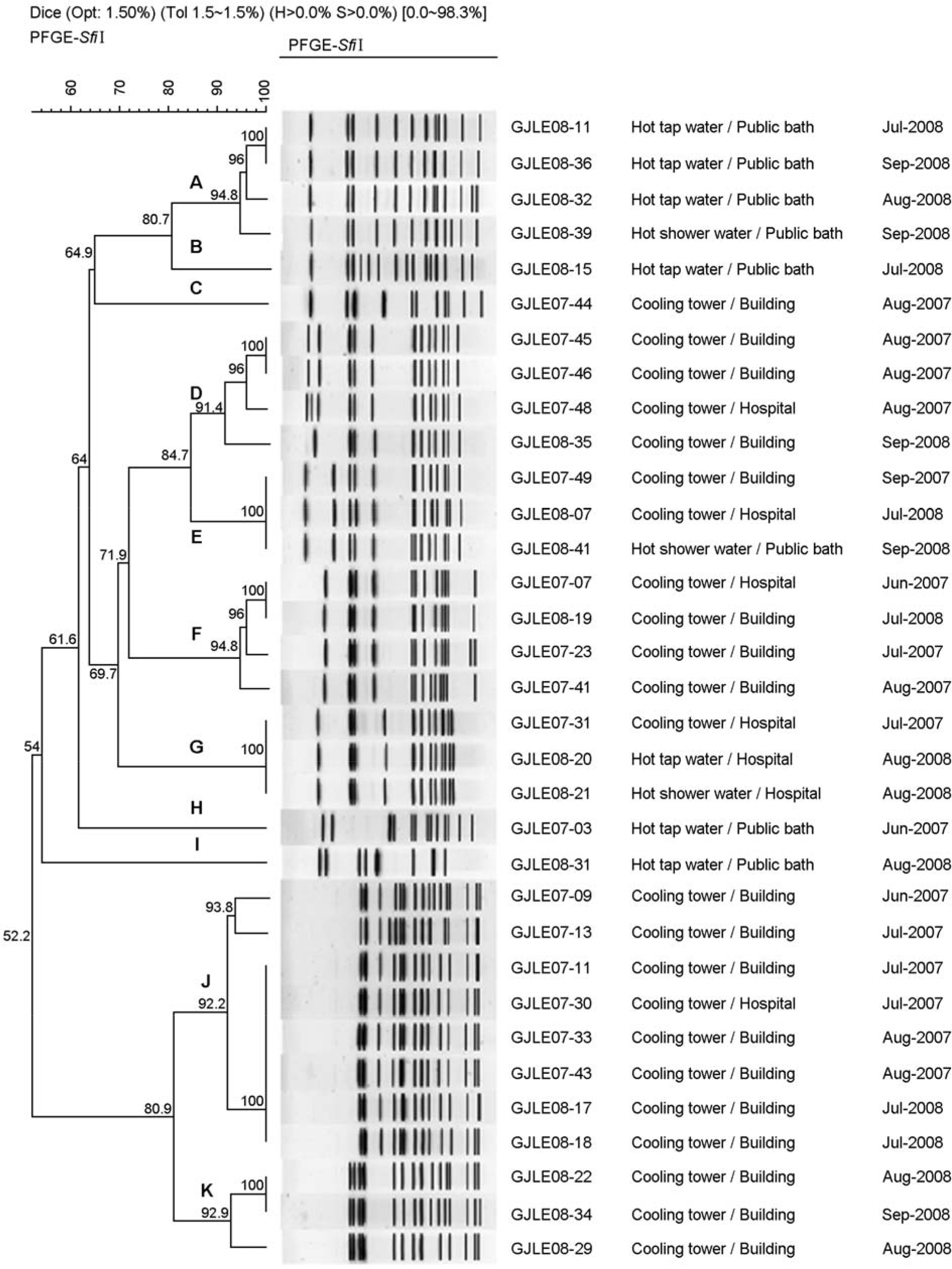
Figure 1. Clustering of L. pneumophila sg 1 isolates by PFGE pattern. Dendrogram corresponding to PFGE electrophoretic patterns in accordance with UPGMA clusting on a matrix based on the Dice coefficient.
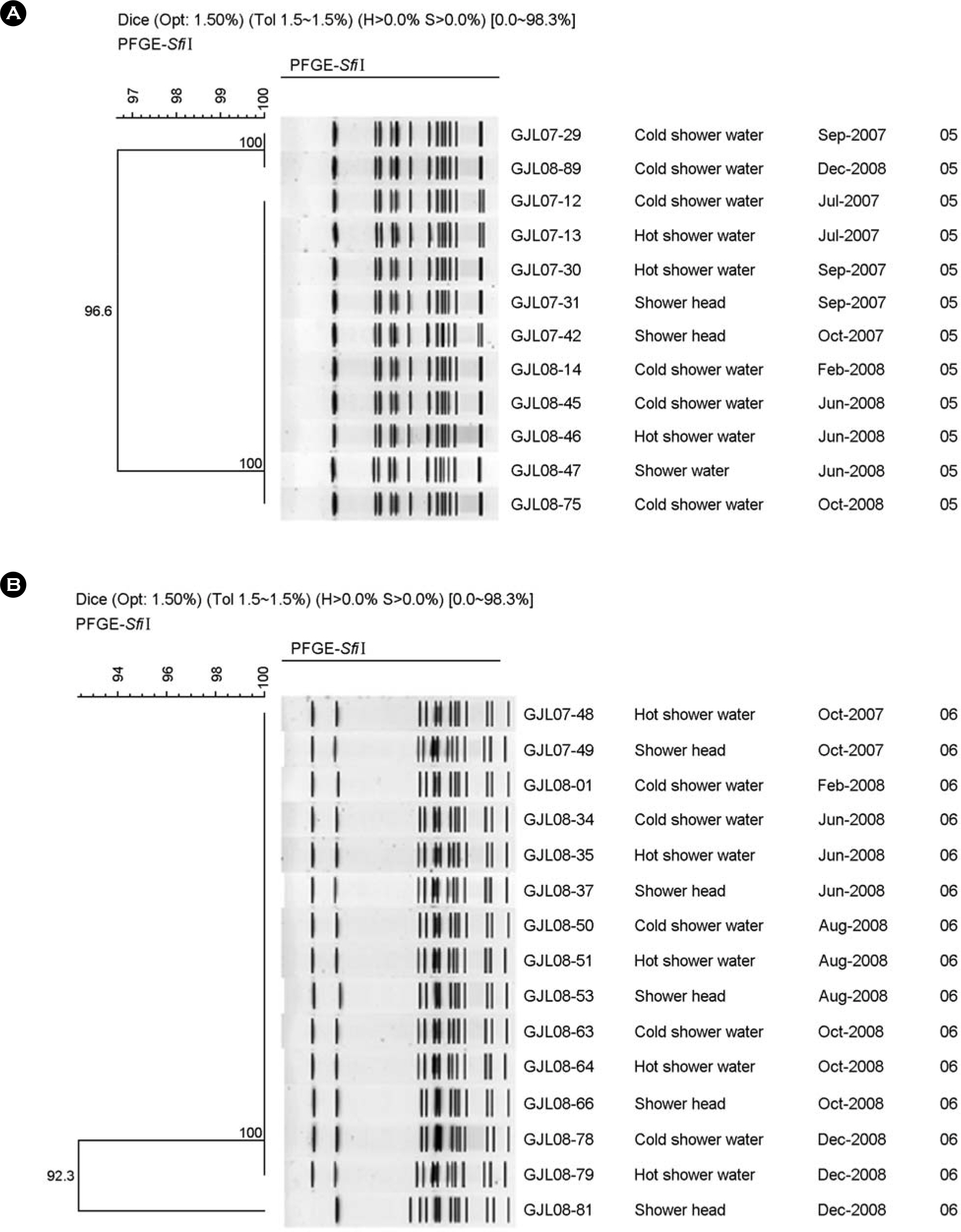
Figure 2. Analysis of PFGE of L. pneumophila sg 5 (A) and L. pneumophila sg 6 (B) isolates derived from 2 sentinel public baths, respectively.
Reference
-
1). Fields BS., Benson RF., Besser RE. Legionella and Legionnaires' Disease: 25 Years of Investigation. Clin Microbiol Rev. 2002. 15:506–26.2). Greig JE., Carnie JA., Tallis GF., Ryan NJ., Tan AG., Gordon IR., Zwolak B., Leydon JA., Guest CS., Hart WG. An outbreak of Legionnaires' disease at the Melbourne Aquarium, April 2000: investigation and case-control studies. Med J Aust. 2004. 180:566–72.
Article3). García-Fulgueiras A., Navarro C., Fenoll D., García J., González-Diego P., Jiménez-Buñuales T., Rodriguez M., Lopez R., Pacheco F., Ruiz J., Segovia M., Balandrón B., Pelaz C. Legionnaires' disease outbreak in Murcia, Spain. Emerg Infect Dis. 2003. 9:915–21.
Article4). Yamamoto H., Hashimoto Y., Ezaki T. Comparison of detection methods for Legionella species in environmental water by colony isolation, fluorescent antibody staining, and polymerase chain reaction. Microbiol Immunol. 1993. 37:617–22.5). Riffard S., Lo Presti F., Vandenesch F., Forey F., Reyrolle M., Etienne J. Comparative analysis of infrequent-restriction-site PCR and pulsed-field gel electrophoresis for epidemiological typing of Legionella pneumophila serogroup 1 strains. J Clin Microbiol. 1998. 36:161–7.6). Pruckler JM., Mermel LA., Benson RF., Giorgio C., Cassiday PK., Breiman RF., Whitney CG., Fields BS. Comparison of Legionella pneumophila isolates by arbitrarily primed PCR and pulsed-field gel electrophoresis: analysis from seven epidemic investigations. J Clin Microbiol. 1995. 33:2872–5.7). Breiman RF., Butler JC. Legionnaires' disease: clinical, epidemiological, and public health perspectives. Semin Respir Infect. 1998. 13:84–9.8). Plouffe JF Jr., File TM Jr. Update of Legionella infections. Curr Opin Infect Dis. 1999. 12:127–32.9). 國立感染症硏究所, 衛生省保健醫療局, 結核感染症課. 病原微生物檢出情報, Infectious Agents Surveillance Report. ISAR. 2000. 21:1–8.10). Kim JS., Lee SW., Shim HS., Oh DK., Cho MK., Oh HB., Woo JH., Chong YS. Outbreak of Legionellosis in ICU of K Hospital, Korea. Korean J Epideiol. 1985. 7:44–58.11). Choi TY. Legionella Infection. Korean J Clin Microbiol. 1998. 1:24–32.12). Lee HK., Park EH., Yoo JY., Oh HB., Kang YH. IgM and IgG antibody response in paired sera of 58 patients confirmed as Legionnaires' disease in 1994-2006, Korea. 2007. Abstr. 39. p.S318. Infect. Chemother.13). Yu VL., Plouffe JF., Pastoris MC., Stout JE., Schousboe M., Widmer A., Summersgill J., File T., Heath CM., Paterson DL., Chereshsky A. Distribution of Legionella species and sero-groups isolated by culture in patients with sporadic community-acquired legionellosis: an international collaborative survey. J Infect Dis. 2002. 186:127–8.14). Bartram J., Chartier Y., Lee JV., Pond K., Suman-Lee S. Legionella and the prevention of legionellosis. 2007. p. 13. World health Organization;Geneva, Swizerland:15). Diversity of Legionella isolates from public utilizing facilities, 2008, Public Health Weekly Report. KCDC. 2009. 2:433–7.16). Drenning SD., Stout JE., Joly JR., Yu VL. Unexpected similarity of pulsed-field gel electrophoresis patterns of unrelated clinical isolates of Legionella pneumophila, serogroup 1. J Infect Dis. 2001. 183:628–32.17). Lawrence C., Reyrolle M., Dubrou S., Forey F., Decludt B., Goulvestre C., Matsiota-Bernard P., Etienne J., Nauciel C. Single clonal origin of a high proportion of Legionella pneumophila serogroup 1 isolates from patients and the environment in the area of Paris, France, over a 10-year period. J Clin Microbiol. 1999. 37:2652–5.18). Thouverez M., Godard C., Leprat R., Talon D. Is pulsed-field gel electrophoresis a valuable tool to identify nosocomial cases of Legionella pneumophila disease? J Hosp Infect. 2003. 55:254–9.19). Kim JM., Jeong SH., Seo D., Park EH., Song EJ., Choi JC., Lee EY., Chang C. Molecular strain typing of Legionella isolates from water in cooling towers of big building in Busan, Korea. Korean J Clin Microbiol. 2004. 7:38–42.20). Seung HJ., Jung JH., Kim SJ., Jin YH., Lee SM., Kim MS., Kim JG. Molecular epidemiological study of Legionella pneumophila isolated from water systems in Seoul. The Report of Research Institute of Public Health & Environment. 2007. 43:283–93.
- Full Text Links
-
- Actions
-
Cited
- CITED
-
- Close
- Share
-
- Similar articles
-
- Community-acquired Legionnaires’ Disease in a Newly Constructed Apartment Building
- Isolation of the Legionella Species from Specimens of Cooling Tower Water
- A Surveillance Study of Cooling Tower Water of Large Buildings in Seoul City for Legionella Species with Molecular Analysis
- Outbreak of Nosocomial Legionellosis Managed by Adoption of Chlorine Dioxide Infusion System
- A Molecular Epidemiological Study on a Cluster of Legionella Pneumonia Occurred in a Tertiary-Care Hospital