
Intra-Articular Injury Associated with Distal Radius Fracture
- Affiliations
-
- 1Department of Orthopaedic Surgery, Seoul National University College of Medicine, Seoul, Korea. hsgong@snu.ac.kr
- KMID: 1424111
- DOI: http://doi.org/10.4055/jkoa.2013.48.2.157
Abstract
- Distal radius fractures are commonly associated with intra-articular injuries such as carpal ligament injuries and triangular fibrocartilage complex (TFCC) injuries. Such injuries occurring in elderly patients with a low-energy distal radius fracture can be treated successfully with cast immobilization and do not usually lead to clinical problems. However, despite healing of the fracture, some intra-articular injuries, especially in active patients with a high-energy fracture, can result in persistent pain and disability. In addition, the current trend of internal fixation and early use of the wrist may actually increase instability due to inadequate healing of the ligament injuries. Due to a lack of typical symptoms and physical findings in acute fracture settings, detection of these injuries is not easy. Arthroscopic examination, as well as radiographs and intraoperative fluoroscopic findings, are useful in detection of carpal ligament injuries. Complete ruptures of intercarpal interosseous ligaments warrant temporary interosseous fixation using K-wires. In TFCC injuries, distal radioulnar joint (DRUJ) instability should be assessed after anatomical reduction and fixation of a distal radius fracture. Operative treatments such as open or arthroscopic repair of TFCC to the fovea can guarantee greater stability of the DRUJ. For optimal results, early detection and appropriate treatment of intra-articular injuries associated with distal radius fractures is critical.
MeSH Terms
Figure
-
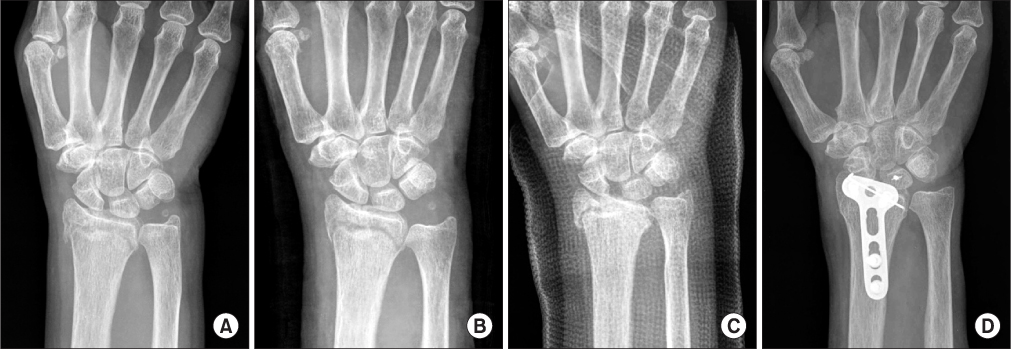
Figure 1 Scapho-lunate interosseous ligament injury associated with a distal radius fracture. (A) The initial radiograph showed an increase in the scapho-lunate distance. (B) The post-reduction radiograph showed a manually reduced radius fracture, which was immobilized with a cast. (C) Radiograph taken three weeks later showed scapho-lunate dissociation and displacement of the radial styloid fragment. Due to the lack of early treatment, open reduction of the fracture and repair of the dorsal interosseous ligament was necessary. (D) One year after open repair of the dorsal interosseous ligament and dorsal plate fixation of the radius, a normal scapho-lunate gap was observed, although the scaphoid appeared to be flexed.
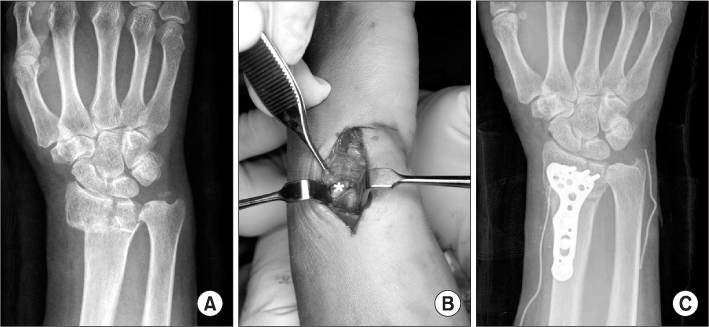
Figure 2 Triangular fibrocartilage complex injury associated with a distal radius fracture. (A) The preoperative radiograph showed an intra-articular comminuted fracture of the distal radius and an ulnar styloid tip fracture. Intraoperative stress testing after fixing the radius revealed increased instability of the distal radioulnar joint, compared with the normal side. (B) Through the ulnar approach protecting the dorsal cutaneous branch of the ulnar nerve, the distal radioulnar ligament insertion that avulsed from the fovea was exposed (asterisk). (C) After trans-osseous repair of the radioulnar ligament to the fovea using pull-out sutures, the distal radioulnar joint stability was immediately recovered.
Reference
-
1. Geissler WB, Freeland AE, Savoie FH, McIntyre LW, Whipple TL. Intracarpal soft-tissue lesions associated with an intra-articular fracture of the distal end of the radius. J Bone Joint Surg Am. 1996. 78:357–365.
Article2. Richards RS, Bennett JD, Roth JH, Milne K Jr. Arthroscopic diagnosis of intra-articular soft tissue injuries associated with distal radial fractures. J Hand Surg Am. 1997. 22:772–776.
Article3. Lindau T, Arner M, Hagberg L. Intraarticular lesions in distal fractures of the radius in young adults. A descriptive arthroscopic study in 50 patients. J Hand Surg Br. 1997. 22:638–643.4. Pechlaner S, Kathrein A, Gabl M, et al. Distal radius fractures and concomitant lesions. Experimental studies concerning the pathomechanism. Handchir Mikrochir Plast Chir. 2002. 34:150–157.5. Smith DW, Henry MH. Comprehensive management of soft-tissue injuries associated with distal radius fractures. J Am Soc Surg Hand. 2002. 2:153–164.
Article6. Leversedge FJ, Srinivasan RC. Management of soft-tissue injuries in distal radius fractures. Hand Clin. 2012. 28:225–233.
Article7. Geissler WB, Fernandez DL, Lamey DM. Distal radioulnar joint injuries associated with fractures of the distal radius. Clin Orthop Relat Res. 1996. 327:135–146.
Article8. Lindau T, Adlercreutz C, Aspenberg P. Peripheral tears of the triangular fibrocartilage complex cause distal radioulnar joint instability after distal radial fractures. J Hand Surg Am. 2000. 25:464–468.
Article9. Lindau T, Hagberg L, Adlercreutz C, Jonsson K, Aspenberg P. Distal radioulnar instability is an independent worsening factor in distal radial fractures. Clin Orthop Relat Res. 2000. 376:229–235.
Article10. Lindau T, Runnquist K, Aspenberg P. Patients with laxity of the distal radioulnar joint after distal radial fractures have impaired function, but no loss of strength. Acta Orthop Scand. 2002. 73:151–156.
Article11. Berger RA, Imeada T, Berglund L, An KN. Constraint and material properties of the subregions of the scapholunate interosseous ligament. J Hand Surg Am. 1999. 24:953–962.
Article12. Ritt MJ, Bishop AT, Berger RA, Linscheid RL, Berglund LJ, An KN. Lunotriquetral ligament properties: a comparison of three anatomic subregions. J Hand Surg Am. 1998. 23:425–431.
Article13. Kwon BC, Baek GH. Fluoroscopic diagnosis of scapholunate interosseous ligament injuries in distal radius fractures. Clin Orthop Relat Res. 2008. 466:969–976.
Article14. Kwon BC, Choi SJ, Song SY, Baek SH, Baek GH. Modified carpal stretch test as a screening test for detection of scapholunate interosseous ligament injuries associated with distal radial fractures. J Bone Joint Surg Am. 2011. 93:855–862.
Article15. Forward DP, Lindau TR, Melsom DS. Intercarpal ligament injuries associated with fractures of the distal part of the radius. J Bone Joint Surg Am. 2007. 89:2334–2340.
Article16. Cooney WP, Dobyns JH, Linscheid RL. Arthroscopy of the wrist: anatomy and classification of carpal instability. Arthroscopy. 1990. 6:133–140.
Article17. Weiss AP, Akelman E, Lambiase R. Comparison of the findings of triple-injection cinearthrography of the wrist with those of arthroscopy. J Bone Joint Surg Am. 1996. 78:348–356.
Article18. Tang JB, Shi D, Gu YQ, Zhang QG. Can cast immobilization successfully treat scapholunate dissociation associated with distal radius fractures? J Hand Surg Am. 1996. 21:583–590.
Article19. Stoffelen D, De Mulder K, Broos P. The clinical importance of carpal instabilities following distal radial fractures. J Hand Surg Br. 1998. 23:512–516.
Article20. Laulan J, Bismuth JP. Intracarpal ligamentous lesions associated with fractures of the distal radius: outcome at one year. A prospective study of 95 cases. Acta Orthop Belg. 1999. 65:418–423.21. Batra S, Gupta A. The effect of fracture-related factors on the functional outcome at 1 year in distal radius fractures. Injury. 2002. 33:499–502.
Article22. Wiesler ER, Chloros GD, Mahirogullari M, Kuzma GR. Arthroscopic management of distal radius fractures. J Hand Surg Am. 2006. 31:1516–1526.
Article23. Peicha G, Seibert F, Fellinger M, Grechenig W. Midterm results of arthroscopic treatment of scapholunate ligament lesions associated with intra-articular distal radius fractures. Knee Surg Sports Traumatol Arthrosc. 1999. 7:327–333.
Article24. Shih JT, Lee HM, Hou YT, Tan CM. Arthroscopically-assisted reduction of intra-articular fractures and soft tissue management of distal radius. Hand Surg. 2001. 6:127–135.
Article25. Adams BD. Effects of radial deformity on distal radioulnar joint mechanics. J Hand Surg Am. 1993. 18:492–498.
Article26. Kihara H, Palmer AK, Werner FW, Short WH, Fortino MD. The effect of dorsally angulated distal radius fractures on distal radioulnar joint congruency and forearm rotation. J Hand Surg Am. 1996. 21:40–47.
Article27. Kwon BC, Seo BK, Im HJ, Baek GH. Clinical and radiographic factors associated with distal radioulnar joint instability in distal radius fractures. Clin Orthop Relat Res. 2012. 470:3171–3179.
Article28. Fujitani R, Omokawa S, Akahane M, Iida A, Ono H, Tanaka Y. Predictors of distal radioulnar joint instability in distal radius fractures. J Hand Surg Am. 2011. 36:1919–1925.
Article29. Kim JP, Park MJ. Assessment of distal radioulnar joint instability after distal radius fracture: comparison of computed tomography and clinical examination results. J Hand Surg Am. 2008. 33:1486–1492.
Article30. Scheer JH, Hammerby S, Adolfsson LE. Radioulnar ratio in detection of distal radioulnar joint instability associated with acute distal radius fractures. J Hand Surg Eur Vol. 2010. 35:730–734.
Article31. Atzei A. New trends in arthroscopic management of type 1-B TFCC injuries with DRUJ instability. J Hand Surg Eur Vol. 2009. 34:582–591.
Article32. Henry MH. Distal radius fractures: current concepts. J Hand Surg Am. 2008. 33:1215–1227.
Article33. Moritomo H. The distal interosseous membrane: current concepts in wrist anatomy and biomechanics. J Hand Surg Am. 2012. 37:1501–1507.
Article34. Nakamura T, Nakao Y, Ikegami H, Sato K, Takayama S. Open repair of the ulnar disruption of the triangular fibrocartilage complex with double three-dimensional mattress suturing technique. Tech Hand Up Extrem Surg. 2004. 8:116–123.
Article35. Ruch DS, Yang CC, Smith BP. Results of acute arthroscopically repaired triangular fibrocartilage complex injuries associated with intra-articular distal radius fractures. Arthroscopy. 2003. 19:511–516.
Article36. Atzei A, Rizzo A, Luchetti R, Fairplay T. Arthroscopic foveal repair of triangular fibrocartilage complex peripheral lesion with distal radioulnar joint instability. Tech Hand Up Extrem Surg. 2008. 12:226–235.
Article37. Iwasaki N, Nishida K, Motomiya M, Funakoshi T, Minami A. Arthroscopic-assisted repair of avulsed triangular fibrocartilage complex to the fovea of the ulnar head: a 2- to 4-year follow-up study. Arthroscopy. 2011. 27:1371–1378.
Article
- Full Text Links
-
- Actions
-
Cited
- CITED
-
- Close
- Share
-
- Similar articles
-
- Clinical Study of Intra-articular Fracture of Distal Radius
- Treatment of the distal radius fractures with open reduction and internal fixation
- A Clinical Study of Anatomic Position Change on the Intra - articular Comminuted Fracture of the Distal Radius
- Radiologic Reduction Loss after Surgical Treatment of Distal Radius Fracture
- Scapholunate Dissociation Associated with Intra-articular Fractures of Distal Radius


