
Treatment of Ulnar Fractures Combined with Distal Radius Fracture
- Affiliations
-
- 1Department of Orthopedic Surgery, Ewha Womans University School of Medicine, Seoul, Korea. kimjk@ewha.ac.kr
- KMID: 1424109
- DOI: http://doi.org/10.4055/jkoa.2013.48.2.151
Abstract
- Approximately 5-6% of distal radius fractures have a concomitant distal ulnar fracture, this incidence is more frequent in osteoporotic elderly patients. When the distal ulnar fracture is stable after fixation of the distal radius fracture, the distal ulnar fracture can be managed with cast immobilization. However, when the distal ulnar fracture shows malalignment or instability, an operative method should be used. The operative method for distal ulnar fracture includes internal fixation using a K-wire, intramedullary nail, or plates and salvage procedures including ulnar head resection or Sauve-Kapandji procedure. Approximately 50% of distal radius fractures are combined with ulnar styloid process fracture. Although approximately 50-70% of ulnar styloid process fractures result in nonunion if they are not treated by an operative method, they tend to be asymptomatic. Recent studies of distal radius fracture treated using a volar locking plate have generally reported that neither the presence nor the size of concomitant ulnar styloid fracture has an effect on clinical outcome.
Figure
-
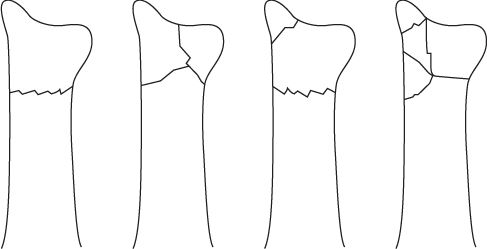
Figure 1 Classification of distal ulnar fracture proposed. Cited from the article of Biyani et al. (Fig. 1) with permission.2)
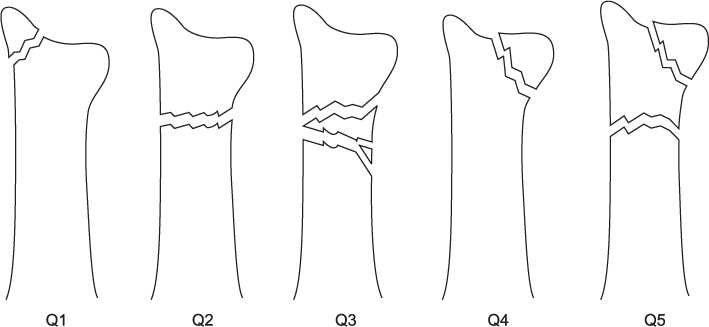
Figure 2 In the comprehensive classification system, the associated fracture of the distal ulna is classified according to a Q system.
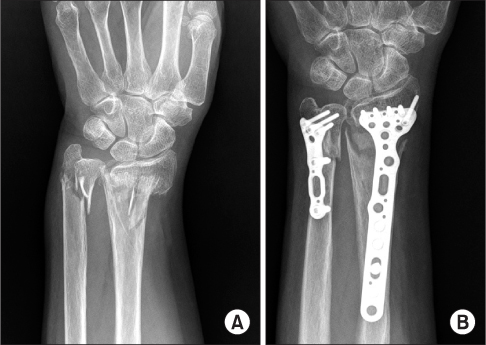
Figure 3 A 74-year-old female patient treated with anatomical locking plate fixation for a concomitant distal ulnar metaphyseal fracture. (A) Preoperative radiograph of the wrist. (B) Radiograph taken at three months after surgery.
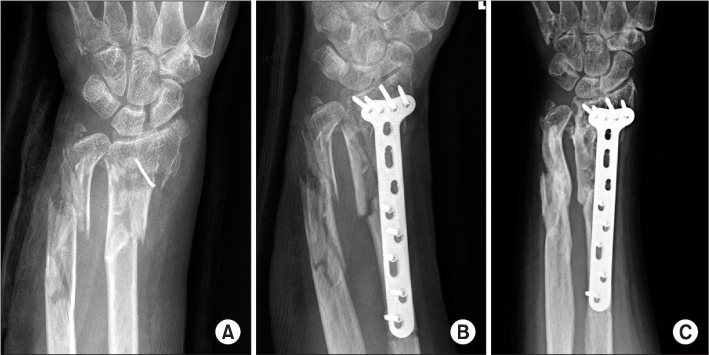
Figure 4 A 68-year-old female patient who received conservative treatment for a concomitant distal ulnar metaphyseal fracture. (A) Preoperative radiograph of the wrist. (B) Radiograph taken immediately after surgery. (C) Radiograph taken at one year after surgery.
Reference
-
1. Logan AJ, Lindau TR. The management of distal ulnar fractures in adults: a review of the literature and recommendations for treatment. Strategies Trauma Limb Reconstr. 2008. 3:49–56.
Article2. Biyani A, Simison AJ, Klenerman L. Fractures of the distal radius and ulna. J Hand Surg Br. 1995. 20:357–364.
Article3. Gschwentner M, Arora R, Wambacher M, Gabl M, Lutz M. Distal forearm fracture in the adult: is ORIF of the radius and closed reduction of the ulna a treatment option in distal forearm fracture? Arch Orthop Trauma Surg. 2008. 128:847–855.
Article4. Kapandji A. Biomechanics of pronation and supination of the forearm. Hand Clin. 2001. 17:111–122.
Article5. Lindau T, Adlercreutz C, Aspenberg P. Peripheral tears of the triangular fibrocartilage complex cause distal radioulnar joint instability after distal radial fractures. J Hand Surg Am. 2000. 25:464–468.
Article6. Zimmerman RM, Kim JM, Jupiter JB. Arthritis of the distal radioulnar joint: from Darrach to total joint arthroplasty. J Am Acad Orthop Surg. 2012. 20:623–632.
Article7. Müller ME, Nazarian S, Koch P, Schatzker J, Heim U. The comprehensive classification of fractures of long bones. 1990. Berlin: Springer-Verlag;106–115.8. Jupiter JB, Marent-Huber M. LCP Study Group. Operative management of distal radial fractures with 2.4-millimeter locking plates. A multicenter prospective case series. J Bone Joint Surg Am. 2009. 91:55–65.
Article9. Ruchelsman DE, Raskin KB, Rettig ME. Outcome following acute primary distal ulna resection for comminuted distal ulna fractures at the time of operative fixation of unstable fractures of the distal radius. Hand (N Y). 2009. 4:391–396.
Article10. McKee MD, Waddell JP, Yoo D, Richards RR. Nonunion of distal radial fractures associated with distal ulnar shaft fractures: a report of four cases. J Orthop Trauma. 1997. 11:49–53.
Article11. Cha SM, Shin HD, Kim KC, Park E. Treatment of unstable distal ulna fractures associated with distal radius fractures in patients 65 years and older. J Hand Surg Am. 2012. 37:2481–2487.
Article12. Ring D, McCarty LP, Campbell D, Jupiter JB. Condylar blade plate fixation of unstable fractures of the distal ulna associated with fracture of the distal radius. J Hand Surg Am. 2004. 29:103–109.
Article13. Dennison DG. Open reduction and internal locked fixation of unstable distal ulna fractures with concomitant distal radius fracture. J Hand Surg Am. 2007. 32:801–805.
Article14. Arora R, Gabl M, Pechlaner S, Lutz M. Initial shortening and internal fixation in combination with a Sauvé-Kapandji procedure for severely comminuted fractures of the distal radius in elderly patients. J Bone Joint Surg Br. 2010. 92:1558–1562.
Article15. Namba J, Fujiwara T, Murase T, Kyo T, Satoh I, Tsuda T. Intra-articular distal ulnar fractures associated with distal radial fractures in older adults: early experience in fixation of the radius and leaving the ulna unfixed. J Hand Surg Eur Vol. 2009. 34:592–597.
Article16. Jakab E, Ganos DL, Gagnon S. Isolated intra-articular fracture of the ulnar head. J Orthop Trauma. 1993. 7:290–292.
Article17. Solan MC, Rees R, Molloy S, Proctor MT. Internal fixation after intra-articular fracture of the distal ulna. J Bone Joint Surg Br. 2003. 85:279–280.
Article18. Kim JK, Koh YD, Do NH. Should an ulnar styloid fracture be fixed following volar plate fixation of a distal radial fracture? J Bone Joint Surg Am. 2010. 92:1–6.
Article19. Kim JK, Yun YH, Kim DJ, Yun GU. Comparison of united and nonunited fractures of the ulnar styloid following volar-plate fixation of distal radius fractures. Injury. 2011. 42:371–375.
Article20. Hauck RM, Skahen J 3rd, Palmer AK. Classification and treatment of ulnar styloid nonunion. J Hand Surg Am. 1996. 21:418–422.
Article21. Stoffelen D, De Smet L, Broos P. The importance of the distal radioulnar joint in distal radial fractures. J Hand Surg Br. 1998. 23:507–511.
Article22. Oskarsson GV, Aaser P, Hjall A. Do we underestimate the predictive value of the ulnar styloid affection in Colles fractures? Arch Orthop Trauma Surg. 1997. 116:341–344.
Article23. May MM, Lawton JN, Blazar PE. Ulnar styloid fractures associated with distal radius fractures: incidence and implications for distal radioulnar joint instability. J Hand Surg Am. 2002. 27:965–971.
Article24. Souer JS, Ring D, Matschke S, Audige L, Marent-Huber M, Jupiter JB. AOCID Prospective ORIF Distal Radius Study Group. Effect of an unrepaired fracture of the ulnar styloid base on outcome after plate-and-screw fixation of a distal radial fracture. J Bone Joint Surg Am. 2009. 91:830–838.
Article25. Zenke Y, Sakai A, Oshige T, Moritani S, Nakamura T. The effect of an associated ulnar styloid fracture on the outcome after fixation of a fracture of the distal radius. J Bone Joint Surg Br. 2009. 91:102–107.
Article26. Orbay JL, Fernandez DL. Volar fixed-angle plate fixation for unstable distal radius fractures in the elderly patient. J Hand Surg Am. 2004. 29:96–102.
Article27. Sammer DM, Chung KC. Management of the distal radioulnar joint and ulnar styloid fracture. Hand Clin. 2012. 28:199–206.
Article
- Full Text Links
-
- Actions
-
Cited
- CITED
-
- Close
- Share
-
- Similar articles
-
- Fracture of the Distal Radius with Ulnar Nerve Palsy
- Ulnar Nerve Palsy Following Closed Fracture of the Distal Radius: A Report of 2 Cases
- Operative Treatment for Ulnar Styloid Process Fractures with Unstable Intraarticular Distal Radius Fractures
- Complications of Distal Radius Fracture
- Risk Factors in Stability after Immobilization of the Distal Radius in Unstable Fractures in Children


