
J Korean Acad Nurs.
2009 Apr;39(2):217-228. 10.4040/jkan.2009.39.2.217.
Health Experience of Depressive Adolescents: Reflected from Newman's Praxis Methodology
- Affiliations
-
- 1Department of Nursing, Chosun University, Gwangju, Korea. yrk@chosun.ac.kr
- 2College of Nursing, Chonnam National University, Gwangju, Korea.
- KMID: 1405624
- DOI: http://doi.org/10.4040/jkan.2009.39.2.217
Abstract
- PURPOSE
Guided by Newman's theory of health as expanding consciousness, this study was done to explore the health experience of adolescents having depression. METHODS: The researcher engaged in six to eight in-depth interviews with six adolescents. To begin the dialog, the researcher asked each participant to recount the first important memory he/she had. All the narrative and diagram sharing between the researcher and participants were summarized according to recognized patterns and later elaborated in following interviews based on Newman's praxis methodology. RESULTS: The significant individual pattern of early health experience was during the binding stage. At the turning point, individual patterns for participants revealed a personal journey of self-discovery and then emergence of reflecting behaviors. After the turning point, the participants changed as they evolved from the initial period of disruption and disorganization to organization at a higher level. The results suggest that adolescents who are depressive find new ways of relating to friends, family, healthcare providers, and the community by expanding their consciousness. CONCLUSION: Newman's praxis methodology is a good way of helping and studying adolescents with depression because it emphasizes participant-nurse/researcher partnership and pattern recognition as nursing practice.
Keyword
MeSH Terms
Figure
-
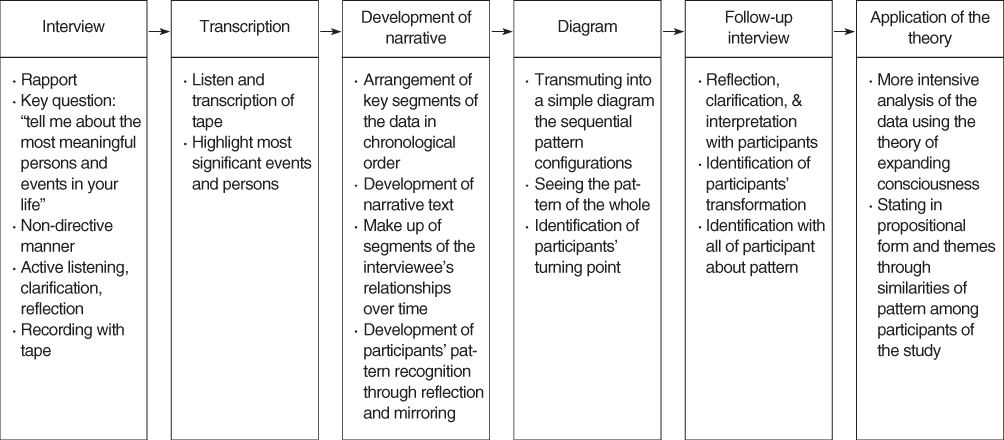
Figure 1 Newman's praxis protocol.
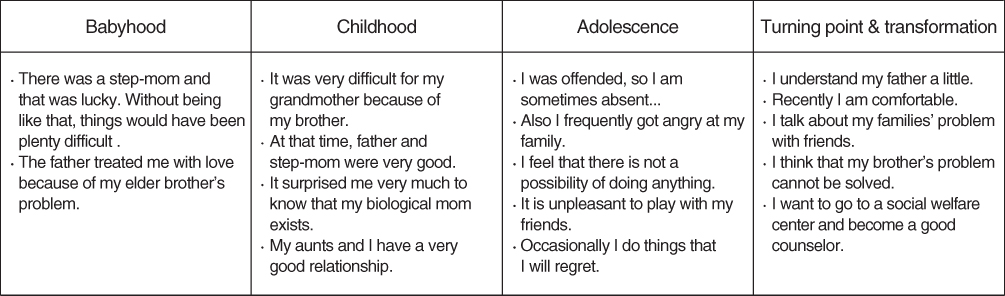
Figure 2 Example of narrative (participant l).

Figure 3 Example of transformation process (participant l's diagram).
Reference
-
1. Bae JY. A experience of the depression: A phenomenological approach. Journal of Korean Academy of Psychiatric Mental Health Nursing. 2003. 12:36–46.2. Bae JY. The study on mental health of Korean adolescents. Journal of Korean Academy of Psychiatric Mental Health Nursing. 2006. 15:308–317.3. Endo E. Pattern recognition as a nursing intervention with Japanese women with ovarian cancer. Advances in Nursing Science. 1998. 20(4):49–61.4. Everall RD, Bostik KE, Paulson BL. Being in the safety zone: Emotional experiences of suicidal adolescents and emerging adults. Journal of Adolescent Research. 2006. 21:370–392.5. Fornos LB, Mika VS, Bayles B, Serrano AC, Jimenez RL, Villarreal R. A qualitative study of Mexican American adolescents and depression. Journal of School Health. 2005. 75:162–172.6. Hyeon MS, Kim KH, Kim SA. Influencing factors on problem behaviors among adolescents: Focused on middle school students in Seoul. Journal of Korean Academy of Nursing. 2004. 34:252–260.7. Kaiser-Larson N. Life pattern of native women experiencing breast cancer. International Journal for Human Caring. 2002. 6:61–68.8. Lea EK, Yang NM, Seo EK. A qualitative study on counseling in Korea. The Korean Journal of Counseling and Psychotherapy. 2007. 19:587–607.9. Lee CS. The alcoholics lived experience of recovery: Using Parses research methodology. 2005. Seoul: Yonsei University;Unpublished doctoral dissertation.10. Lee CS, Kweon YR, Kim SJ. The impact of school bullying victim and depression on suicidal ideation of middle school students. Journal of Korean Academy of Psychiatric Mental Health Nursing. 2007. 16:32–40.11. Lee E. Construction of a structural model about male and female adolescents' alienation, depression, and suicidal thoughts. Journal of Korean Academy of Nursing. 2007. 37:576–585.12. Newman MA. Theory of nursing practice. Nursing Science Quarterly. 1994. 7:153–157.13. Newman MA. Health as expanding consciousness. 2000. 2nd ed. Boston, MA: Jones & Bartlett Publishers.14. Newman MA. Transforming presence: The difference that nursing makes. 2008. Philadelphia, PA: F. A. Davis Company.15. Noveletsky-Rosenthal HT. Pattern recognition in older adults living with chronic illness. 1996. Boston, USA: Boston College;Unpublished doctoral dissertation.16. Pharris MD. Coming to know ourselves as community through nursing partnership with adolescents convicted of murder. Advances in Nursing Science. 2002. 24(3):21–42.17. Pharris MD. Picard C, Jones D, editors. Engaging with communities in a pattern recognition process. Giving voice to what we know: Margaret Newman's theory of health as expanding consciousness in nursing practice, research and education. 2005. London: Jones & Bartlett;83–94.18. Picard C. Pattern of expanding consciousness in mid-life women: Creative movement and the narrative as modes of expression. Nursing Science Quarterly. 2000. 13:150–157.19. Picard C. Implementing the rock challenge; Young people's perspective on a drug-prevention and performing-arts programme. Journal of Research in Nursing. 2005. 10:355–356.20. Resnick MD, Bearman PS, Blum RW, Bauman KE, Harris KM, Jones J, et al. Protecting adolescents from harm: Findings from the national longitudinal study of adolescent health. Journal of the American Medical Association. 1997. 278:823–832.21. Ryu EJ, Choi KS, Seo JS, Nam BW. The relationships of internet addiction, depression, and suicidal ideation in adolescents. Journal of Korean Academy of Nursing. 2004. 34:102–110.22. Sandelowski M. The problem of rigor in qualitative research. Advances in Nursing Science. 1986. 8(3):27–37.23. Shin HS, Lee KS, Lee HG, Shin KS. Sex-differences in the effects of comorbidity of depression/anxiety and aggression on adjustment problems of juvenile delinquents. The Korean Journal of Counseling and Psychotherapy. 2004. 16:491–510.24. Turner HA, Muller PA. Long-term effects of child corporal punishment on depressive symptoms in young adults: Potential moderators and mediators. Journal of Family Issues. 2004. 25:761–782.25. Yamashita M. Newman's theory of health applied in family caregiving in Canada. Nursing Science Quarterly. 1999. 12:73–79.26. Yoo AJ, Lee JS, Suh JH. Perceptions of parenting, peer relationship and depression of adolescents from divorced and non-divorced family. Korean Association of Child Studies. 2004. 25:191–203.
- Full Text Links
-
- Actions
-
Cited
- CITED
-
- Close
- Share
-
- Similar articles
-
- A Study on Health as Expanding Consciousness of the Low-income Elderly Living Alone
- Health as Expanding Consciousness: Based on the Experiences of Victims of Sexual Violence
- A Study on Health as Expanding Consciousness of Korean Elderly People with Chronic Illnesses in the Community
- Effect of Loneliness and Depressive Symptoms on Smartphone Overdependence among South Korean Adolescents: A Nationwide Cross-Sectional Study
- Female Adolescents' Sexual Assertiveness Types: Q Methodology


